What is established?
The killings occurred during a violent transition after Côte d’Ivoire's October 2000 presidential election. General Robert Guéï attempted to stop the count and proclaim himself the winner. Laurent Gbagbo's supporters forced him from power, but unrest continued as supporters of opposition leader Alassane Ouattara demanded a new vote after Ouattara had been barred from running.
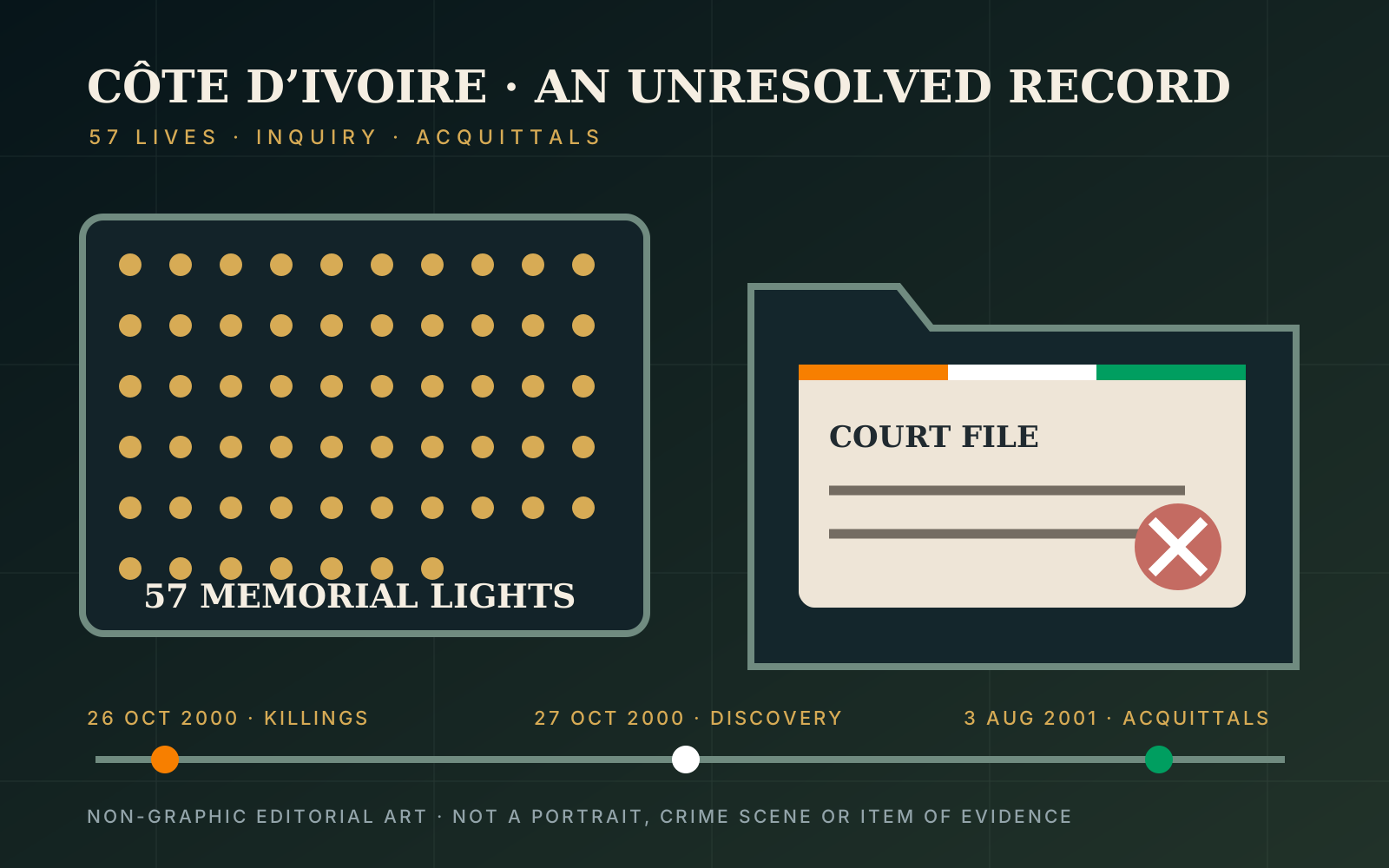
On October 27, 2000, 57 bodies were discovered in a forest on the outskirts of Abidjan. The victims were mostly young men. Human Rights Watch reported that the majority—roughly 30 to 40—had been detained as suspected supporters of Ouattara's Rally of Republicans, or RDR, at the Camp Commando gendarmerie base in Abobo before being killed on October 26.
This file does not present all 57 deaths as one moment witnessed from beginning to end. The evidence described several linked phases: detention, shootings at the base, use of surviving detainees as porters, transport of bodies and further killings near the disposal site. The grave became known as the Charnier de Yopougon, although the forest site was outside the suburb and reporting also associates it with Banco.
The victims and the wider violence
Many victims were believed to be northern Ivorians, Muslims or RDR supporters. Human Rights Watch also documented that foreigners and people whose nationality was questioned were targeted during the same period. The archive avoids assigning an identity or party affiliation to every man without a verified name-by-name record.
The 57 bodies were not the total death toll from the October election crisis. Human Rights Watch reported more than 150 deaths in the post-election violence, including bodies found in the Ébrié Lagoon and at other locations. This page is intentionally limited to the mass grave and the prosecution attached to it; it does not split every associated killing into additional pages.
Evidence of gendarmerie involvement
Human Rights Watch interviewed survivors, former detainees, relatives, medical workers and other witnesses. Its account described gendarmes killing detainees inside Camp Commando after the death of a gendarmerie lieutenant, then organizing the movement of bodies to a forest. The organization concluded that the disposal operation showed signs of planning and involvement by numerous personnel.
A United Nations international commission of inquiry spent two months examining the October and December violence. Contemporary reporting by IRIN, then part of the UN Office for the Coordination of Humanitarian Affairs, said the commission found that members of the gendarmerie bore responsibility for the Yopougon massacre.
That institutional conclusion must be kept separate from individual criminal guilt. A finding that members of a force carried out a massacre does not by itself prove that each officer placed on trial was one of the perpetrators. The criminal court demanded a direct evidentiary connection to the eight accused.
The trial and eight acquittals
The trial opened at the Agban Gendarmerie Camp in Abidjan in July 2001. Eight gendarmes faced accusations connected to the killing of the 57 men. The proceedings drew protests from victims' groups, which argued that higher-ranking military and political figures also should face scrutiny.
On August 3, 2001, the court acquitted all eight defendants. Associated Press reporting quoted Judge Delli Sepleu's conclusion that prosecutors had produced no evidence directly linking the officers to the bodies. The judge also identified investigative gaps: tire tracks at the disposal site had not been analyzed, and bullets recovered from bodies had not been subjected to ballistics testing capable of linking them to particular weapons.
The two known survivors did not testify at the trial, citing fear for their safety. Their absence severely weakened the prosecution's ability to connect named defendants to the events they had described. Relatives' representatives and opposition figures criticized the proceedings, but criticism does not convert an acquittal into a conviction. The defendants remain acquitted in the record summarized here.
Why accountability remains unresolved
The case presents two findings that can coexist. Investigations documented strong evidence that gendarmes committed the massacre, while the criminal court concluded that the prosecution failed to prove the case against the eight specific officers before it. The first is an institutional attribution; the second is an individual criminal result.
No later final conviction for the 57 killings was located in the reliable sources reviewed for this dossier. The status is therefore unresolved accountability / acquittals. It does not mean that the killings are mysterious, and it does not erase the court's evidentiary standard.
The record also leaves command responsibility unresolved. Human Rights Watch documented officers present during abusive operations but stated that it could not pinpoint command responsibility through the police and gendarmerie hierarchy. This page does not assign a commander where the investigated record did not.
Verified timeline
- October 22, 2000
A presidential election takes place after major opposition candidates, including Alassane Ouattara, are excluded. - October 24–26, 2000
Political, ethnic and religious violence spreads through Abidjan as successive demonstrations and security-force operations unfold. - October 26, 2000
Witness evidence places mass detention, killings at Camp Commando and the movement of bodies to the forest on this day. - October 27, 2000
The bodies of 57 young men are discovered in the forest near Yopougon. - July 2001
The trial of eight gendarmes opens at Agban Gendarmerie Camp. - August 3, 2001
All eight defendants are acquitted after the court finds no direct link between them and the 57 bodies.
Editorial classification
The category is mass killing / extrajudicial executions / failed prosecution. “Failed prosecution” describes the outcome without treating acquittal as proof that no massacre occurred or that no gendarmes were involved. It also avoids treating an institutional inquiry as a substitute criminal conviction.
Côte d’Ivoire remains IN_PROGRESS in the project control. This eighth file is published because the event is distinct, well documented and not duplicated by the archive's later Abobo, Duékoué or Nahibly cases.
Sources and verification notes
Facts were checked against a detailed rights investigation, a UN-linked contemporaneous report, the trial outcome and a government human-rights record.
- Human Rights Watch — Election Violence in Abidjan: October 24–26, 2000December 20, 2000 · interviews, 57-body finding, Camp Commando killings and wider context.
- Human Rights Watch — Côte d’Ivoire: The New RacismAugust 2001 · full investigation, official inquiries, command limits and the mass grave's place in election violence.
- The New Humanitarian / IRIN — Gendarmes’ trial postponedJuly 24, 2001 · eight defendants and the UN commission's attribution to members of the gendarmerie.
- Associated Press via Deseret News — Officers acquitted in massacre of 57August 4, 2001 · acquittals, missing forensic work, absent survivors and court reasoning.
- U.S. Department of State — 2001 Country Report: Côte d’IvoireGovernment human-rights record used as supplementary context for investigations and accountability.
Frequently asked questions
When were the 57 bodies found?
They were found on October 27, 2000, after killings documented the previous day.
Were all victims identified as RDR members?
No. Many were reported as actual or suspected RDR supporters, northern Ivorians or Muslims, but the archive does not assign an affiliation to every victim without a verified record.
Did the United Nations blame the gendarmerie?
A UN commission concluded that members of the gendarmerie bore responsibility for the massacre. That was an institutional finding, not a conviction of every officer.
How many officers were tried?
Eight gendarmes were tried in 2001.
Were they convicted?
No. All eight were acquitted after the court found that prosecutors had not directly linked them to the 57 bodies.
Why is the case unresolved?
No individual conviction for the 57 killings was located, and the record does not establish complete command responsibility.