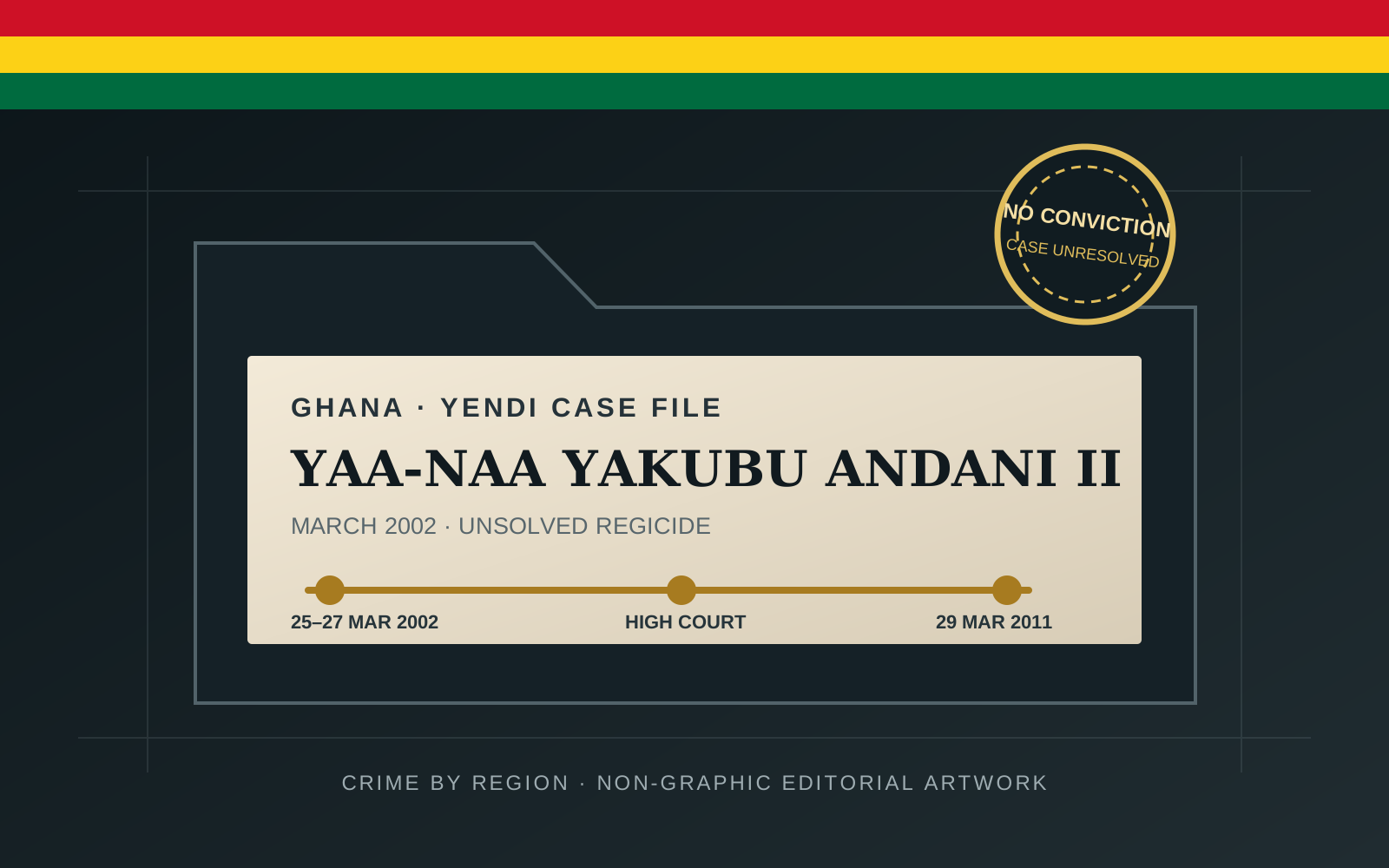
Case-status note: “Unsolved / partial” records that the king's death is documented but no murder conviction was located. People acquitted in 2011 remain acquitted. The Abudu and Andani royal gates are political and kinship communities, not criminal entities, and this page assigns no collective liability.
Dagbon's disputed succession
Dagbon's kingship is rooted in a system in which the Abudu and Andani royal gates have alternated claims to the Yaa-Naa title. Disputes over succession long predated 2002. Academic and humanitarian accounts trace decades of contested decisions, state intervention and unresolved funeral and installation questions.
That background matters because the 2002 violence did not emerge in isolation. It also creates a reporting hazard: explaining a factional dispute can easily slide into treating every member of a royal gate as responsible for crimes committed during a clash. The criminal case required proof against named individuals. It could not rest on affiliation alone.
Three days of violence in Yendi
The High Court record placed the central fighting between March 25 and March 27, 2002. Armed clashes developed around the Gbewaa Palace and other parts of Yendi. Communications, curfews, the postponement of a traditional festival and the conduct of local officials became contested elements in later testimony and public inquiries.
The palace burned, and Yaa-Naa Yakubu Andani II died on March 27. Members of his household, elders and other participants or residents also died. Published totals for the wider conflict differ, and the 2011 prosecution centered on the king's murder rather than producing a complete judicial victim list. This file therefore does not force a single number from incompatible accounts.
The killing was a national crisis as well as a personal loss for the Yaa-Naa's family and community. Ministers resigned in the aftermath, the government appointed a commission of inquiry and security measures were imposed. Those political consequences do not substitute for a criminal finding about the person or people who caused the death.
Early investigations and proceedings
Investigators and the Wuaku Commission gathered testimony about the fighting, alleged preparations, weapons, official decisions and events at the palace. Commission findings can guide public policy and further investigation, but they use a different process and purpose from a criminal trial. A commission allegation is not equivalent to proof beyond reasonable doubt.
Early criminal proceedings against individual suspects did not produce a murder conviction. One 2003 jury trial ended with an acquittal. The fragmented results mattered later because some witnesses and factual propositions had already been tested, while the larger political demand for accountability continued.
Years passed before the most extensive prosecution. The delay increased the risk of faded memories, unavailable witnesses and contested reconstructions. It also deepened the perception among affected families that the state had failed to produce a dependable account.
The 2010–2011 High Court case
Fifteen people were indicted in the case reported as The Republic v. Iddrisu Iddi @ Mbadugu and 13 Others. The counts included conspiracy to murder. The court record stated that Zakaria Yakubu, also known as Zakaria Forest, alone faced a separate murder count but was at large and not before the court.
The prosecution called witnesses to describe the lead-up to the clashes, the fighting and alleged roles of the accused. At the close of the prosecution case, defence lawyers submitted that the state had not produced evidence requiring the accused to answer. This procedural posture is important: the judge was deciding whether the prosecution had established a legally sufficient case to continue, not choosing between completed prosecution and defence narratives.
On March 29, 2011, the High Court upheld the no-case submission. All fifteen defendants before the court were acquitted and discharged. Contemporary Ghanaian reporting identified the counts as rioting, conspiracy to murder and murder. The acquittal meant the prosecution's evidence did not cross the threshold to call for a defence; it cannot responsibly be rewritten as a technical delay or as continuing suspicion against those defendants.
What the acquittal established—and what it did not
The 2011 ruling established that the state had not made a sufficient case against the fifteen people before the court. It did not establish that the Yaa-Naa survived, that no homicide occurred or that another named person committed the killing. A failed prosecution answers the legal case against its defendants; it does not automatically solve the underlying crime.
The decision drew fierce public reaction and criticism. That reaction is part of the case's history, but criticism from politicians, families or retired judges is not a replacement verdict. The acquitted people retain the benefit of the ruling unless a lawful later process changes their status. No such later conviction was located for this review.
The record's reference to an accused who was at large likewise cannot be treated as guilt. An indictment states an allegation. Without arrest, trial and judgment, it remains unadjudicated.
Peace process versus criminal accountability
Separate from the murder case, traditional leaders and the Ghanaian state pursued mediation to restore peace and settle the succession crisis. Funeral rites, reconstruction and an agreed path toward installing a new Yaa-Naa eventually allowed Dagbon to move beyond years of institutional paralysis.
That political and cultural progress was significant, but reconciliation and prosecution answer different questions. A peace settlement can reduce violence and restore governance without determining who committed a past homicide. The successful installation of a successor therefore does not convert the murder into a solved case.
Current status
The source review completed on September 12, 2026 located the 2011 High Court ruling and reporting of the acquittals but no later murder conviction. The most defensible status is therefore unsolved or partial: the victim, date, place and broad conflict are documented, while individual criminal responsibility remains unadjudicated.
Any future update should be based on a charge, judgment or official investigative development, not anniversary rhetoric or factional accusation. The distinction protects both the memory of Yaa-Naa Yakubu Andani II and the presumption of innocence owed to living people.
Questions still open
The central unanswered question is who caused the Yaa-Naa's death and under whose direction. Other questions concern the full sequence around the palace, the precise number and identities of all people killed, whether critical warnings or security duties were mishandled, and whether evidence sufficient for a lawful new prosecution still exists.
Frequently asked questions
When was Yaa-Naa Yakubu Andani II killed?
He died in Yendi on March 27, 2002, after three days of armed clashes.
What was the context?
The violence arose within a long-running Dagbon succession dispute between the Abudu and Andani royal gates. That context does not establish collective criminal responsibility.
What happened in the 2011 trial?
The High Court upheld a submission of no case to answer and acquitted all fifteen defendants before it.
Was anyone convicted?
No reliable murder conviction was located in the source review completed September 12, 2026.
Did the later peace process solve the murder?
No. Mediation helped resolve the succession crisis and restore the kingship, but it did not adjudicate individual criminal responsibility for the 2002 killing.