What happened at Tuzla's Kapija?
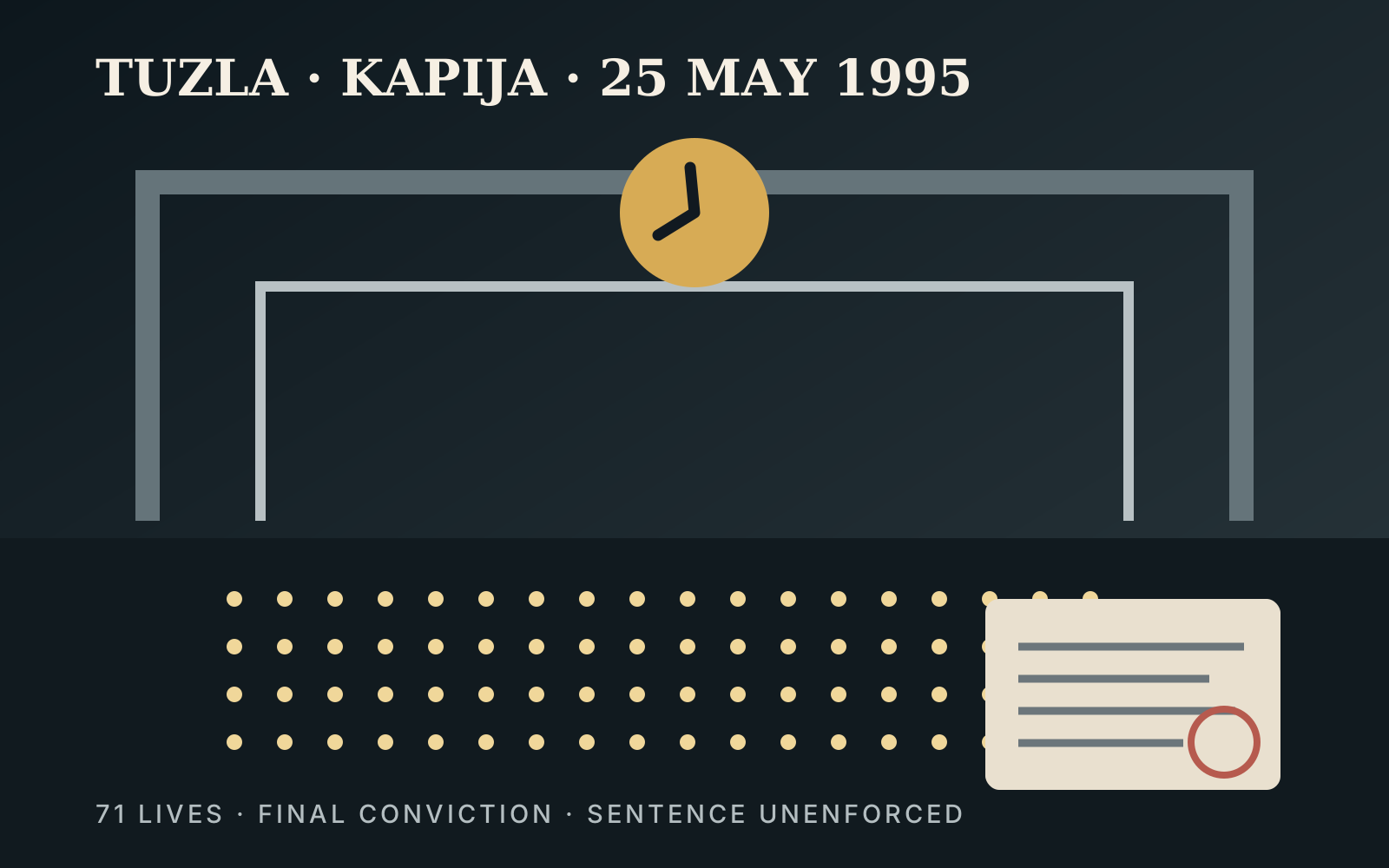
At about 8:55 p.m. on 25 May 1995, an artillery projectile exploded in the Kapija area of central Tuzla. It was Youth Day, and the streets were crowded, especially with young people. The Court of Bosnia and Herzegovina found that the shell was fired from Army of Republika Srpska positions near Panjik on Mount Ozren.
Seventy-one civilians were killed. The court's 2009 summary recorded around 130 wounded; later memorial and journalistic sources publish higher figures. This dossier uses the judicial count for the core case record and notes the variation rather than choosing a larger number without qualification.
The attack and its context
Tuzla had been declared a United Nations safe area in 1993. The shelling occurred late in the Bosnian war, when artillery fire continued to threaten civilian areas. According to the Bosnian judgment, the attack was direct and indiscriminate and violated international humanitarian law.
Most victims were in their teens or twenties. Public commemorations have since centered on Kapija and the memorial cemetery at Slana Banja. The attack is sometimes called the Tuzla Gate massacre, translating “Kapija,” but both names refer to the same event and are treated as one case here.
Investigation and arrest
Prosecutors alleged that Novak Đukić, then commander of the Ozren Tactical Group, ordered artillery units at Panjik to shell the Kapija area. He was arrested in 2007. The case relied on survivor and insider testimony, military records and ballistic evidence tested in court.
Đukić denied responsibility. His defence challenged the ballistics and later sponsored reconstructions in Serbia. Those arguments are documented as defence claims; they did not overturn the final judgment of the Court of Bosnia and Herzegovina.
The 2009 judgment and appellate history
On 12 June 2009, the Court of Bosnia and Herzegovina convicted Đukić of a war crime against the civilian population and sentenced him to 25 years. The judgment found that he ordered the 25 May shelling. It acquitted him on a separate allegation concerning nine projectiles allegedly fired on 28 May because the evidence was insufficient.
The appellate panel initially upheld the conviction. After Bosnia's Constitutional Court found that the wrong criminal code had been used in calculating sentences in a group of war-crimes cases, Đukić was released pending reconsideration. The Court of Bosnia and Herzegovina again upheld the conviction and, applying the more lenient law in force at the time of the crime, fixed the sentence at 20 years in 2014.
A final sentence not being served
After his release, Đukić went to Serbia, where he also held citizenship. He did not report to serve the final sentence in Bosnia. Bosnia issued an international warrant and asked Serbia to recognize and enforce the judgment.
Proceedings in Belgrade were repeatedly delayed, including on health grounds and amid defence efforts to contest the Bosnian findings. A June 2026 review by Balkan Diskurs reported that Đukić had still not begun serving the sentence. This gap is why the case is classified as adjudicated but not fully enforced.
Judgment, denial and editorial limits
Post-judgment experiments commissioned by the defence argued that the casualties could not have resulted from a shell fired from Bosnian Serb positions. The Humanitarian Law Center described those efforts as an attempt to revise judicially established facts and stressed that a Serbian enforcement court could recognize or refuse the request but could not rewrite the Bosnian judgment's factual description.
This page does not suppress the existence of defence claims. It identifies who made them and their legal status: they have not displaced the final conviction. Nor does one conviction establish criminal responsibility for every person in the chain of command.
Status as of September 2026
Novak Đukić's conviction and 20-year sentence remain final. No judgment overturning them was located. The latest reliable source reviewed, published in June 2026, reported that he remained in Serbia and had not begun serving the sentence.
The legal record is therefore both substantial and incomplete: individual responsibility was adjudicated, yet enforcement failed. Wider questions about institutional responsibility, cross-border cooperation and the long-term harm to survivors remain outside the single conviction.
Questions that remain
- When, if ever, will Serbia recognize and enforce the final Bosnian sentence?
- Why did cross-border proceedings remain unresolved for more than a decade?
- Will any additional commanders or artillery personnel face prosecution?
- Can the surviving victims obtain fuller reparations and institutional acknowledgment?
- How should public institutions respond to campaigns denying judicially established facts?
Frequently asked questions
How many people were killed?
Seventy-one civilians. The Bosnian court recorded around 130 wounded, while later sources give higher totals.
Who was convicted?
Novak Đukić, commander of the Ozren Tactical Group of the Army of Republika Srpska.
What was the sentence?
The initial 25-year sentence was recalculated under the more lenient applicable law and fixed at 20 years.
Did he serve the sentence?
As of June 2026, he had not begun serving it and remained in Serbia.
Why is the case classified as adjudicated but unenforced?
The conviction is final, but the prison term has not been carried out.