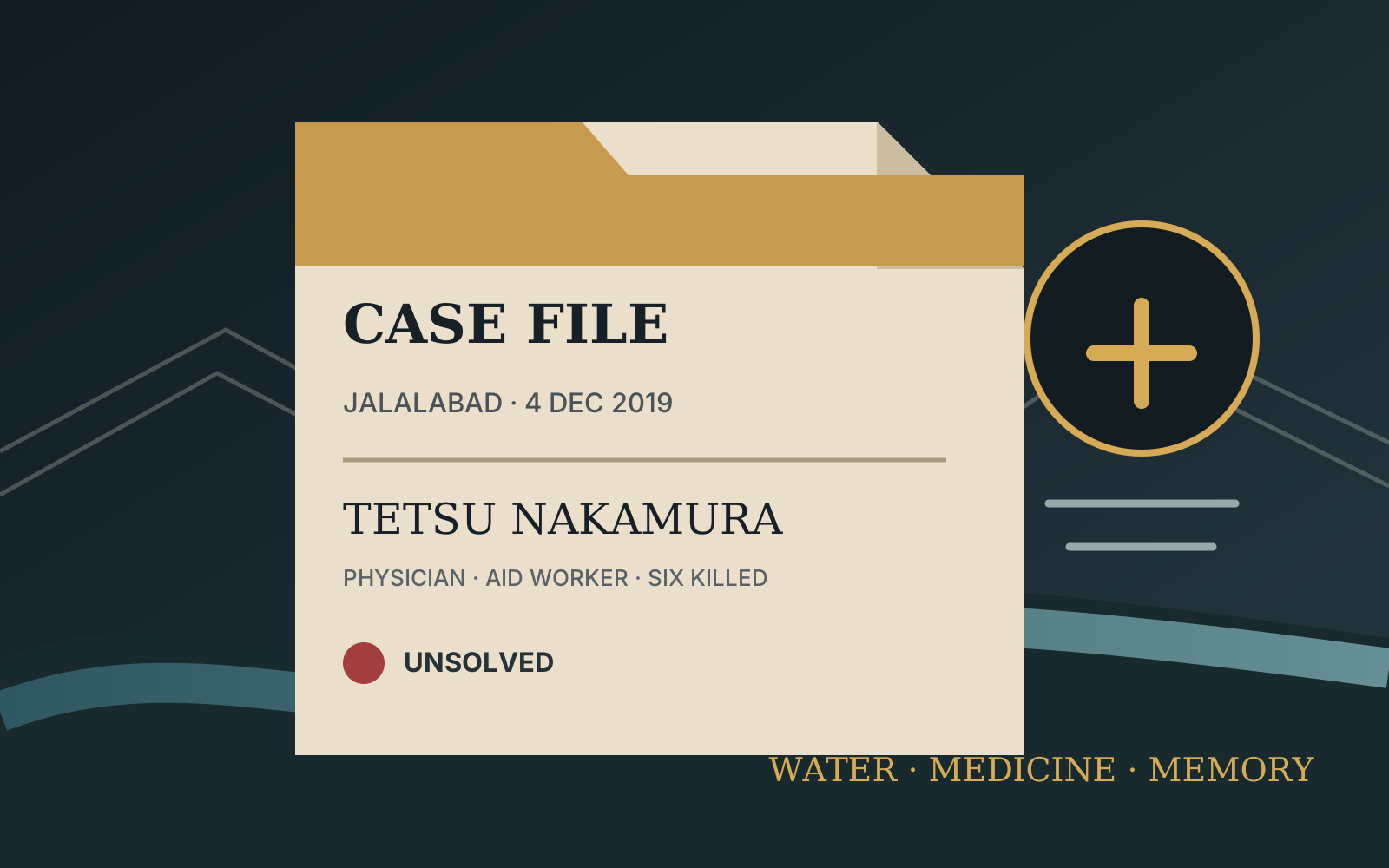
Decades of service in Afghanistan
Tetsu Nakamura was a Japanese physician and the Afghanistan representative of Peace Japan Medical Services, the field organization associated with the Japanese nonprofit Peshawar-kai. He began working with Afghan patients and refugees in the 1980s. His work eventually extended beyond clinics as drought, hunger and displacement convinced him that access to water was inseparable from public health.
Nakamura helped lead irrigation and agricultural projects in eastern Afghanistan. Reuters described how he shifted from medicine to canal construction after seeing children die amid drought and malnutrition. By 2019, he had become a widely recognized public figure in Nangarhar. Afghans commonly called him “Kaka Murad,” or Uncle Murad, and President Ashraf Ghani had granted him honorary Afghan citizenship shortly before his death.
This background matters because the attack was not an isolated street crime against an unknown traveler. It removed a humanitarian worker whose medical and water projects had become embedded in local communities. It does not, however, establish why any particular attacker targeted him.
The December 4 attack
On the morning of December 4, 2019, Nakamura was traveling to work in Jalalabad with members of his organization. Gunmen attacked the vehicle. Afghanistan’s provincial authorities and multiple international reports described the assault as targeted rather than random.
Nakamura was critically wounded and initially taken for treatment. He died before he could be transferred for further care. Five Afghan colleagues traveling with him were also killed. Japan’s Ministry of Foreign Affairs formally recorded that six people, including Nakamura, died in the shooting in Nangarhar Province.
Contemporary accounts differed in some operational details, including the number of attackers and the precise sequence of fire. This archive therefore does not reconstruct movements that were not consistently established across the reviewed sources. The reliable core is clear: armed men ambushed the aid vehicle in Jalalabad and six people died.
Six lives, not one headline
Nakamura’s international profile dominated much of the reporting, but he was not the only victim. Five Afghan members of the traveling party—described across reports as colleagues, guards and the driver—were also killed. The official Japanese statement expressly acknowledged all six deaths and extended condolences to every family.
The reviewed sources did not present one consistent, independently verified spelling list for all five Afghan victims. Rather than risk introducing errors into a permanent record, this file records their roles and the collective death toll without inventing or harmonizing uncertain names. Their lives are not treated as incidental to Nakamura’s biography.
Investigation and attributed responsibility
Afghan authorities opened an investigation and publicly described the shooting as a terrorist attack. Early reporting referred to searches and detentions connected to vehicles or other leads. A detention is an investigative act, not proof of guilt, and no such person is described here as a convicted perpetrator.
The Taliban denied involvement. That denial is part of the contemporary record, but it is not proof that the organization was uninvolved; equally, the absence of an accepted claim cannot be converted into evidence against another group. Later media reports advanced theories and named possible militant suspects, yet the reviewed record did not contain a final public judgment testing those claims.
Political change after August 2021 further complicated continuity of the investigation and public access to its record. This page avoids inferring what closed or nonpublic files might contain. Its classification rests only on what can be verified in reliable, publicly accessible material.
Grief in Afghanistan and Japan
The killings prompted vigils and official mourning in Afghanistan. Voice of America documented public tributes and the use of Nakamura’s Afghan nickname, while President Ghani met his family and praised his service. In Japan, the government condemned the attack and acknowledged the Afghan victims alongside Nakamura.
Peshawar-kai said its work would continue. The organization’s decision to maintain medical and irrigation projects became part of Nakamura’s legacy, but continuation of the work did not resolve the criminal case. Commemoration and accountability are separate questions.
What is established and what remains unresolved?
- Established: gunmen attacked the Peace Japan Medical Services vehicle in Jalalabad on December 4, 2019.
- Established: Tetsu Nakamura and five Afghan colleagues were killed.
- Established: Nakamura was a physician, humanitarian worker and honorary Afghan citizen known for medical and irrigation projects.
- Attributed statement: the Taliban denied responsibility; the denial is not treated as a judicial finding.
- Not established by a final public judgment located here: the identities of every attacker, the organization behind them, motive and command responsibility.
- Classification: unsolved, because no final prosecution or conviction resolving individual responsibility was located through the review date.
Source and status methodology
Japan’s Ministry of Foreign Affairs supplies the official date, province and six-person death toll. Reuters provides independent reporting on Nakamura’s medical and irrigation work and the circumstances of his death. Voice of America independently documents the traveling party, honorary citizenship and Afghan public response.
The Guardian is used for contemporary reporting on the attack and the Taliban denial. That denial is labeled as a statement by the organization, not a verified exoneration. Later allegations naming possible perpetrators were excluded from the core narrative because no final, public adjudication located for this review tested them.
The public record was reviewed through September 13, 2026. “No final conviction located” describes the limit of the sourced public record; it does not claim that authorities performed no investigative work or that no confidential evidence exists.
Frequently asked questions
When was Tetsu Nakamura killed?
He and five Afghan colleagues were killed in Jalalabad on December 4, 2019.
What work did he do?
He provided medical care and led irrigation and agricultural projects through Peace Japan Medical Services.
Did the Taliban claim the attack?
No. The Taliban denied involvement. The denial does not identify the perpetrators or amount to a judicial conclusion.
Was anyone convicted?
No reliable public final judgment convicting the perpetrators was located through September 13, 2026.