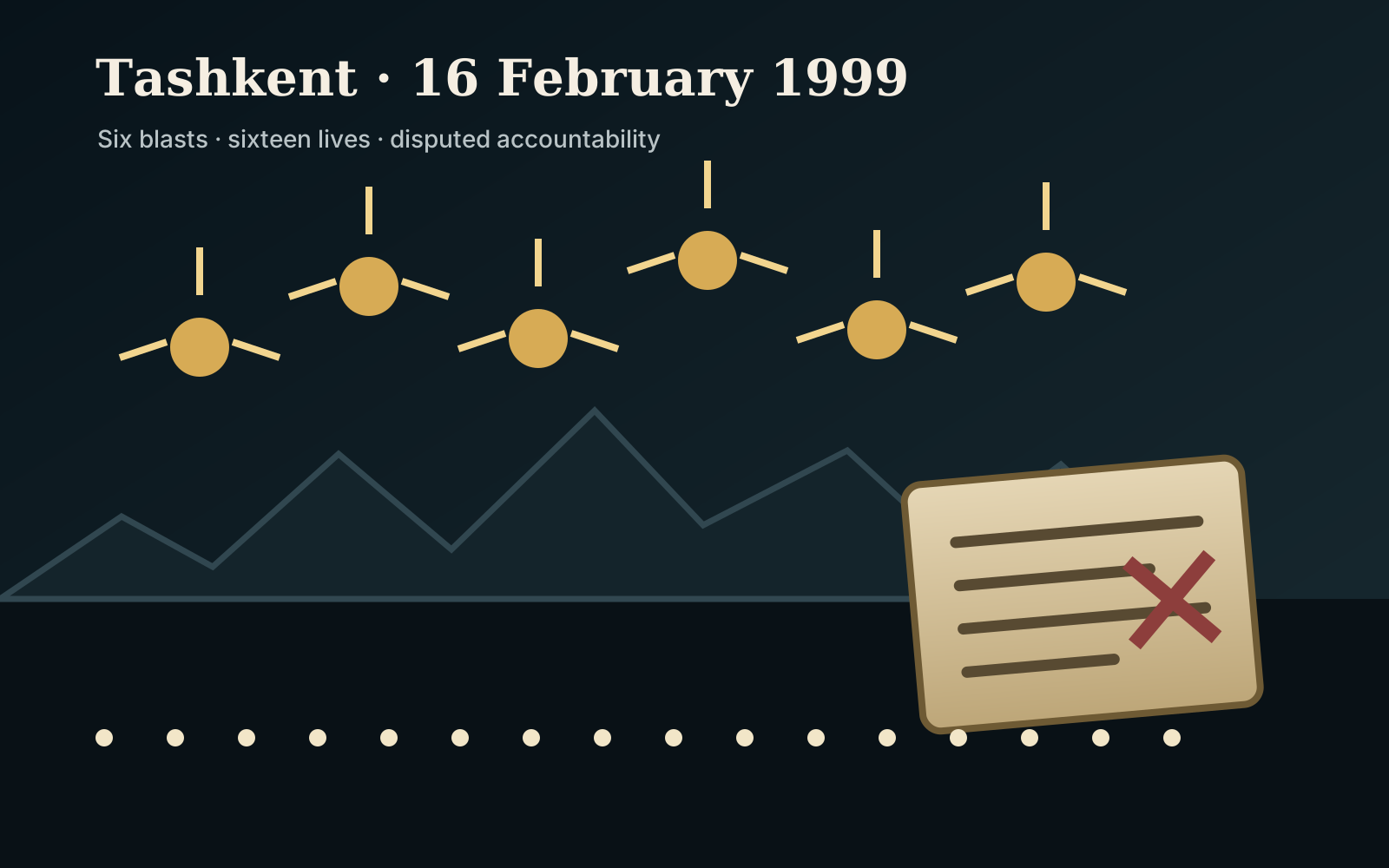
Six explosions in the capital
The blasts struck Tashkent during the late morning. Contemporary reporting described six explosions over a short period near government buildings and other central locations. One of the most powerful detonations occurred near the Cabinet of Ministers, where President Islam Karimov was expected to attend a meeting. He was not harmed.
The casualty record is more stable than the attribution. Later reporting by Radio Free Europe/Radio Liberty and Human Rights Watch consistently recorded 16 deaths and more than 100 injuries. The attack shattered the image of tightly controlled stability that the government had promoted since independence.
Authorities almost immediately characterized the violence as terrorism and an attempted assassination. That interpretation is plausible given the location and timing, but the surviving public record does not establish through an independent investigation that every blast served a single plan or that every later defendant had the role alleged by prosecutors.
The government response
President Karimov’s government blamed Islamic militants and also accused exiled political opponents of involvement. Security agencies launched broad arrest operations. Contemporary observers reported that large numbers of people associated with independent Islamic practice, banned organizations or political opposition were detained or questioned.
The official theory eventually linked the attack to an alliance of militant and opposition networks. The Islamic Movement of Uzbekistan was repeatedly named in official and later accounts. Yet public access to the underlying investigation was limited, and alternative explanations circulated. This page does not endorse speculative counter-theories. It records only that the state’s attribution was not tested in a process that answered the documented coercion concerns.
That boundary matters. A government may correctly identify some perpetrators while still violating the rights of suspects or sweeping unrelated people into a prosecution. Conversely, proof that a confession was coerced does not identify who actually planted the bombs. Both propositions can be true, and neither should be used to erase the dead and injured.
Convictions, death sentences and contested evidence
Uzbek courts conducted several trials connected to the attacks and the broader alleged conspiracy. Human Rights Watch’s 2000 regional review reported that 19 men received death sentences after proceedings it described as patently unfair show trials for alleged participation in the bombings or other violence. Other defendants received lengthy prison terms.
One prominent August 1999 case involved six men with links to the banned Erk opposition party. Human Rights Watch reported that the court convicted them despite torture allegations and claims that confessions had been forced. Radio Free Europe/Radio Liberty likewise reported criticism from rights groups that the defendants had been tortured in custody and that their statements were coerced.
These proceedings did produce legal outcomes, but a verdict is not automatically reliable proof when the evidence depends on statements allegedly obtained under torture. The archive therefore avoids calling every convicted person a bomber or organizer. It identifies the judgments as part of the historical record while preserving the unresolved evidentiary dispute.
Amnesty International issued urgent actions concerning people sentenced to death in bombing-related proceedings and warned of imminent execution. Some executions were later announced by the government. Because the public record is fragmented and individual cases were not consistently transparent, this page does not merge all defendants into a single group or assign a shared operational role.
The victims behind a political case
The scale of the later crackdown and the controversy around the trials can obscure the first harm: sixteen people were killed in a coordinated urban attack, and more than one hundred others were wounded. The available English-language record does not provide a complete, consistently verified public list of all victims. This page therefore does not invent names or biographies.
Remembering the victims also requires resisting false certainty. A careful archive can state what happened, how many people were killed and what courts decided without pretending that a disputed confession closes every factual question. The victims deserve an account strong enough to survive scrutiny.
Case timeline
- 16 February 1999: Six car bombs explode in central Tashkent. Sixteen people are killed and more than 100 are injured. Karimov survives what authorities call an assassination attempt.
- February–spring 1999: Security agencies carry out broad arrests and build cases against alleged militants and political opponents.
- August 1999: Courts convict defendants in prominent connected trials. Human-rights organizations report torture allegations and coerced-confession concerns.
- Late 1999–2000: Death sentences and executions are reported in bombing-related cases; rights monitors describe the proceedings as profoundly unfair.
- 2001–2003: Human Rights Watch and RFE/RL continue documenting disputed prosecutions and the government’s account of responsibility.
- Current archive status: No later independent process located for this review has resolved the complete authorship of the bombings or repaired the central fair-trial defects.
What the evidence supports—and what it does not
Supported
- Six explosions struck Tashkent on 16 February 1999.
- Sixteen people were killed and more than 100 were injured.
- Uzbek authorities treated the attacks as an assassination attempt against Karimov and blamed militant and opposition networks.
- Courts convicted numerous defendants and imposed death and prison sentences.
- Credible monitors documented torture allegations, coerced-confession concerns and serious due-process failures.
Not established here
- That every defendant convicted in a connected trial personally planned or carried out the bombings.
- That one organization’s responsibility for every blast was independently proven.
- That speculative alternative theories identify the real perpetrators.
- That the convictions, standing alone, resolved the case to a reliable contemporary standard.
Current status
The attack itself is not a mystery: the date, general sequence and casualty toll are well documented. What remains unresolved is the complete chain of individual responsibility. Uzbekistan’s courts issued convictions, but the use of alleged coerced confessions and the absence of an independent review prevent this archive from treating those judgments as a complete and dependable solution.
The file remains open editorially, not because no one was prosecuted, but because prosecution and reliable accountability are not synonyms. Any future update should be based on accessible court records, a credible reinvestigation or verified information that clarifies specific roles without relying on evidence tainted by torture.
Sources and methodology
- Human Rights Watch — World Report 2000: UzbekistanDeath sentences, trial criticism and broader repression after the bombings.
- Human Rights Watch — Uzbek Torture Victims Sentenced to Prison TermsContemporary account of the August 1999 convictions and torture allegations.
- Amnesty International — Death penalty / possible imminent executionUrgent-action record concerning death sentences in the post-bombing prosecutions.
- Radio Free Europe/Radio Liberty — Security Service Rebuts Charges It Knew of BombingsCasualty figures and the official theory of responsibility.
- Radio Free Europe/Radio Liberty — Human Rights Groups Criticize ConvictionsContemporary reporting on coerced-confession and torture claims.
- The Independent — Bombs Rock Uzbek CapitalContemporary reporting on the explosions and assassination allegation.
Source boundary: official attribution is presented as the government’s position. Human-rights findings about torture and unfair trials are not converted into a claim that every defendant was innocent or that any unsupported alternative theory was correct.
Frequently asked questions
What happened in Tashkent on 16 February 1999?
Six car bombs exploded in central Tashkent near government sites. Sixteen people were killed and more than 100 were injured.
Was President Islam Karimov the target?
Uzbek authorities said the attack was an assassination attempt because one explosion occurred near the Cabinet of Ministers shortly before Karimov was expected there. That remains the official interpretation rather than a fact established by an independent inquiry.
Who was convicted?
Uzbek courts convicted numerous defendants in bombing-related and connected political trials. Human Rights Watch and other monitors documented torture allegations, coerced-confession concerns and serious fair-trial failures, so this archive does not treat every verdict as reliable proof of each defendant’s role.
Why is the case classified as unresolved?
The attack is established, but the full authorship and individual roles remain contested because the principal prosecutions were not independently monitored to a standard that resolves the torture and due-process concerns.
How many people died?
Reliable contemporary and later sources report 16 deaths. More than 100 people were injured.