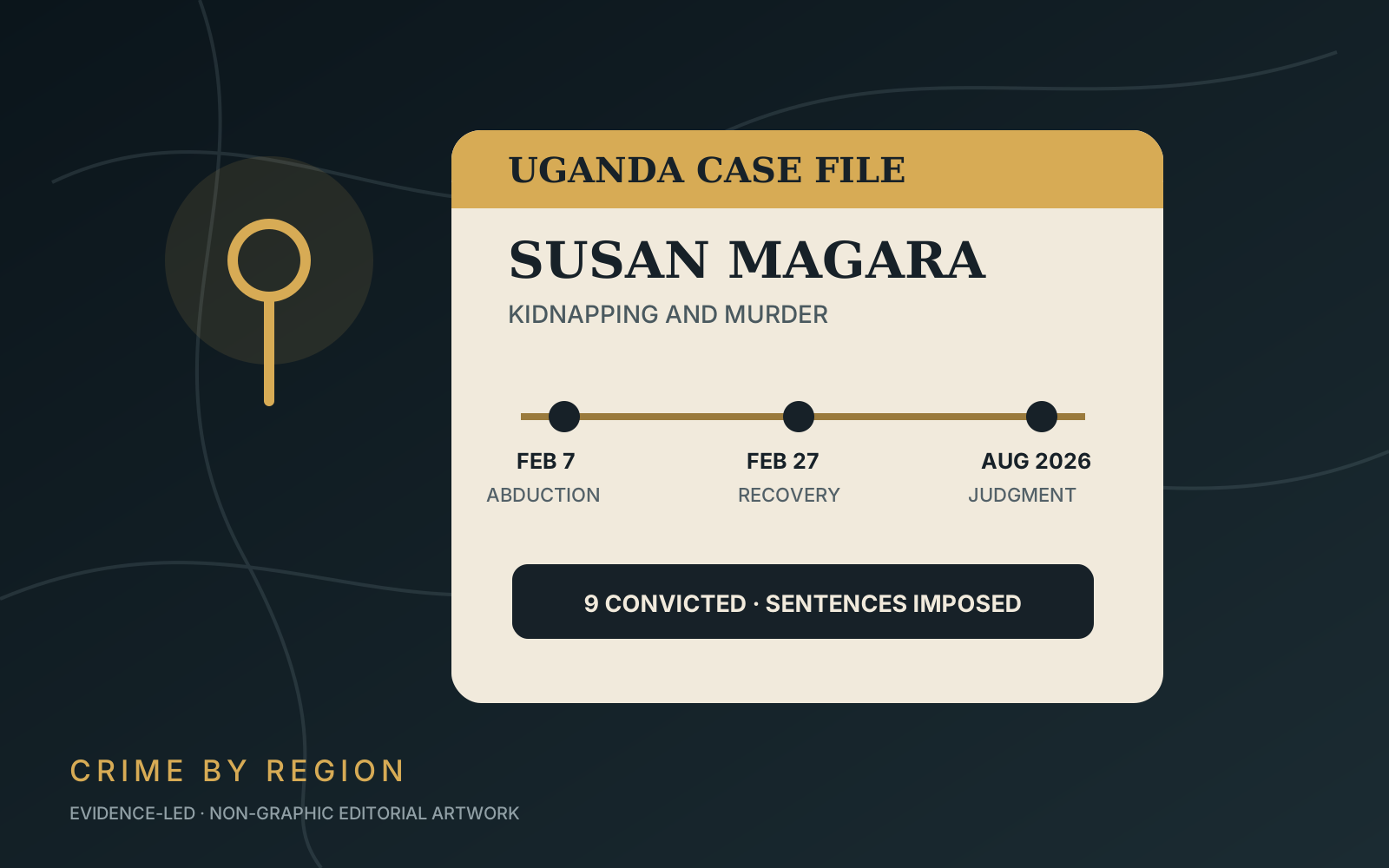
Case-status note: “Solved / adjudicated” reflects the High Court convictions and sentences reported in August 2026. It does not mean every investigative question is public, that appellate review is complete, or that a death sentence has been carried out.
Susan Magara
Susan Magara was 28 and worked as a cashier at Bwendero Dairy Farm, a business connected to her family. Reliable Ugandan court reporting consistently identifies her as the victim of a planned kidnapping for ransom, not as a participant in a business or political dispute.
Coverage of the case often focused on the length of the trial and the size of the ransom. This file keeps the central fact in view: a young woman was deprived of her liberty, her family was pressured over many days, and she was killed despite the effort to secure her release.
The February 7 abduction
Magara was abducted on the evening of February 7, 2018, while driving home in Kampala. Her vehicle was left behind. The kidnappers then contacted her family and demanded money for her release.
The prosecution case described a coordinated operation rather than a spontaneous crime. Telephone communications, the movement of suspects, the place where Magara was held and the handling of ransom negotiations became central parts of the evidentiary record summarized when the High Court delivered judgment.
Captivity and ransom
The court heard that Magara was held for approximately twenty days. Her captors used communications with relatives to apply pressure and prove that she remained alive. Reporting on the judgment described a ransom payment of 700 million Ugandan shillings.
A payment does not establish consent, partnership or a commercial transaction. In a kidnapping case, money is transferred under coercion in an effort to protect the captive. The later killing was therefore not described by the court as a failed negotiation but as the conclusion of a planned criminal operation.
This page does not reproduce distressing material that circulated during the ransom demands. Such details are unnecessary to establish the captivity and would risk converting a victim's suffering into spectacle.
February 27: recovery in Wakiso
Magara's body was found on February 27, 2018, near the Kampala-Entebbe Expressway in Wakiso District. The discovery confirmed that she had been killed despite the ransom process. It also transformed the investigation from an active effort to recover a captive into a kidnapping-and-murder inquiry.
The recovery location was distinct from the abduction point and the alleged place of detention. Investigators therefore had to connect multiple scenes, communications and participants. The public evidence summarized in 2026 reflected that broader conspiracy case.
Arrests and the long prosecution
Security agencies arrested a number of suspects during 2018. Nine people ultimately faced the completed trial discussed here: Yusuf Lubega, Mahad Kisalita, Ismail Bukenya, Abubaker Kyewokya, Hassan Wasswa, Abbas Musa Buwembo, Hussein Kato Miiro, Hajara Nakandi and Muzamir Ssali.
The proceedings lasted years. Delay alone does not prove guilt or innocence, but it raises important concerns for defendants awaiting judgment and for a family waiting for an authoritative account. The High Court's eventual decision assessed the prosecution evidence against each accused rather than treating arrest as proof.
Names and spellings vary slightly across reports, including forms of Kyewokya or Kyewolwa and Buwembo or Buvumbo. This archive uses the forms published by the Daily Monitor conviction report while noting that such variations refer to the same defendants in the sentencing coverage.
Nine convictions in August 2026
On August 3, 2026, Justice Alex Mackay Ajiji convicted all nine defendants of kidnapping with intent to obtain a ransom and of murder. The published account described an 84-page judgment and a prosecution theory based on the defendants' shared roles in abducting, holding and killing Magara.
The finding was collective in the legal sense of participation in a common criminal enterprise, but the sentencing reports also distinguished individual roles. This page does not claim that every defendant personally performed the same act. It records the court's conclusion that each bore criminal responsibility for the kidnapping and resulting murder.
Conviction is a judicial finding after trial. It is different from the earlier police announcements, pretrial allegations and media speculation. Only the conduct encompassed by the judgment is presented here as adjudicated.
Two death sentences and seven life terms
On August 5, the High Court sentenced Abbas Musa Buwembo and Hajara Nakandi to death. The other seven defendants received life imprisonment. Uganda Radio Network and New Vision reported the same basic division of sentences.
The judgment treated the ransom payment as an aggravating feature because Magara was killed after her captors had received the demanded money. The court reserved the most severe punishment for the two defendants it considered to have played the most direct roles in her captivity and death.
A death sentence is not an execution. Uganda retains capital punishment, but the country's long period without civilian executions and the availability of appellate review mean the case status must be stated precisely. This file records the sentence imposed, not a punishment carried out.
What remains procedurally open
Criminal convictions and sentences can be appealed. No final appellate decision altering or affirming the August 2026 judgment was located in the source review completed on September 12, 2026. The High Court outcome is therefore the latest verified judicial stage reported here.
If a later appellate court changes a conviction or sentence, the archive should be updated. Until then, the defendants are described as convicted, while the possibility of review remains separate from the established trial-court record.
Questions beyond the verdict
The convictions answer who the High Court found legally responsible among the nine people tried. Public reporting still leaves narrower questions about the full planning chronology, the recruitment of participants, the handling of evidence across the long investigation and whether any additional person escaped prosecution.
Those gaps do not erase the verdict. They define its scope. Responsible coverage should neither reduce the case to an unresolved mystery after conviction nor exaggerate the judgment into proof of every rumor that circulated after the abduction.
Frequently asked questions
When was Susan Magara abducted?
She was abducted while returning home in Kampala on February 7, 2018.
Was ransom paid?
The judgment reporting described a payment of 700 million Ugandan shillings during her captivity.
When was her body recovered?
It was recovered in Wakiso District on February 27, 2018.
How many defendants were convicted?
Nine defendants were convicted of kidnapping for ransom and murder on August 3, 2026.
What sentences were imposed?
Two defendants received death sentences and seven received life imprisonment on August 5, 2026. The death sentences are not described as executions.