What is the current status of the Zorig case?
Direct answer: the assassination remains unsolved. The Inter-Parliamentary Union’s February 2026 decision said the investigation into the assassins and masterminds was still open and had not established their identities through a reliable completed process.
This classification does not ignore the 2016 convictions. It accounts for what happened afterward: torture of two defendants was established in court, senior officials were convicted for torture, two murder defendants were released in 2021, and the Supreme Court returned the Zorig case for further investigation.
Mongolian authorities later reported a joint working group formed by the General Intelligence Agency and National Police Agency under prosecutorial supervision, plus a parliamentary oversight group. The IPU welcomed those bodies but said in February 2026 that substantive progress information had not been provided.
Who was Sanjaasürengiin Zorig?
Zorig was one of the leading figures of Mongolia’s peaceful democratic movement in the early 1990s. By 1998 he was a member of the State Great Hural and acting Minister of Infrastructure.
The IPU record states that he was being considered as a candidate for prime minister on the day he died. That political prominence is relevant to the long-running view that the killing may have been a political assassination, but it does not by itself prove a motive or identify an organizer.
A victim-aware account should distinguish Zorig’s public role from later political uses of the case. His leadership explains national significance; criminal responsibility still requires evidence tested through lawful proceedings.
The killing on 2 October 1998
Zorig was killed in his home in Ulaanbaatar on 2 October 1998. The IPU has followed the case since 2000 and repeatedly described it as an assassination.
The initial investigation suffered serious deficiencies. The IPU’s 2013 resolution said the crime scene was not properly secured and that dozens of people were allowed to contaminate it. It also cited limited experience with contract-killing investigations and concern about political will.
Those early failures matter because they reduced the value of physical and scene evidence before modern forensic methods could be applied. They do not justify filling evidentiary gaps with rumor. This archive therefore avoids naming alleged masterminds or presenting any untested theory as fact.
Years of secrecy and limited oversight
The investigation remained classified for years and was handled by police and intelligence bodies. Parliament, the family and the public received limited information. The IPU repeatedly argued that legitimate investigative confidentiality had become a barrier to oversight and trust.
Several files were ordered declassified in December 2017, but the IPU later reported that important verdicts and records remained inaccessible. Secrecy also affected the 2016 and 2017 court proceedings: trials were held behind closed doors because parts of the file were classified.
Transparency is not the same as publishing every sensitive lead. The core concern was whether courts, parliament and the victim’s family could examine enough of the record to assess the investigation and protect due process.
The 2016 convictions
Three suspects—Ts. Amgalanbaatar, B. Sodnomdarjaa and T. Chimgee—were convicted on 27 December 2016 and sentenced to 24 or 25 years’ imprisonment. The trial took place behind closed doors, and the family and lawyers were restricted from sharing information.
An appellate court upheld the sentences in March 2017 after another closed hearing. At that stage, Mongolian officials said witness testimony and evidence supported the convictions. At the same time, Zorig’s family and the IPU raised concerns about secrecy, procedural fairness and whether the proceedings had identified those who ordered the killing.
This page records both parts of that history: convictions were entered, but their evidentiary reliability and completeness later became central legal issues.
Torture findings changed the legal picture
In March 2019, a video released in Mongolia showed the torture and ill-treatment of Chimgee and Sodnomdarjaa. A parliamentary ad hoc committee was formed, and a criminal case was opened against intelligence and law-enforcement officials.
On 22 July 2020, an Ulaanbaatar court concluded that the two defendants had been tortured during the murder investigation. Although an appeals court initially set that judgment aside and ordered a retrial, the Supreme Court of Mongolia convicted former intelligence chief Bat Khurts in March 2021 for torture connected to the Zorig case. A former deputy prosecutor was also sentenced.
Mongolia’s 2021 report to the United Nations Committee Against Torture separately confirmed that the investigation into alleged torture of the two people convicted in the Zorig case had been completed and sent to court. These records establish why the murder convictions cannot be summarized without the torture history.
The 2021 releases and renewed investigation
On 14 May 2021, Mongolia’s Supreme Court ordered Chimgee and Sodnomdarjaa released on bail and returned the Zorig case for further investigation. The IPU record noted that legal proceedings had not then been formally abandoned because the murder file remained active.
The February 2026 IPU decision referred to an earlier acquittal of the two and urged authorities to end proceedings against them in light of the torture and miscarriage of justice. It also emphasized that investigators should pursue plausible leads to identify the true masterminds.
The current record therefore cannot support either of two simplistic claims: that the case was solved by the 2016 verdicts, or that nothing judicial happened. Convictions, torture adjudications, releases and reinvestigation are all part of the verified sequence.
The investigation reported in 2025–2026
In a February 2025 letter, a deputy speaker of Mongolia’s parliament told the IPU that the General Intelligence Agency and National Police Agency had established a joint working group under the Prosecutor’s Office. Parliament had also created a group to oversee the investigation and restore the rights of people wrongfully charged.
At its February 2026 session, the IPU welcomed those steps but said Mongolian parliamentary authorities had not supplied detailed progress reports. It requested information about the groups’ mandates, composition, access to declassified files and investigative results.
That is the most current authoritative status located for this publication: a renewed institutional framework has been reported, but the identities of the true perpetrators and masterminds have not been established in a transparent, reliable adjudication.
What the case establishes—and what remains unknown
The public record establishes the date and place of Zorig’s killing, his public office, the existence of the 2016 convictions, the later torture findings, the 2021 releases and the continuing investigation.
It does not establish a lawful final answer to who physically carried out the assassination, who commissioned it or why. The long-standing political-assassination interpretation is reported by the IPU as a widely held view, not as a completed criminal finding.
This distinction is essential for both accuracy and fairness. It avoids turning people associated with discredited proceedings into proven killers, and it avoids erasing the legal consequences imposed on officials responsible for torture.
A victim-aware and defendant-aware record
Respect for Zorig requires more than repeating the most dramatic theory. The archive centers verified milestones and acknowledges investigative failures without sensationalizing the killing.
Accuracy also requires care toward people accused in a process later shown to involve torture. Their names appear because they are central to the public judicial history, but this page does not label them the true assassins.
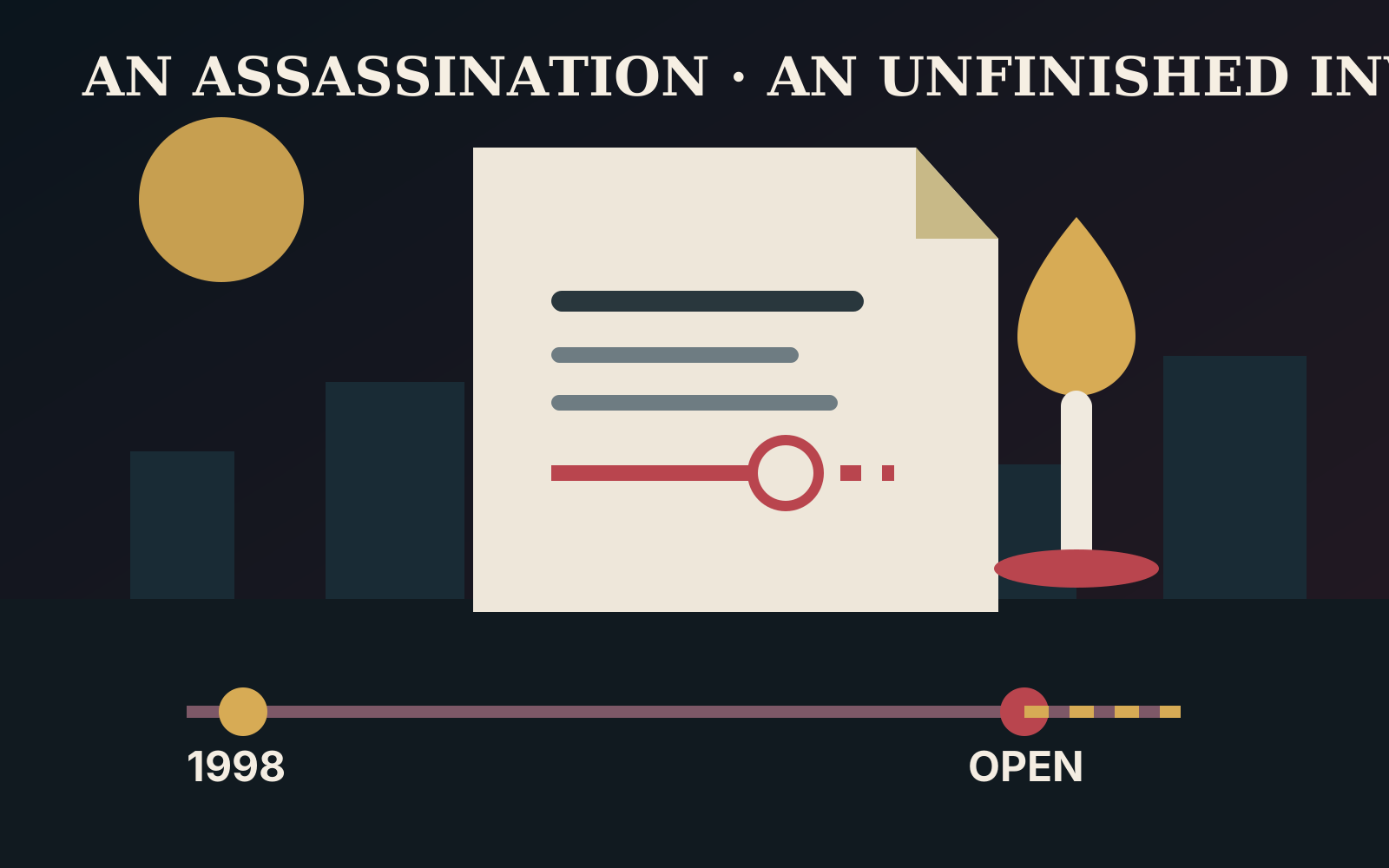
The symbolic artwork uses a memorial light, an Ulaanbaatar skyline and an unfinished legal file. It is not a generated likeness of Zorig, a reconstruction of his home or a depiction of supposed perpetrators.
Case timeline
- 2 October 1998 — Sanjaasürengiin Zorig is assassinated in his Ulaanbaatar home.
- 2000 — The IPU begins formal examination of the case.
- 2013 — The IPU records crime-scene contamination, investigative weaknesses and continuing secrecy.
- 2015 — Three suspects are arrested after years without a public breakthrough.
- 27 December 2016 — A closed trial convicts three people and imposes sentences of 24 to 25 years.
- 14 March 2017 — A closed appellate hearing upholds the sentences.
- December 2017 — The government orders declassification of several case files.
- March 2019 — Video showing torture and ill-treatment of two defendants becomes public.
- 22 July 2020 — An Ulaanbaatar court concludes that Chimgee and Sodnomdarjaa were tortured during the investigation.
- 31 March 2021 — Mongolia’s Supreme Court convicts former intelligence chief Bat Khurts for torture connected to the case.
- 14 May 2021 — The Supreme Court releases Chimgee and Sodnomdarjaa on bail and returns the murder case for further investigation.
- 2024–2025 — Joint investigative and parliamentary oversight groups are reported established.
- February 2026 — The IPU says the assassins and masterminds remain unidentified and continues monitoring the case.
Questions readers ask
Who was Sanjaasürengiin Zorig?
Zorig was a leading figure in Mongolia’s democratic movement, a parliamentarian and acting Infrastructure Minister. He was being considered for the premiership when he was killed.
When and where was he killed?
He was assassinated in his home in Ulaanbaatar on 2 October 1998.
Were three people convicted?
Yes. Three people were convicted in a closed 2016 trial. Later proceedings established torture of two defendants, two were released in 2021, and the murder case was returned for further investigation.
Why is the case still unsolved?
The current authoritative record says the identities of the true assassins and masterminds have not been established through a reliable completed process. The investigation remains open.
Did the torture findings erase every court action?
No. The historical convictions, torture convictions and release orders all remain part of the record. The key status point is that the murder responsibility itself is not reliably and finally adjudicated.
What is the latest reported investigative step?
Authorities reported a joint intelligence-police working group under prosecutorial supervision and a parliamentary oversight group. In February 2026, the IPU said it still lacked substantive progress information.