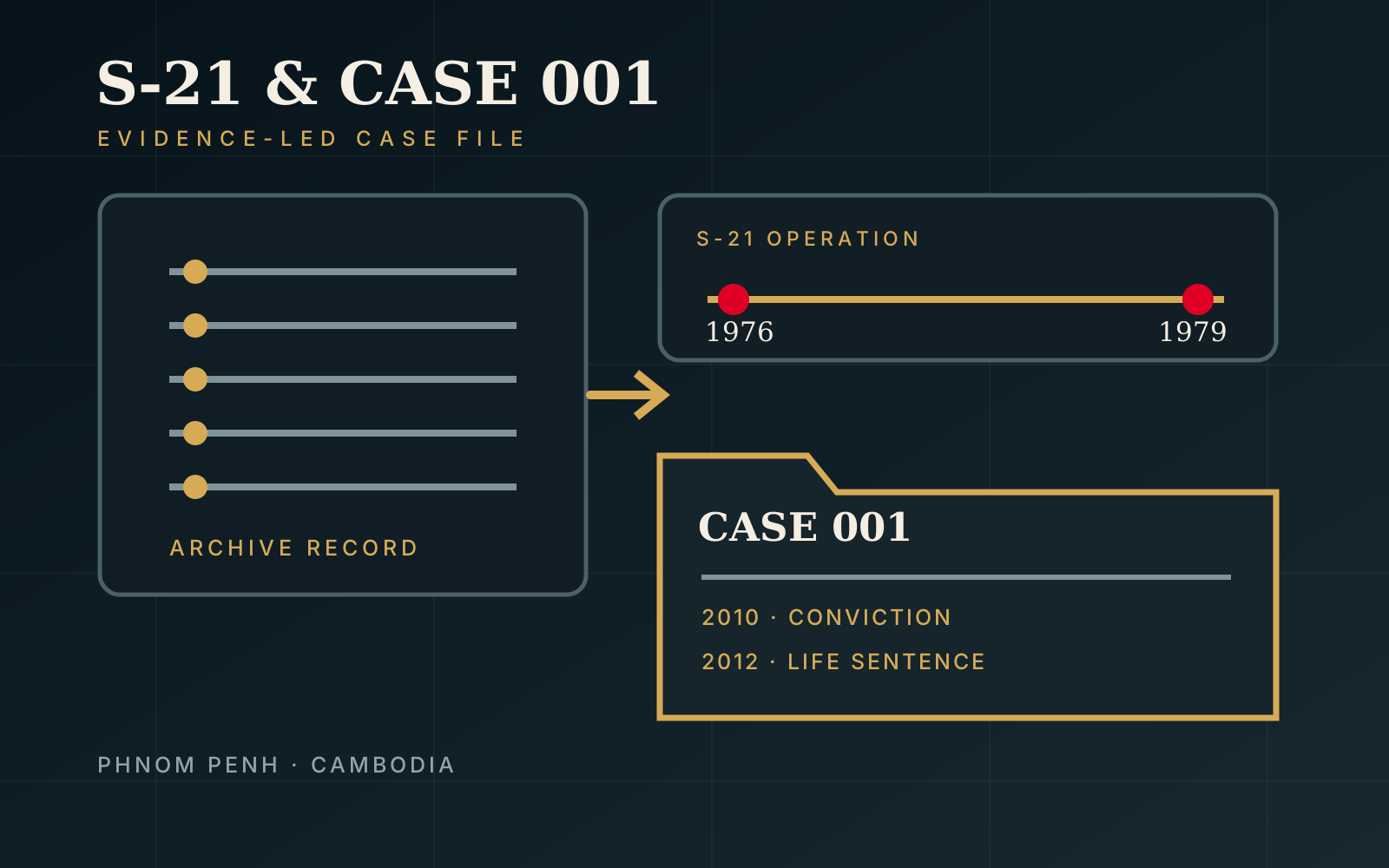
Case-status note: “Solved / adjudicated” refers specifically to Kaing Guek Eav's final conviction and life sentence in ECCC Case 001. It does not mean that every S-21 staff member was prosecuted, that the fate of every detainee is individually documented, or that this one proceeding resolved all crimes committed under Democratic Kampuchea.
What happened at S-21?
S-21 was a security centre operated by the Communist Party of Kampuchea in Phnom Penh. The Extraordinary Chambers in the Courts of Cambodia describes it as a facility for the unlawful detention, interrogation and execution of people treated as enemies of the party. The centre operated under Kaing Guek Eav, better known by the alias Duch, from 1976 until early January 1979.
The institution occupied a former school complex that later became the Tuol Sleng Genocide Museum. Detainees included people accused of disloyalty within the Khmer Rouge system as well as relatives and others caught in expanding purges. Confessions were manufactured through coercion and violence, then used to reinforce the premise that hidden enemies existed. The ECCC found that detention, interrogation and killing were not isolated misconduct: they formed an organized system.
Case 001 converted part of that historical record into a judicial finding about one defendant. The ECCC convicted Duch of crimes against humanity and grave breaches of the Geneva Conventions. It did not convict him of genocide. Keeping the legal categories exact matters because “Khmer Rouge trial” is not itself a charge, and different ECCC cases addressed different defendants, sites and offenses.
How the security centre functioned
The ECCC found that Duch helped establish S-21 and design its operation. He first supervised its interrogation unit and became chairman in March 1976. His authority later extended over the entire staff. The official judgment summary records that he refined procedures, selected staff, taught interrogators to use physical and psychological violence, transmitted orders and exercised effective control over subordinates.
S-21's paperwork was part of the mechanism. Prisoners were photographed, biographies were compiled, interrogations produced written “confessions,” and lists tracked people through the centre. The United States Holocaust Memorial Museum explains that many supposed admissions concerned imagined links to foreign intelligence services or purged party figures. The records are valuable evidence, but they are not truthful proof that detainees committed the offenses forced into those statements.
Most prisoners were eventually taken to Choeung Ek for execution; others died from torture or extreme detention conditions. Crime by Region does not reproduce graphic methods or photographs. The essential factual point is the institutional sequence established in court: arrest and transfer, unlawful confinement, coerced interrogation, and death.
The victims and the problem of numbers
The ECCC's current profile records a finding that no fewer than 12,273 people were detained at S-21 and that at least 11,742 prisoners were executed there. Those figures are judicial minimums tied to the evidence assessed in Case 001. The Trial Chamber also found that other victims died from disease, malnutrition and the physical and psychological suffering caused by detention conditions.
Other respected institutions publish broader estimates. The United States Holocaust Memorial Museum places the number detained between 14,000 and 17,000 and notes that only a small number are believed to have survived. These are not necessarily incompatible claims: surviving records are incomplete, while a court may state only the minimum it finds proved. This page therefore uses the ECCC's minimums in its dossier and labels estimates from other institutions separately.
Numbers should not erase identities. Seventy-four civil parties were ultimately admitted to Case 001, and 22 testified during the trial. The tribunal also heard fact, expert and character witnesses. Their participation meant the proceeding included direct accounts of loss and survival alongside documents created by S-21 itself.
Duch's role and responsibility
Kaing Guek Eav was born in 1942 and used “Duch” as his revolutionary name. The ECCC profile traces his leadership of an earlier security centre, M-13, and his involvement in planning S-21 in 1975. He became the centre's chairman in 1976. When S-21 ceased operations on January 6, 1979, Duch fled the site.
The Trial Chamber did not base responsibility only on his job title. It found that Duch participated in a common criminal system of ill-treatment, directed operations, controlled staff, transmitted arrest, torture and execution orders, and knew crimes were being committed. It also found that he failed as a superior to prevent or punish crimes by subordinates.
That combination explains why the case is described as institutional crime and individual responsibility. S-21 required many participants and links to the broader party hierarchy, yet Case 001 tried one person. Duch's conviction is a legal resolution of his responsibility; it is not a judicial finding that he acted alone.
How the case was documented
The S-21 archive was unusually extensive for a site created to conceal crimes. Entry photographs, prisoner lists, interrogation records, annotations and internal correspondence survived the regime's fall. Museum, Cambodian documentation and tribunal teams preserved and analyzed that material. Witnesses and civil parties added testimony that documents created by perpetrators could not supply.
The court's published case history shows a formal investigation beginning in 2007, an indictment in 2008 and substantive trial hearings from March through September 2009. Closing statements followed in November. The Trial Chamber delivered judgment on July 26, 2010.
Documentary abundance still has limits. A photograph proves that a person was recorded at the centre, not every event that followed. A coerced confession records what S-21 demanded, not reliable guilt. A minimum victim count does not become a complete list. Responsible case writing distinguishes what the tribunal found from what the archive cannot fully reconstruct.
The 2010 Trial Chamber judgment
On July 26, 2010, the Trial Chamber convicted Duch of crimes against humanity and grave breaches of the 1949 Geneva Conventions. The crimes against humanity included persecution on political grounds, extermination encompassing murder, enslavement, imprisonment, torture and other inhumane acts. The grave breaches included wilful killing, torture, inhumane treatment, unlawful confinement and denial of fair-trial rights.
The Trial Chamber imposed 35 years' imprisonment. It reduced the sentence by five years as a remedy for Duch's unlawful prior detention by the Cambodian Military Court, and time already served also affected the calculation. Both the prosecution and the defense appealed.
The judgment was the ECCC's first verdict. Its significance came from more than chronology: it applied international criminal law to a preserved security-centre record and formally recognized victims through convictions and civil-party participation. At the same time, debate over the original sentence showed that a conviction and the final punishment are separate stages.
The 2012 final appeal judgment
The Supreme Court Chamber heard appeals in March 2011 and issued its judgment on February 3, 2012. It replaced the 35-year term with life imprisonment. The ECCC now lists life imprisonment as Duch's final sentence.
This appellate outcome is why the case status can be stated without qualification about a pending appeal. Unlike cases where public reporting stops at a trial verdict, Case 001 has an identified final appellate chamber, date and result. The sentence did not become a death penalty; it remained life imprisonment.
Duch was later transferred to Kandal Provincial Correctional Centre. He died in Phnom Penh on September 2, 2020, while serving the life sentence. His death ended the punishment in practice but did not vacate the conviction or change the adjudicated status of Case 001.
What Case 001 did—and did not—decide
Case 001 concerned charges against Duch related to S-21. The ECCC lists S-21, Choeung Ek and S-24 among the sites examined in the proceeding. Other Khmer Rouge leaders and other alleged crime sites were addressed in separate cases with their own procedural histories.
The final judgment therefore should not be stretched into a claim of complete accountability. It did not identify or sentence every guard, interrogator, official or person who supplied detainees. Nor does it provide an individual narrative for every victim represented in the surviving records.
It did establish a demanding core: the nature of S-21's system, Duch's authority and actions, the categories of international crimes, minimum victim findings, and a final life sentence. Those points are sufficient for a solved/adjudicated classification while the unresolved dimensions remain visible.
Why the case matters
The S-21 prosecution demonstrates how an archive created by a criminal institution can later support accountability, but only when read critically. Prisoner photographs and forced confessions must be understood as products of persecution, not neutral administrative files. Survivor testimony and contextual evidence are indispensable.
It also shows why precise language matters in mass-crime reporting. Duch was convicted of crimes against humanity and grave breaches, not genocide in Case 001. The Trial Chamber sentence was not the final sentence. The minimum counts proved in court should not be silently substituted for broader historical estimates.
The verified bottom line is clear. Duch directed S-21's organized system of detention, interrogation and execution; the ECCC convicted him in 2010; the Supreme Court Chamber imposed life imprisonment on February 3, 2012; and he died in 2020 while serving that sentence.
Frequently asked questions
What was S-21?
S-21 was a Khmer Rouge security centre in Phnom Penh used for unlawful detention, interrogation and execution between 1976 and early 1979.
Who was Kaing Guek Eav, known as Duch?
Duch was the chairman and secretary of S-21. The ECCC found that he helped establish the centre and directed its operation and staff.
How many people did the ECCC find were detained and executed?
The ECCC profile records no fewer than 12,273 detainees and at least 11,742 executions at S-21. Other institutions publish broader estimates, so this file keeps the judicial minimums distinct.
What crimes was Duch convicted of?
He was convicted of crimes against humanity and grave breaches of the 1949 Geneva Conventions. Case 001 did not convict him of genocide.
What sentence did Duch receive?
The Trial Chamber imposed 35 years in 2010, with a five-year remedy for unlawful prior detention. On February 3, 2012, the Supreme Court Chamber imposed life imprisonment.
Why is the case classified as solved?
The proceedings produced a final conviction and life sentence. The label applies to Duch's adjudicated responsibility in Case 001, not to every participant or every Khmer Rouge crime.