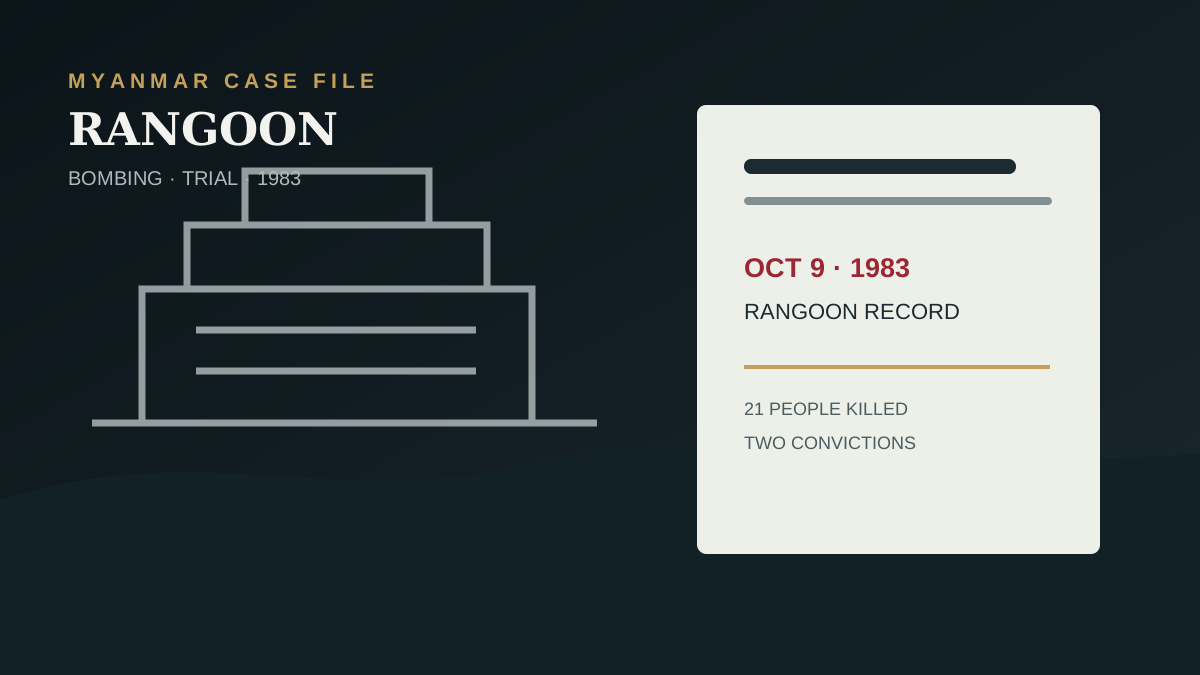
Classification note: Crime by Region classifies this file as Solved / adjudicated. Burmese authorities identified three members of the operation; one died during pursuit and two were convicted after trial. The North Korean government denied involvement, so this page distinguishes its denial from the Burmese findings, the surviving defendant's confession and later official historical assessments.
A presidential visit to Burma
South Korean president Chun Doo-hwan arrived in Burma, now Myanmar, on a state visit. His schedule included a wreath-laying ceremony at the Martyrs' Mausoleum, a memorial to independence leader Aung San and colleagues assassinated in 1947. Senior South Korean ministers, advisers, diplomats, journalists and security personnel gathered ahead of him.
The location carried national significance for Burma and ceremonial importance for the visiting delegation. The attackers exploited the predictable schedule of an official event, concealing explosive devices in the mausoleum before the ceremony.
The explosion on October 9
A bomb detonated at approximately 10:25 a.m. as the delegation waited. Chun had not yet arrived because his motorcade was delayed. The intended target survived, but the blast struck the officials and local personnel already at the site.
The dead included South Korea's deputy prime minister and economic planning minister Suh Suk-joon, foreign minister Lee Bum-suk, commerce and industry minister Kim Dong-whie and energy minister Suh Sang-chul, along with other advisers, officials and journalists. Four Burmese nationals were also killed. Forty-six people were reported injured.
Those totals should not be reduced to an “assassination attempt that failed.” The principal target survived, but 21 other people were killed. Their deaths are the center of the criminal case.
The Burmese investigation
Burmese investigators identified three Korean People's Army officers as suspects. The inquiry concluded that the team entered Burma by sea and prepared the devices as part of a mission directed at the South Korean president. Contemporary and later official accounts treated the operation as a North Korean act, while Pyongyang denied involvement.
The investigation's strength lay in more than geopolitical suspicion. Two members of the team were captured after the bombing, and one cooperated with authorities and confessed to the mission. The third suspect was pursued and killed after a confrontation in which Burmese personnel also died.
Capture of the surviving officers
Kang Min-chol, whose name is also transliterated as Kang Min-chul, survived serious injuries and was taken into custody. A second surviving officer, commonly identified in English-language sources as Kim Jin-su, was also captured. Both were prosecuted in Burma.
Transliteration varies across decades-old reporting, particularly for the second defendant. This page uses the most common English forms but does not treat spelling differences as separate people or cases.
Trial and sentences
The Burmese court convicted both surviving defendants. Kang's cooperation and confession were reflected in a life sentence. The second defendant, who did not cooperate, received a death sentence and was later executed. The third identified member of the team never stood trial because he had been killed during the pursuit.
Kang remained in Insein Prison for more than two decades. North Korea continued to deny that he was its citizen or agent. He died in custody in May 2008 while being transferred for medical care. His death ended the remaining sentence; it did not reopen or nullify the conviction.
Attribution and North Korea's denial
Burma's criminal investigation, the confession of a surviving officer and later assessments by the U.S. Congressional Research Service identify the bombing as a North Korean attempt to kill Chun. A declassified U.S. intelligence assessment separately described the case against North Korean responsibility.
North Korea's denial remains part of the historical record. It is not presented as an acquittal because Pyongyang's political denial was not a ruling by the Burmese trial court. Conversely, institutional attribution does not prove uncharged details about every official who may have known of or authorized the plan.
Diplomatic consequences
Burma broke diplomatic relations with North Korea after the investigation. The attack transformed a ceremony in Rangoon into an international crisis and demonstrated how inter-Korean conflict could be exported onto the territory of a third country.
Relations between Myanmar and North Korea were later restored, but the diplomatic shift did not alter the 1983 verdicts. Historical reconciliation and criminal adjudication are separate processes.
What is established—and what remains bounded?
- Established: a bomb exploded at the Martyrs' Mausoleum on October 9, 1983, during Chun Doo-hwan's scheduled visit.
- Victim record: 21 people—17 South Koreans and four Burmese nationals—were killed, and 46 were injured.
- Investigated: Burmese authorities identified a three-man North Korean military team.
- Adjudicated: both surviving defendants were convicted; one received life imprisonment and one was executed.
- Not adjudicated: the third suspect died during pursuit and therefore was never tried.
- State attribution: Burma and later official assessments attributed the mission to North Korea; North Korea denied involvement.
- Boundary: the public record reviewed does not establish through trial the full higher-level chain of authorization.
Sources and editorial method
The page relies on declassified and government-document sources for attribution, supplemented by later human-rights documentation and established reporting for chronology, victims and Kang's custody. Conflicting transliterations are normalized, and political claims are separated from the criminal verdicts.
- CIA FOIA — Rangoon Bombing Incident: The Case Against the North Koreans
- Congressional Research Service — North Korean Actions, 1950–2007
- Committee for Human Rights in North Korea — Kang Min-chol documentation
- The Korea Herald — historical review of the Rangoon bombing
Editorial boundary: The bombing is treated as one coordinated incident. Individual victims, the pursuit and the later death of a convicted prisoner are not split into artificial extra cases.