Classification note: Crime by Region classifies this file as Solved / Adjudicated because courts convicted the gunman and an accomplice for the assassination and imposed sentences on two other defendants. The label does not mean every organizer was captured, that a complete motive was proved, or that the full chain of responsibility was exposed.
Who were U Ko Ni and Nay Win?
U Ko Ni was a prominent Muslim lawyer, constitutional expert and legal adviser to Myanmar's National League for Democracy. He advocated constitutional reform and was credited with helping devise the office of state counsellor, the position through which Aung San Suu Kyi led the civilian government despite being barred from the presidency.
Nay Win was a Yangon taxi driver. He was not part of Ko Ni's political or legal work. He entered the case because he joined other bystanders in chasing the fleeing shooter, an intervention that cost him his life. Recording both victims matters: the public prominence of one should not erase the other.
The airport shootings
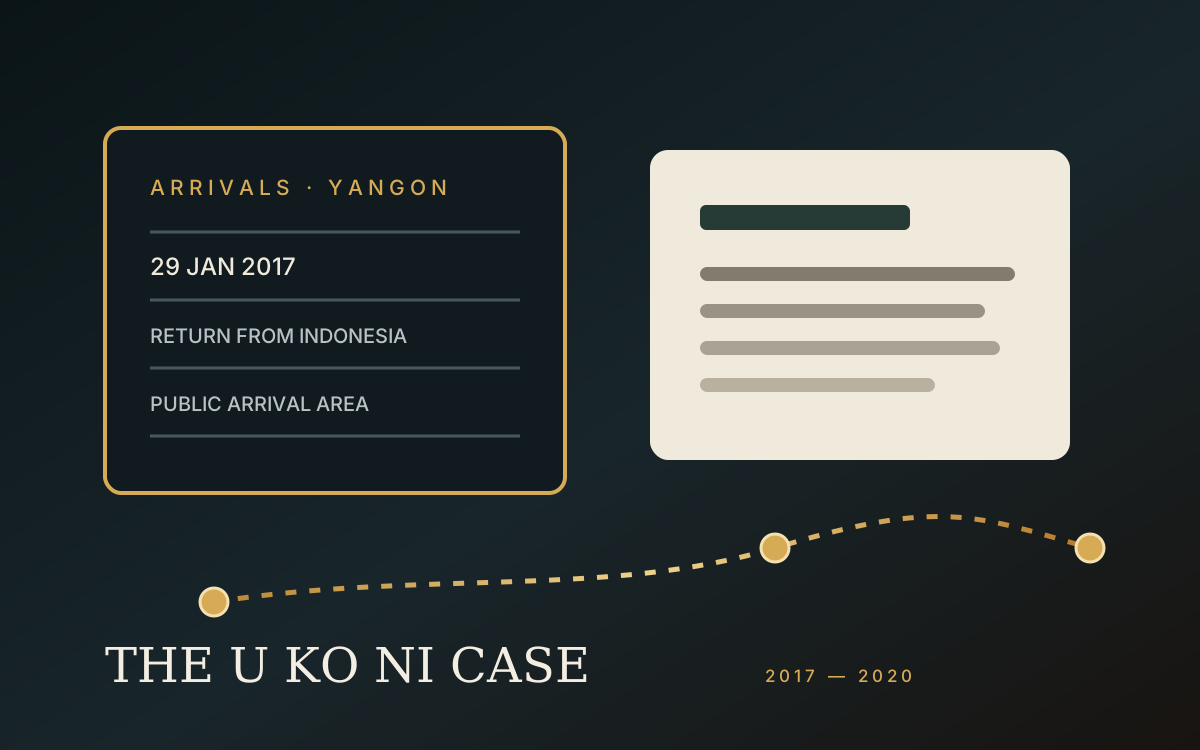
Ko Ni returned to Yangon from Indonesia on January 29, 2017 after taking part in a delegation concerned with democracy and conflict resolution. Outside the airport terminal, while holding his young grandson, he was shot at close range. The child was not physically injured.
The gunman ran from the scene. Taxi drivers and other witnesses pursued him. During that pursuit, Nay Win was shot and killed. The group nevertheless detained the shooter, Kyi Lin, and police arrested him shortly after the attack.
Contemporary reporting quickly described the killing as an assassination because of Ko Ni's public role and the targeted nature of the shooting. That description does not, by itself, prove a particular political sponsor or motive.
From the gunman to the alleged plot
The immediate arrest gave investigators a direct starting point. Public police accounts and evidence discussed during the later trial linked Kyi Lin to Aung Win Zaw, a former military officer who had previously been imprisoned with him. Airport surveillance footage was reported to show the two men together on the day of the killing.
Authorities alleged that Aung Win Zaw's brother, former lieutenant colonel Aung Win Khaing, had arranged for a gunman. Reuters reported that Aung Win Khaing evaded capture. Another former officer, Zeyar Phyo, was accused during the investigation of financing the plot, but the most serious allegation against him did not result in a murder conviction.
A detailed Reuters investigation examined court records, business filings and the accused men's military and political connections. It also made an essential boundary clear: no evidence had emerged that active military officials ordered the killing. This file therefore does not convert connections, public suspicion or political context into a judicial finding.
The 2019 verdicts and sentences
In February 2019, a Yangon court sentenced Kyi Lin and Aung Win Zaw to death. The judgments established responsibility for the direct killing and criminal participation in the assassination. Myanmar Now later reported that Kyi Lin was the gunman and Aung Win Zaw was treated as his accomplice.
Two other defendants received shorter prison terms. Zeyar Phyo was sentenced to five years for destroying evidence after the accusation that he financed the assassination was dropped before the verdict. Aung Win Tun received three years for harboring his brother, Aung Win Zaw, after the killing.
Those procedural distinctions are important. A conviction for destroying evidence is not a murder conviction, and harboring a person after a crime is not the same as planning the crime. The archive records each outcome at the level the judgment supports.
Appeals and the limits of the public record
The victims' families and their lawyers argued that the shorter sentences did not reflect the alleged roles described during the case. Myanmar Now reported that, after earlier attempts for harsher punishments failed, prosecution lawyers brought a special appeal to Myanmar's Supreme Court in September 2020. A special appeal was the final available avenue, but it was not certain whether the court would accept it or when a decision might follow.
The same report said Aung Win Khaing, described as the alleged mastermind, remained at large. Crime by Region found no later reliable English-language court report, through the September 2026 publication review, that established his arrest or supplied a final public resolution of the special appeal. This is a limitation of the verifiable public record, not proof that no unpublished development occurred.
Political context is not a complete motive finding
Ko Ni worked on constitutional reforms that challenged entrenched military power and was a visible Muslim public figure during a period of severe anti-Muslim hostility. He had received threats before his death. Those facts explain why the assassination carried national political significance and why many observers examined extremist and military-linked networks.
They do not authorize a writer to name an unconvicted sponsor. The convictions identify criminally responsible participants; the broader cause, financing and command chain were not fully resolved by the judgments available for review. The page therefore attributes reported allegations and avoids presenting the political interpretation as a completed court finding.
What is resolved — and what remains open?
- Resolved in court: Kyi Lin and Aung Win Zaw were convicted and received death sentences in February 2019.
- Separately adjudicated: Zeyar Phyo was convicted of destroying evidence, and Aung Win Tun was convicted of harboring his brother.
- Not captured in the latest detailed report: alleged organizer Aung Win Khaing remained at large in September 2020.
- Not fully established: the complete motive, financing and higher chain of responsibility.
- Public-record gap: no later reliable English-language judgment resolving the special appeal was located during the September 2026 source review.
The narrow classification is therefore adjudicated, not fully closed. It acknowledges the convictions without suggesting that every person behind the assassination was identified and held accountable.
Frequently asked questions
Where was U Ko Ni assassinated?
He was shot outside Yangon International Airport in Myanmar on January 29, 2017, after returning from Indonesia.
Who was Nay Win?
Nay Win was a taxi driver who joined the pursuit of the gunman. He was shot and killed during that attempt to intervene.
How many defendants received sentences?
Four men received sentences reported in the 2019 judgment: Kyi Lin and Aung Win Zaw received death sentences, Zeyar Phyo received five years, and Aung Win Tun received three years.
Was the alleged organizer convicted?
No. The detailed 2020 reporting used for this file said alleged organizer Aung Win Khaing remained at large.
Why is the file not simply called closed?
The gunman and an accomplice were convicted, but the wider organizing structure, complete motive and final public status of the special appeal were not fully resolved in the reliable record reviewed.
Source and status methodology
This file cross-checks the airport chronology and political background against contemporary Associated Press, TIME and Reuters reporting. It uses Myanmar Now's detailed account for the four sentences, the special appeal and the fugitive status reported in 2020. Statements about people who were not convicted remain attributed allegations.
Myanmar archiveInteractive world mapSearch all cases
← Return to Myanmar case files