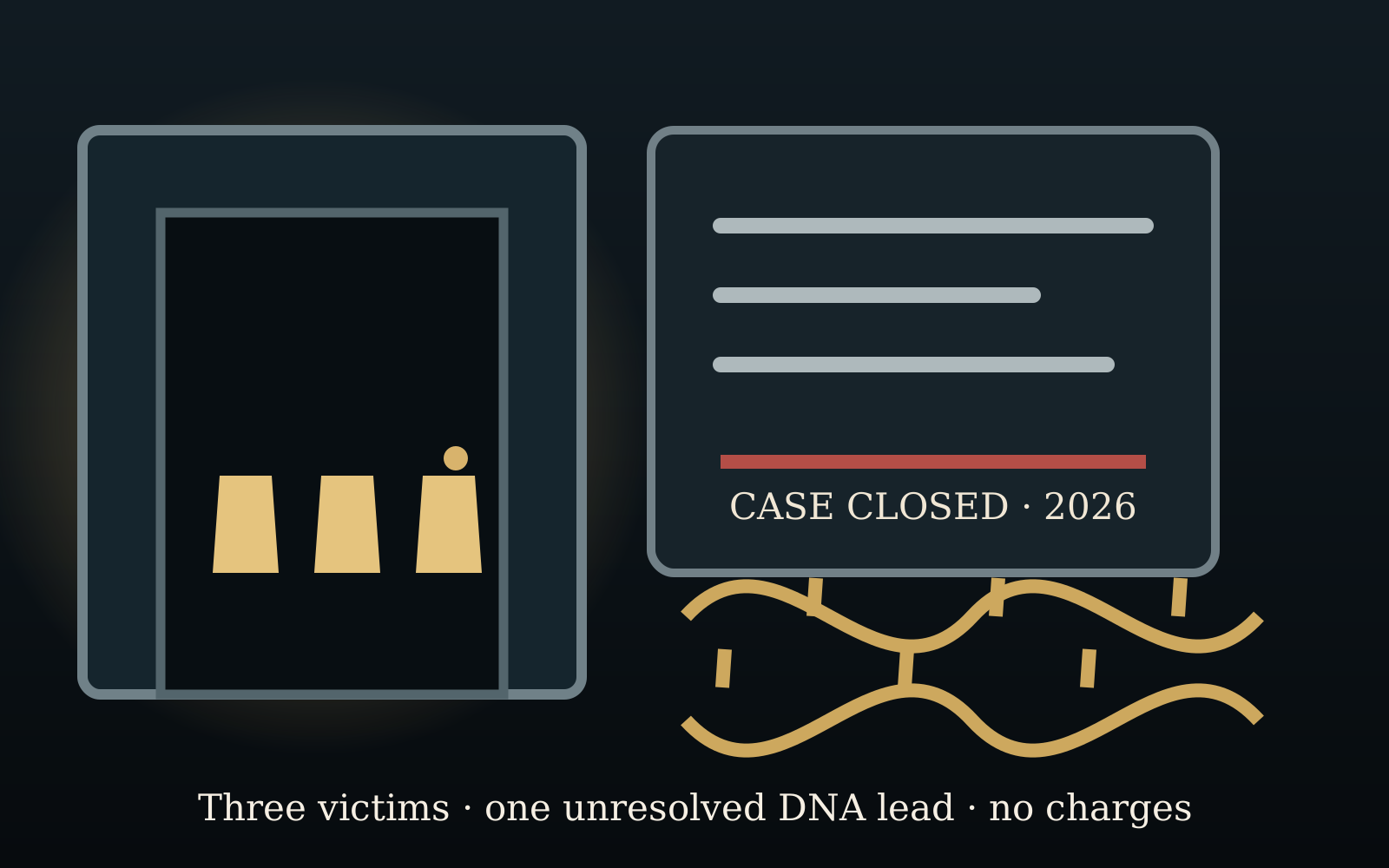
Status boundary: A former police officer became a suspect after his DNA was matched to material recovered from a fork in the apartment. He denied involvement, was never charged and has not been identified publicly. Investigators could not rule out pre-laboratory contamination during the fork's handling in 2001, even though the forensic laboratory excluded cross-contamination between the later analyses. This page does not treat the DNA match, the man's earlier database searches or his former occupation as proof of guilt.
Three lives connected by family and friendship
Tiina Lätt was a twenty-year-old dentistry student at the University of Tartu. She had recently moved into a two-room apartment on Põllu Street that her family had bought for her studies. Urmas Aal, thirty, was an Estonian Defence Forces officer and acting head of the Estonian National Defence College. The two had previously been partners and remained on friendly terms.
Elmo Lätt, Tiina's forty-four-year-old father, came to Tartu on the morning of 15 April 2001 after Tiina reported that her handbag had disappeared and then reappeared at a party the previous night. Cash, her keys and a temporary driving licence showing her address were missing. Tiina asked her father to bring a spare key and change the lock.
The apartment falls silent
Elmo entered the apartment at about 11:30 a.m. Tiina and Urmas arrived within the next hour. After that, none of the three answered telephone calls. Relatives and friends searched across Tartu before arranging for a locksmith to open the apartment that evening.
All three were found dead from gunshot wounds. Police found little disturbance, no clear sign of a struggle and few unidentified traces. Cartridge cases had been removed and the door was locked when the killer left. Those details widened the range of possible explanations rather than establishing a single motive.
A national investigation without a decisive lead
The Central Criminal Police formed a special task force. Investigators examined personal motives, possible connections to Urmas's military work and the theory that someone who had taken Tiina's keys intended to burglarize the apartment. None could be proved.
In 2005, a prisoner admitted stealing Tiina's handbag and said he passed the remaining contents to another man. That man denied going to the apartment and said the keys had gone to a third person who died later in 2001. Police found no physical evidence connecting those men to the apartment, and the case became effectively dormant while remaining formally open.
A fork produces a new DNA lead
Prosecutor Mari Kartau revisited the cold case after arriving in Tartu in 2022. Evidence stored since 2001 was submitted for modern forensic examination. Testing recovered male DNA from a fork taken from the apartment kitchen and matched it to a former police officer who had no known relationship with the victims or reason to have been in the home.
The man was detained as a suspect in early 2025. He denied involvement and could not explain the DNA. Investigators also learned that in 2002 he had accessed police database records concerning Urmas Aal and other people connected to the case, despite having no role in the murder inquiry. He said he could no longer remember why.
What the DNA evidence could not establish
The Estonian Forensic Science Institute excluded laboratory cross-contamination between the man's reference sample and the fork because they were examined almost two decades apart in different laboratories. It could not exclude earlier contamination: the fork had been processed for fingerprints in 2001 under conditions that were not sterile.
The institute's DNA department said the quantity recovered made casual transfer decades earlier relatively unlikely. That assessment strengthened the lead but did not answer when or how the material reached the fork. Investigators still needed corroborating evidence, and no charge followed.
The investigation ends on a legal calculation
While investigators were assessing the new lead, prosecutors re-examined which limitation rule applied. They concluded that the interaction between Estonia's earlier criminal law, abolition of the death penalty and the Penal Code that took effect in 2002 left murders committed during this period subject to a ten-year limitation period.
That conclusion reversed the position under which investigators had continued working. In spring 2026, around the twenty-fifth anniversary of the killings, the families were told that the investigation was closed and stored evidence was returned. The decision prevented the unresolved DNA lead from being tested through a prosecution.
A legal endpoint without a factual answer
The file now has a formal procedural endpoint but no established perpetrator or motive. No one has been convicted, and the former officer's suspect status did not become a charge. The possible relationship between the stolen keys and the killings also remains unproved.
The victims' families have continued to seek information and asked anyone with relevant knowledge to contact police or the public broadcaster's investigative programme. This archive therefore records the case as unresolved and the 2026 closure as a limitation decision, not a determination of who committed the murders.
Case timeline
- 14 April 2001 Tiina Lätt's handbag disappears at a Tartu party and later reappears without cash, keys or a driving document bearing her address.
- 15 April 2001 Elmo Lätt brings a spare key to Tiina's Põllu Street apartment; Tiina and Urmas Aal arrive later, and all three are found dead that evening.
- 2005 A prisoner admits stealing the handbag, but the account of where the keys went does not produce evidence tying anyone to the apartment.
- 2022 Prosecutor Mari Kartau revives active work on the still-open case and orders modern examination of stored evidence.
- Early 2025 A former police officer is detained as a suspect after DNA from a fork is matched to him; he denies involvement and is not charged.
- Spring 2026 Prosecutors close the investigation after concluding that the applicable ten-year limitation period had expired.
- 17 September 2026 ERR's Pealtnägija investigation publicly details the DNA lead, contamination question and limitation decision.
Questions readers ask
Who were the victims in the Põllu Street case?
Elmo Lätt, 44; his daughter Tiina Lätt, 20; and Urmas Aal, 30, an Estonian Defence Forces officer.
Why were Tiina's missing keys important?
Her handbag vanished at a party and returned without keys or a document showing her home address, creating a possible route into the apartment. Investigators never proved that this led to the murders.
What produced the later DNA lead?
Modern testing found male DNA on a fork recovered from the apartment kitchen and matched it to a former police officer.
Was the former officer charged?
No. He was detained as a suspect, denied involvement and was never charged. His identity was withheld in the reporting reviewed for this page.
Could the DNA have been contamination?
Laboratory cross-contamination was excluded, but earlier transfer during nonsterile fingerprint handling in 2001 could not be ruled out.
Why was the investigation closed?
Prosecutors concluded in 2026 that the applicable ten-year limitation period had expired because of the interaction between successive criminal laws.