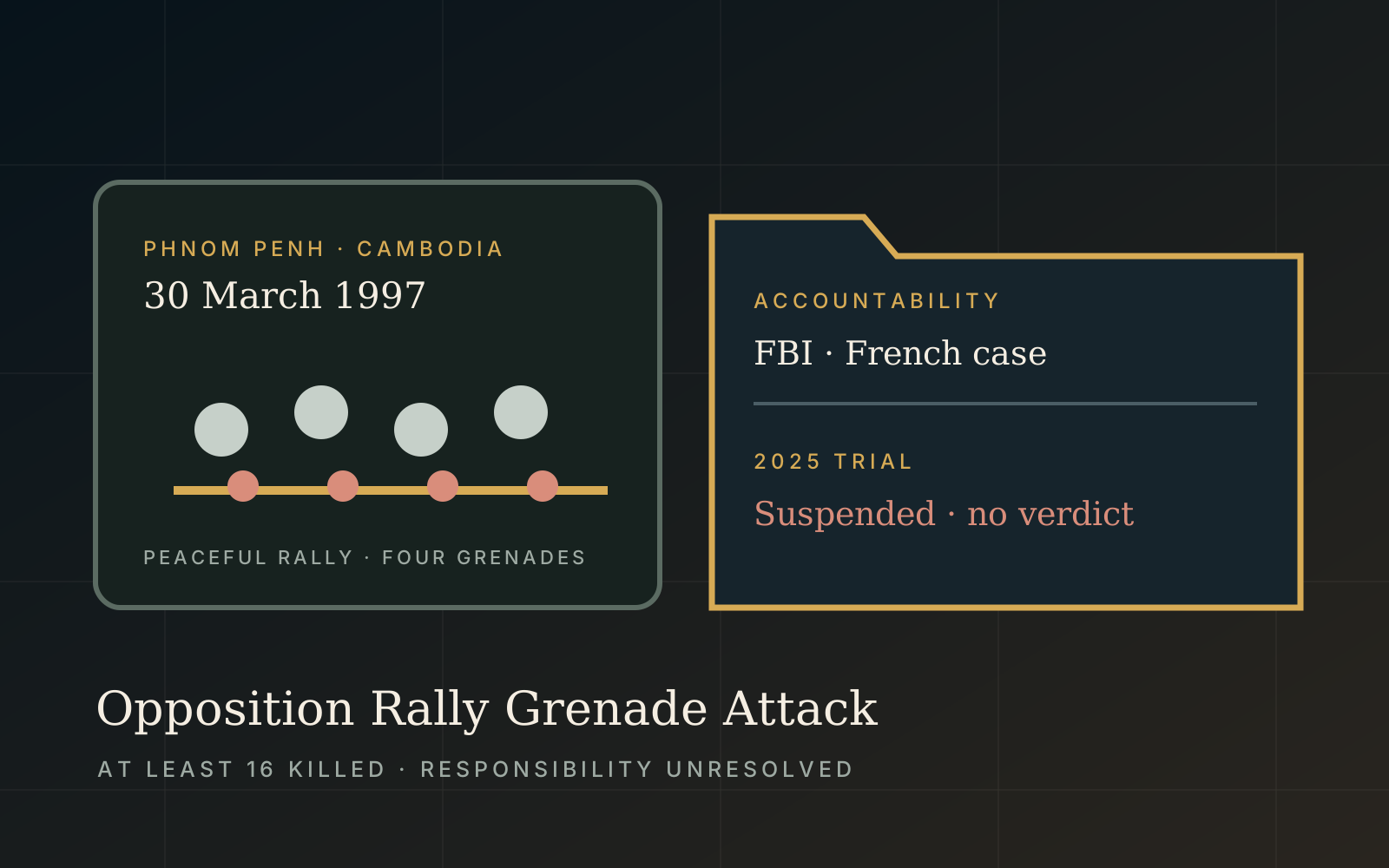
Case-status note: French judges indicted Huy Piseth and Hing Bun Heang and brought them to trial in absentia. Those procedural actions are not convictions. The defendants denied involvement, and the court suspended the 2025 trial before judgment to investigate new evidence. Allegations about higher-level responsibility remain allegations.
What happened at the rally?
The demonstration was organized by the Khmer Nation Party, led by Sam Rainsy, to protest judicial corruption. Roughly 200 people gathered in a park opposite or near Cambodia's National Assembly. The event had been authorized and was described by rights monitors as peaceful.
As Rainsy addressed the crowd, four grenades were thrown into the gathering in rapid succession. The explosions killed at least 16 people and wounded more than 100. Some later sources use a figure of approximately 150 injured. Because published totals differ, this file uses the conservative formulation “more than 100” and identifies the wider estimate only as a reported count.
Rainsy was struck by a fragment but survived. One of his bodyguards, who shielded him, was killed. U.S. citizen Ron Abney was among those seriously wounded. His presence brought the Federal Bureau of Investigation into the case.
A political attack with civilian victims
The rally was a public gathering, and those killed and injured included ordinary participants and people supporting a political protest. The case is frequently narrated through the rivalry between Rainsy and Cambodia's governing leadership, but the casualty count represents individual people whose lives and families were permanently changed.
This page avoids reproducing graphic injuries. The number and placement of explosions, the security perimeter, witness accounts and investigative records are sufficient to explain the crime. Details that add shock without evidentiary value are excluded.
Security and the escape route
Human Rights Watch and later French court material described members of the prime minister's bodyguard unit positioned behind the demonstrators. Witnesses and investigators examined allegations that security personnel allowed the grenade throwers to escape toward a nearby military compound and prevented pursuit.
Those assertions became central to the French indictment, but they must be described with their legal status intact. They were findings supporting a decision to send two defendants to trial, not facts established by a final conviction. Cambodian officials disputed the allegations, and Hing Bun Heang publicly denied being present or involved.
The Cambodian investigation
Cambodian authorities announced an investigation, but rights groups repeatedly criticized its independence, speed and results. No one was arrested and finally convicted in Cambodia for the attack. Human Rights Watch reported that the government failed to conduct a credible investigation and obstructed outside efforts to obtain accountability.
The absence of a Cambodian prosecution did not make every outside allegation true. It did, however, leave essential questions unanswered: who obtained the grenades, who selected the site and timing, who threw them, and whether anyone with authority enabled the attackers' escape.
The FBI inquiry
The FBI became involved because Ron Abney, an American, had been injured. Its investigators interviewed witnesses and reviewed the scene and conduct of security units. Later declassified material was cited by Human Rights Watch, U.S. congressional records and the French proceeding.
Investigators reportedly developed evidence that raised serious questions about members of the bodyguard unit and prior knowledge of the attack. Yet the FBI inquiry did not produce a U.S. prosecution. Cooperation constraints and jurisdictional realities limited what could follow from the investigative work.
The French case
Sam Rainsy holds French citizenship, allowing him and his wife to pursue a criminal complaint in France. After years of investigation, French judges ordered Huy Piseth and Hing Bun Heang to stand trial. The 2021–2022 charging decisions alleged that the two men, who had held senior roles connected to Hun Sen's security apparatus, helped organize or facilitate the attack.
The defendants remained in Cambodia and were not taken into French custody. They rejected the allegations. Their trial began in Paris in March 2025 in absentia. Testimony was heard, but prosecutors requested additional time after new evidence emerged. The court suspended proceedings rather than delivering the expected verdict.
The suspension is crucial to the current classification. It means the case did not end in either conviction or acquittal. Any description of the defendants as perpetrators would therefore exceed the judicial record.
Status through September 15, 2026
No reliable final verdict issued after the suspended March 2025 proceeding was located in this review. The French case remained the most advanced attempt at individual accountability, but further investigation had not yet produced a published final judgment.
The attack is classified as unsolved because the crime and victims are documented while individual criminal responsibility remains unadjudicated. The French indictment is described as an allegation tested in court; the denials are preserved; and no political leader is presented as having ordered the crime without a final finding.
Questions still unanswered
- Who physically threw the four grenades?
- Who supplied the weapons and selected the rally as the target?
- Did members of any security unit deliberately facilitate the escape?
- What additional evidence caused the French court to suspend the 2025 trial?
- When will the French proceeding resume, and will the defendants participate?
- Will Cambodian authorities ever conduct a credible domestic prosecution?
Sources and methodology
- Amnesty International, April 1997Contemporary documentation of the peaceful demonstration and attack.
- U.S. Government Publishing Office — March 30, 1997 grenade attack recordCongressional material concerning the FBI investigation and accountability.
- Human Rights Watch, March 28, 2017Victim totals, investigative history and two-decade accountability review.
- Human Rights Watch, March 29, 2022French indictment and attributed allegations.
- Voice of America, March 24, 2022Charging decision and defendants' denials.
- AFP via Arab News, March 21, 2025Trial in absentia and suspension for further investigation.
Facts were cross-checked across contemporary documentation, government records, rights investigations and later court reporting. Victim-count differences and the unfinished judicial posture are disclosed rather than flattened.
Frequently asked questions
What happened at the Phnom Penh rally on March 30, 1997?
Four grenades were thrown into a peaceful opposition demonstration near Cambodia's National Assembly, killing at least 16 people and wounding more than 100.
Who was the apparent target?
Opposition leader Sam Rainsy, who was speaking at the rally, was treated by investigators and later French proceedings as the intended target.
Did the FBI investigate?
Yes. The FBI investigated because U.S. citizen Ron Abney was seriously wounded, but no Cambodian prosecution resulted.
Were anyone convicted?
No final conviction was located. A French court tried Huy Piseth and Hing Bun Heang in absentia in March 2025, then suspended proceedings to investigate new evidence.
Are the two Cambodian officials proven guilty?
No. They were indicted and tried in absentia, but the suspended proceeding had produced no final verdict as of September 15, 2026. Both allegations and denials remain clearly identified.
Is this the same case as the killings of Kem Ley or Chea Vichea?
No. The 1997 rally attack involved different victims, a mass-casualty grenade assault and separate Cambodian, U.S. and French investigations.