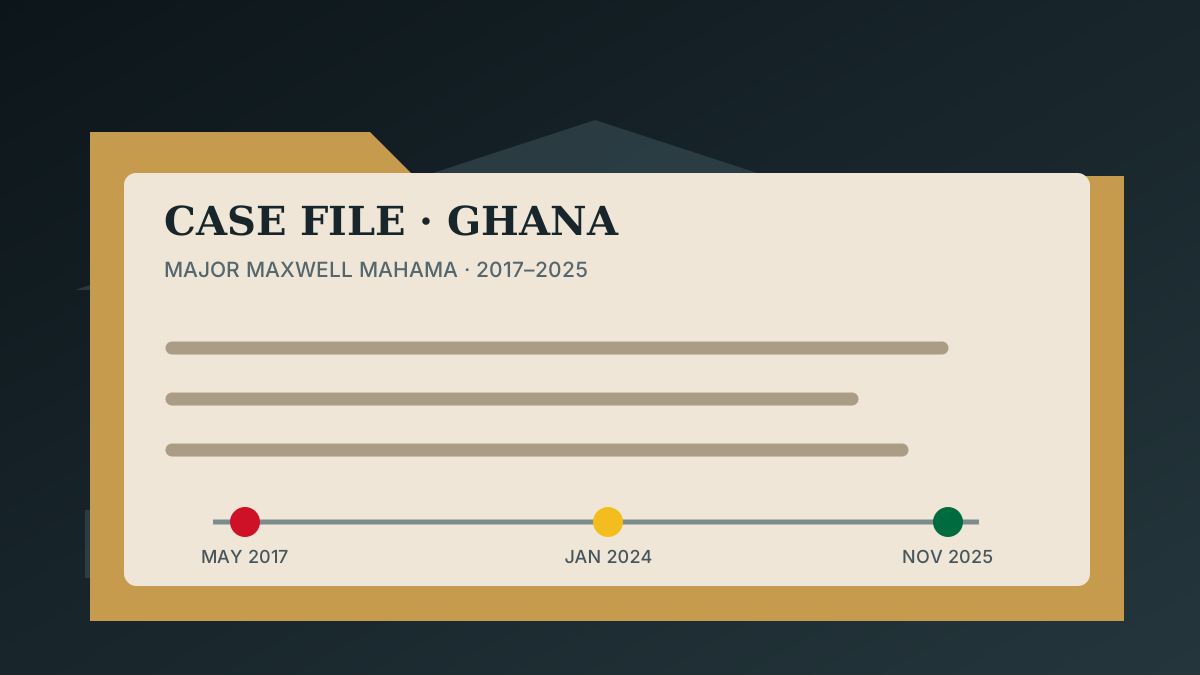
Case-status note: “Solved / adjudicated” reflects verified convictions for the killing. It does not mean every original verdict remains intact. Baah's conviction was overturned, two defendants were acquitted at trial, and the public record reviewed does not establish the final result of every appeal that had been announced.
Who was Major Maxwell Mahama?
Major Maxwell Adam Mahama was an officer of the Ghana Armed Forces. At the time of his death, official and court reporting described him as commander of a military detachment stationed at Diaso in the Central Region. The unit had been deployed in connection with efforts to check illegal mining, commonly called galamsey in Ghana.
Many contemporary reports first called him Captain Mahama. Later coverage commonly used Major Mahama after his posthumous promotion. Some indexed court materials render his middle name as “Adom,” while Ghana News Agency and Graphic Online reports use “Adam.” This page follows the latter form but connects both spellings for entity clarity.
The case became a national reference point in Ghana's debate over mob violence and “instant justice.” Its importance does not rest on the disturbing recordings that circulated after the killing; this account avoids reproducing graphic imagery and focuses on the documented sequence, evidence and judicial results.
The morning of May 29, 2017
The preliminary account released by Ghana's Criminal Investigation Department said Mahama left his detachment base at about 8:00 a.m. for a 20-kilometre walk or jog. He wore civilian clothes and carried his service sidearm. The route took him toward Denkyira Obuasi.
At the outskirts of the community, he stopped where women were selling food by the roadside and bought snails, leaving them to collect on his return. When he took out money, sellers saw the sidearm at his waist. The official account said one seller then contacted the local assembly member, William Baah, to report what had been seen.
The critical fact is that Mahama was not established to be a robber. A suspicion based on the visible weapon became a false identification. Reporting based on the police account said the message spread before his identity was verified and people gathered to confront him.
The attack near Denkyira Obuasi
According to the prosecution narrative later summarized by the courts and Ghanaian newsrooms, the group encountered Mahama near the Denkyira Obuasi cemetery. He was attacked while trying to explain who he was and escape. The official timeline placed his death at about 10:00 a.m.
This archive does not reproduce the graphic details or images. What matters legally is that investigators treated the death as a homicide committed by a group and sought to identify the conduct attributable to individual participants. That distinction became central over the years: presence, association, encouragement, conspiracy and direct participation are not interchangeable findings.
Police initially made multiple arrests as teams examined video, witness accounts and other evidence. The number of people arrested or investigated was not the same as the number ultimately tried or convicted. Early arrest figures therefore should not be read as final findings of guilt.
Investigation and public response
The Ghana Police Service said its investigation aimed to identify each person whose actions caused the death, determine what that person did and connect those actions to the killing and the required intent. The official framing is significant because a group crime still requires evidence against individuals.
The killing brought widespread condemnation. Ghana's Parliament archived a June 2017 statement on Mahama's murder, and public discussion focused on the danger of punishing a suspected person without investigation or trial. The case also prompted calls for civic education against mob justice.
That response should not replace the evidentiary record. Public outrage can explain why a case mattered nationally, but it cannot establish a defendant's guilt. The 2025 appeal would underscore this boundary when one conviction was found unsafe.
The long High Court trial
Fourteen defendants ultimately stood trial in the Accra High Court. Ghana News Agency reported that the prosecution called 14 witnesses and presented multiple items of evidence. After the prosecution case, the court rejected a 2022 submission that there was no case to answer and directed the defendants to present their defences. That ruling was procedural: it meant the trial would continue, not that guilt had already been decided.
On January 29, 2024, a seven-member jury returned unanimous verdicts. Twelve defendants were found guilty on charges that included murder, conspiracy to commit murder and abetment of murder. The court imposed life sentences. Two defendants, Bismarck Donkor and Bismarck Abanga, were acquitted and discharged.
Graphic Online's detailed verdict report distinguished the counts. William Baah was convicted of abetment. Eleven others were convicted of conspiracy, and eight of those defendants were also found guilty of murder. This count-by-count distinction matters because the later appeal concerned Baah's separate abetment conviction, not a blanket reversal of the entire trial.
William Baah's November 2025 acquittal
Baah appealed his conviction and life sentence. On November 20, 2025, a three-judge panel of Ghana's Court of Appeal unanimously quashed the abetment conviction and entered a verdict of not guilty. Ghana News Agency, Graphic Online and the indexed appellate record identify the decision as William Baah @ Misty & 13 Others v. The Republic, suit number H2/32/24.
The appellate court found that the trial judge had gravely misdirected the jury. The reports explain that caution statements from two co-accused, which implicated Baah, could not properly be used against him in the way they had been. The court also found inconsistencies in that material and no evidence establishing that Baah intentionally abetted the crime.
That ruling changes Baah's status completely: he is not a convicted participant in the current record. It is inaccurate to say “all 12 were convicted” without adding that one of those convictions was later set aside. It is equally inaccurate to imply that Baah's acquittal erased the murder and conspiracy convictions entered against other defendants.
What remains after the appeal?
The reliable public record reviewed for this page supports several carefully separated conclusions. Mahama's killing is established. The 2024 High Court verdicts produced convictions against 12 defendants and acquittals for two. The 2025 Court of Appeal decision removed Baah from the convicted group. Ghana News Agency described the 11 other defendants as having faced murder and conspiracy charges, and no source reviewed reported that the same appellate judgment overturned their verdicts.
However, counsel for three convicted defendants announced in January 2024 that appeals would be pursued. This archive did not locate reliable published decisions resolving those announced appeals through September 11, 2026. It therefore reports the convictions found in the public record while avoiding the stronger claim that every appellate route is exhausted.
The distinction is not technical clutter. It is the difference between a historical headline and a current case status. A responsible case file must record acquittals with the same clarity as convictions and leave an appeal “not located” rather than guessing its outcome.
Established facts, allegations and adjudicated outcomes
- Established: Major Maxwell Adam Mahama was killed near Denkyira Obuasi on May 29, 2017.
- Established from the official account: he was jogging in civilian clothes with a sidearm when a mistaken armed-robber report spread.
- Prosecution case: prosecutors alleged that members of the group pursued and attacked him after the report. Those allegations were assessed defendant by defendant at trial.
- Adjudicated in January 2024: 12 defendants were convicted and sentenced to life imprisonment; two were acquitted.
- Corrected in November 2025: the Court of Appeal quashed William Baah's abetment conviction and entered a not-guilty verdict.
- Still bounded: the reviewed sources do not establish the final result of every appeal announced by other convicted defendants.
The case is classified as “Solved / adjudicated” because convictions for murder and conspiracy remain documented. The qualifier is necessary because one trial conviction was overturned and the public record does not support a claim of total procedural finality.
Source and status methodology
The event timeline was checked against the preliminary Criminal Investigation Department account reproduced by Graphic Online and MyJoyOnline in June 2017. The account identifies Mahama's assignment, route, the mistaken report and the investigative purpose. Contemporary statements are used for the early timeline, not as substitutes for later verdicts.
The January 2024 outcome was cross-checked through Ghana News Agency and Graphic Online. Their reports identify the jury verdict, life sentences, two trial acquittals and the different charge categories. The November 2025 appellate result was checked through Ghana News Agency, Graphic Online and the DennisLaw index of the Court of Appeal judgment.
Where reports differ in spelling or compress multiple counts, this page uses the most conservative shared facts. It does not list every alleged participant, describe an arrested person as guilty, or treat the prosecution narrative as a judgment. The source record was reviewed through September 11, 2026.
Frequently asked questions
Who was Major Maxwell Mahama?
He was a Ghana Armed Forces officer commanding a military detachment at Diaso in the Central Region.
Why was he mistaken for an armed robber?
The official investigative account said roadside sellers saw his sidearm while he was jogging in civilian clothes. A report then spread before his identity was verified.
How many defendants were convicted at trial?
Twelve defendants were convicted in January 2024 and received life sentences. Two other defendants were acquitted.
Was William Baah convicted?
He was convicted of abetment at trial, but the Court of Appeal quashed that conviction on November 20, 2025 and entered a not-guilty verdict. His current status in the reviewed record is acquitted.
Did Baah's acquittal overturn every conviction?
No. The appellate judgment concerned Baah's conviction. The reviewed sources do not report that it overturned the verdicts against the other convicted defendants.
Is every appeal finished?
The public record reviewed does not establish that. Appeals by other convicted defendants had been announced, but reliable published decisions resolving each one were not located through September 11, 2026.