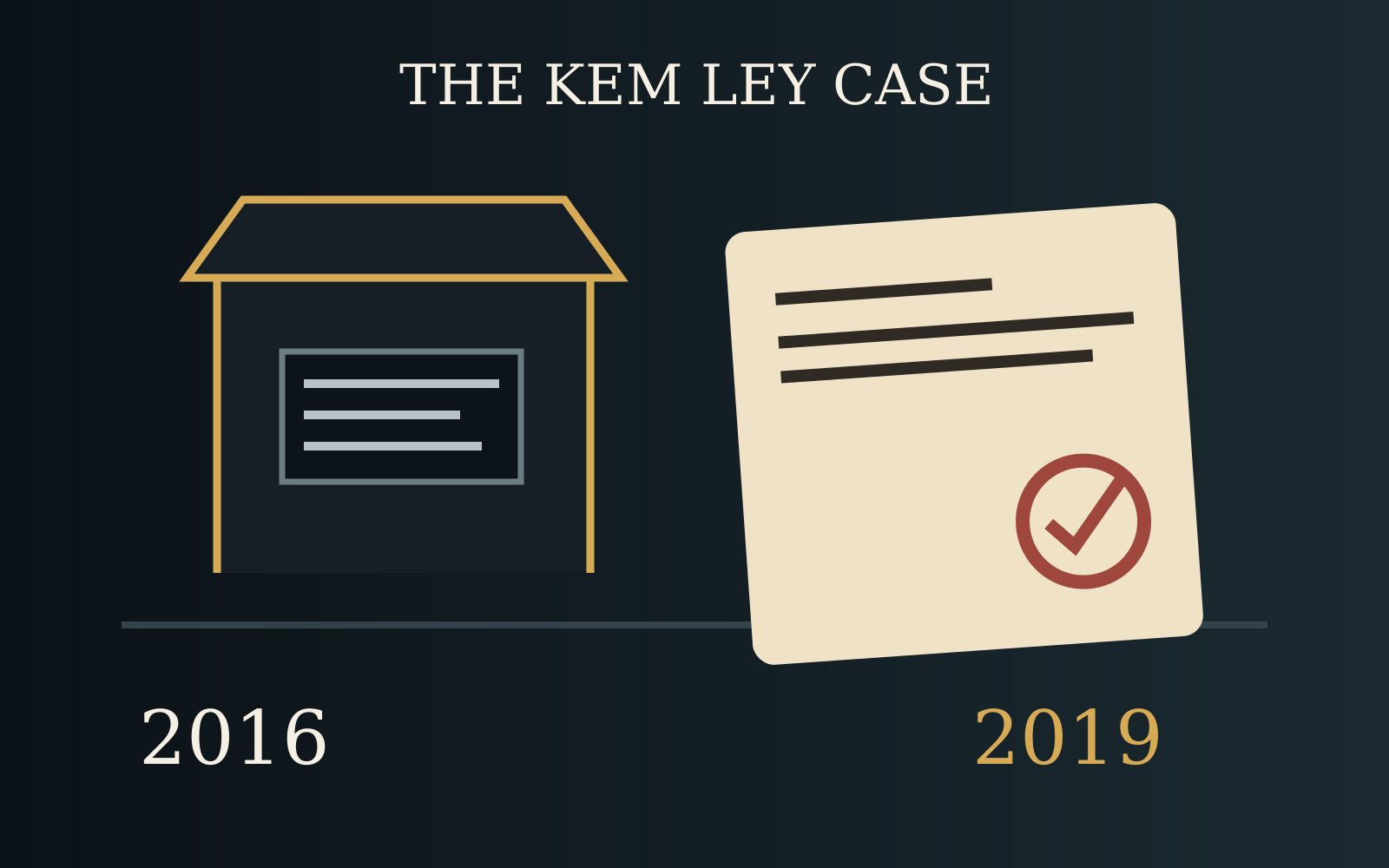
Case-status note: Oeuth Ang was convicted of the shooting and his life sentence was upheld. That judgment does not establish that he acted alone or prove allegations about organizers. Wider responsibility remains unresolved.
What happened to Kem Ley?
On the morning of July 10, 2016, Kem Ley was having coffee inside the convenience store of a Caltex petrol station on Monivong Boulevard in central Phnom Penh. A man entered and shot him. Kem Ley died at the scene, and the attacker fled before being detained nearby.
Kem Ley was a widely known political commentator, researcher and human-rights defender. His death caused large public mourning and immediate demands for a credible investigation. United Nations experts condemned the killing and called for a prompt, impartial and transparent inquiry.
Police identified the arrested man as Oeuth Ang. He gave the name “Choub Samlab,” commonly translated as “Meet to Kill,” and claimed that he shot Kem Ley over an unpaid debt. Reporting and later rights-group assessments questioned that account. The debt claim was part of the defendant's narrative; it was not independently established as the complete motive.
The victim and the public context
Kem Ley regularly discussed politics, governance and social conditions in Cambodian media. His visibility made the daylight killing a matter of national importance, but visibility alone does not prove why he was targeted or who, beyond the convicted gunman, may have been responsible.
The killing occurred amid concerns about pressure on political opposition, civil society and human-rights defenders. Those circumstances are relevant context, not proof that any specific official or organization ordered the crime. No final judgment reviewed for this dossier established such a chain of command.
Human-rights organizations have also documented fear and pressure surrounding later public calls for accountability. This page records those concerns without presenting political suspicion as a criminal verdict.
Arrest and the stated motive
Oeuth Ang was apprehended shortly after the shooting. Authorities treated him as the direct attacker. He acknowledged the killing and said the dispute involved money, but monitors highlighted inconsistencies about whether he and Kem Ley had known one another and whether the alleged loan existed.
The gunman's confession and rapid arrest answered one question—who physically carried out the shooting according to the prosecution and judgment—but did not automatically resolve planning, procurement of the weapon, assistance before or after the crime, or motive.
Rights groups reported that investigators had referred to other people connected to the account, including individuals known only by names or aliases. No reliable final conviction of an accomplice was located through September 15, 2026.
The 2017 trial and conviction
On March 23, 2017, the Phnom Penh Municipal Court convicted Oeuth Ang of the premeditated murder of Kem Ley and an unlawful weapons offense. He received life imprisonment. The hearing lasted only part of a day, a point repeatedly cited by Amnesty International, Human Rights Watch and the International Commission of Jurists when questioning the investigation's depth.
The conviction is a standing judicial result and must not be minimized. At the same time, a conviction of the direct gunman is not evidence that every possible participant was identified. The archive therefore classifies the case as solved in part rather than wholly resolved.
Independent observers listed investigative gaps involving the defendant's background, the debt story, possible assistance, communications and other circumstances. Their criticism is an assessment of the process; it is not itself proof of a hidden organizer.
The Supreme Court decision
On May 24, 2019, Cambodia's Supreme Court rejected Oeuth Ang's request for a reduced sentence and upheld life imprisonment. That decision left his conviction intact.
The appeal outcome settled the punishment imposed on Oeuth Ang, but it did not provide a public judicial answer to the wider questions raised by monitors. Civil-society organizations continued to request an independent and effective inquiry after the Supreme Court ruling.
No source reviewed reported that the Supreme Court judgment convicted another person, validated a broader political theory or established that the stated debt was the complete motive.
What remains unresolved
Human Rights Watch, Amnesty International and the ICJ have maintained that the authorities did not conduct an effective investigation into whether anyone else participated. Their joint statements emphasize possible accomplices, planning and motive rather than disputing that Oeuth Ang was convicted as the gunman.
Some public allegations attribute the assassination to political actors. Those allegations remain unproved in the criminal record reviewed here. Repeating them as fact would collapse the necessary distinction between suspicion, advocacy and adjudication.
The defensible conclusion is narrower: Kem Ley was deliberately killed; Oeuth Ang was convicted and his life sentence upheld; and no transparent, final process has established whether there were organizers or additional participants.
Current status
The case is classified solved / partial. There is a standing conviction for the direct killing, but wider responsibility and motive remain unresolved.
No later final conviction of an accomplice was located in reliable sources reviewed through September 15, 2026. Calls for an independent inquiry therefore remain relevant to the historical record.
This classification respects both parts of the evidence: the court's judgment against Oeuth Ang and the documented limits of an investigation that did not publicly answer substantial questions about the broader crime.
Questions that remain
Did Oeuth Ang plan the assassination alone? Was the alleged debt real? Who supplied information, transport or the weapon? Were other named or unnamed persons meaningfully investigated? What motive can be demonstrated through admissible evidence?
Without a further credible investigation or judgment, those questions cannot be converted into conclusions. The archive records the uncertainty instead of filling it with speculation.
Frequently asked questions
Who was Kem Ley?
Kem Ley was a Cambodian political commentator, researcher and human-rights defender known for public analysis of governance and social issues.
When and where was Kem Ley killed?
He was shot while having morning coffee at a petrol-station convenience store on Monivong Boulevard in Phnom Penh on July 10, 2016.
Who was convicted?
Oeuth Ang, who also identified himself as Choub Samlab, was convicted of premeditated murder and sentenced to life imprisonment in March 2017.
Was the sentence upheld?
Yes. Cambodia's Supreme Court upheld Oeuth Ang's life sentence on May 24, 2019.
Is the wider case fully solved?
No. One gunman was convicted, but independent monitors say possible accomplices, planning and motive were not effectively investigated.
What is the archive status?
Solved in part: the convicted gunman's responsibility was adjudicated, while any wider responsibility remains unresolved.