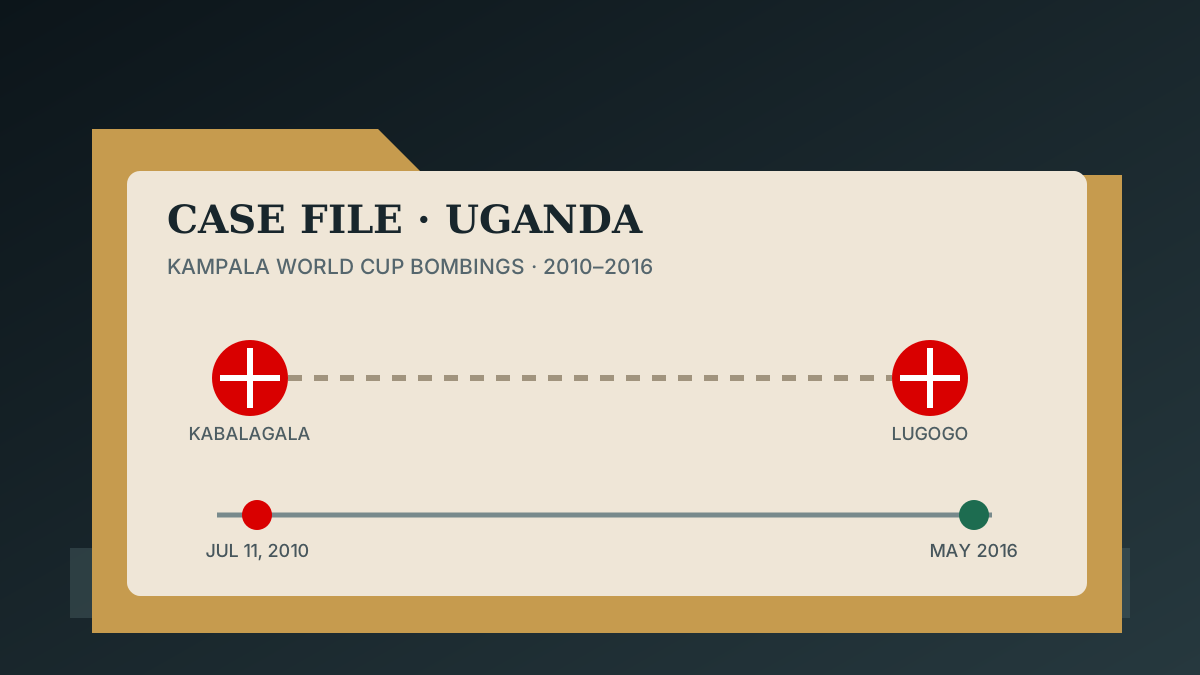
Case-status note: “Solved / adjudicated” records verified convictions. It does not turn the five acquittals into guilt, erase concerns about the treatment of some suspects, or imply that a final ruling was found for the appeal announced in June 2016.
Two public screenings in Kampala
The attacks took place late on Sunday, July 11, 2010, as the Netherlands and Spain played the World Cup final in South Africa. Both targets were social venues where large crowds had gathered around televised coverage: the Ethiopian Village restaurant in Kabalagala and Kyadondo Rugby Club in Lugogo. A contemporaneous FBI notice placed the first blast at roughly 10:30 p.m. and the later attack at the rugby club at about 11:20 p.m.
The Uganda Judiciary's summary of the eventual judgment said 76 people were killed. Reuters used the same figure in its sentencing report. The Institute for Security Studies later wrote that 74 people died and 70 were injured. Counts can differ because institutions use different inclusion rules or later records; the available sources reviewed here do not resolve the discrepancy. For consistency with the criminal judgment, this file uses 76 when describing the court record and attributes the lower institutional figure when discussing the source variance.
The victims were Ugandans and foreign nationals who had gathered for an ordinary public event. The archive does not reproduce graphic photographs, casualty imagery or spectacle from the venues. The evidentiary and judicial sequence is sufficient to understand why the case mattered.
Claim of responsibility and investigative frame
Al-Shabaab claimed responsibility after the bombings. The group linked the attack to Uganda's military role in the African Union Mission in Somalia. That public claim is distinct from the criminal question of which individuals could be proved to have planned, supplied or supported the attacks.
Ugandan police worked with regional and international counterparts. The FBI issued a public request for help identifying suspects eight days after the attack. Arrests followed in Uganda and neighboring Kenya, but the early sweep was broader than the group ultimately tried and convicted. Charges were dropped against some people, and later proceedings tested individual evidence rather than assigning collective guilt.
Human Rights Watch documented serious concerns about unlawful transfers from Kenya, prolonged detention and the case brought against Kenyan rights defender Al-Amin Kimathi. A Ugandan court discharged Kimathi and four other defendants in September 2011. Those facts belong in the record because a credible archive must distinguish the successful prosecution of some defendants from failed or contested cases against others.
The High Court trial
The principal trial proceeded in the International Crimes Division of Uganda's High Court. Thirteen men stood trial. On May 26, 2016, Justice Alphonse Owiny-Dollo delivered the judgment. The Uganda Judiciary summarized the court's conclusion that the prosecution had proved a coordinated operation involving planning, surveillance, movement and assembly of explosives, and support for their detonation at crowded venues.
The court's result was not a blanket conviction. Seven defendants—Issa Ahmed Luyima, Hussein Hassan Agade, Idris Magondu, Hassan Haruna Luyima, Mohammed Ali Mohammed, Habib Njoroge Seleman and Hijjar Nyamandondo—were convicted of the core terrorism, murder and attempted-murder offences described in the judgment. Muzafalu Luyima was convicted as an accessory rather than as one of the seven principal offenders.
Five other defendants were acquitted. The Judiciary's official summary said the record contained no evidence tying them to the Kampala bombings. This distinction matters: an arrest, a charge and even years of pretrial detention do not establish guilt. The acquittals are part of the case outcome, not a footnote to be omitted.
Sentences imposed in May 2016
On May 27, 2016, the High Court sentenced five of the principal defendants to life imprisonment. Reuters identified them as Issa Ahmed Luyima, Hussein Hassan Agade, Idris Magondu, Habib Suleiman Njoroge and Mohammed Ali Mohammed. Hassan Haruna Luyima and Selemani Hijar Nyamandondo received 50-year prison terms.
Muzafalu Luyima received one year of community service for his accessory conviction. Reuters reported that the court accounted for the period he had already spent on remand, which exceeded the custodial term associated with that offence.
The sentence structure is why a one-line description such as “eight bombers received life” would be inaccurate. Seven principal defendants received two different categories of long prison sentence; the eighth conviction concerned accessory liability and a noncustodial order. Five co-defendants were acquitted.
The reported appeal—and what is not established
Daily Monitor reported that the seven principal convicts filed a notice of intention to appeal on June 1, 2016. The article said they challenged both the convictions and sentences as harsh and excessive. That filing proves an appellate process was initiated; it does not by itself show whether the appeal was heard, withdrawn, dismissed or allowed.
The source review completed on September 12, 2026 did not locate a reliable public judgment resolving that appeal. This page therefore treats the 2016 High Court convictions and sentences as the latest verified judicial outcomes found, while explicitly flagging the announced appeal. If a later appellate judgment becomes available, the status and sentence summary should be updated.
Why the case remains significant
The bombings were the deadliest attack then carried out by al-Shabaab outside Somalia and placed civilian sports gatherings within the regional security conflict. For Uganda, the case also tested the capacity of a domestic court to manage a multi-defendant terrorism prosecution while confronting allegations of rendition, coercion and overbroad arrest practices.
The judgment produced substantial convictions, but the wider record resists a simple victory narrative. Families received judicial findings against seven principal defendants, yet other accused people were cleared after lengthy proceedings. Rights groups documented procedural failures. The source record located for this review still does not provide a final public appellate endpoint.
Frequently asked questions
When and where did the bombings happen?
On July 11, 2010 at the Ethiopian Village restaurant in Kabalagala and Kyadondo Rugby Club in Lugogo, Kampala, during the FIFA World Cup final.
How many people were killed?
The Uganda Judiciary and Reuters reported 76 deaths. The Institute for Security Studies reported 74. This page preserves and attributes the discrepancy.
Who claimed responsibility?
Al-Shabaab claimed responsibility and linked the attack to Uganda's role in the African Union mission in Somalia.
What was the 2016 verdict?
Seven defendants were convicted of the core offences, an eighth was convicted as an accessory, and five defendants were acquitted.
What sentences were imposed?
Five principal defendants received life sentences, two received 50-year terms, and the accessory conviction resulted in community service after time on remand was considered.
Was the case appealed?
A notice of appeal was filed in June 2016. No reliable public final ruling on that appeal was located in the September 12, 2026 review.