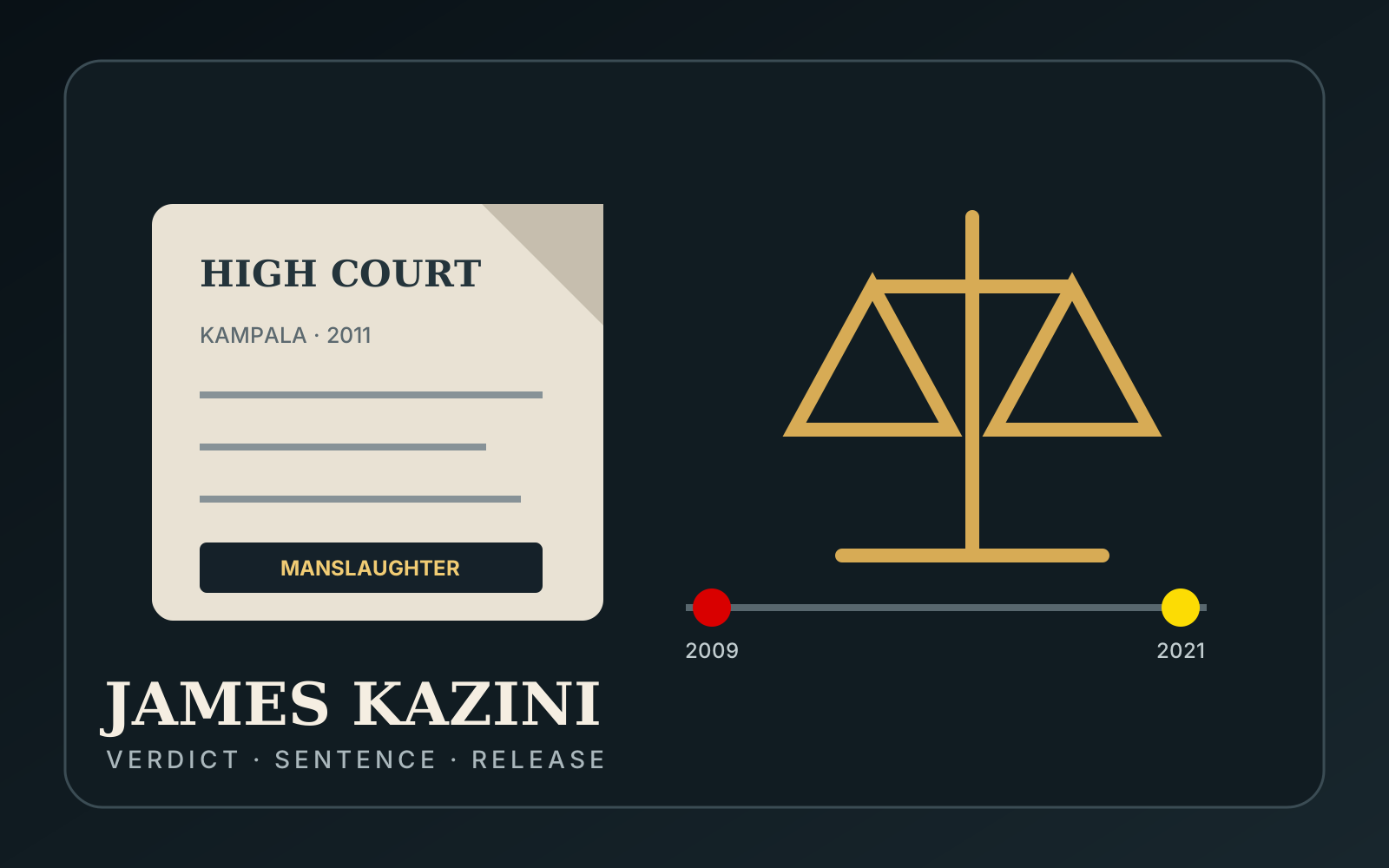
Legal-status note: Lydia Draru was not convicted of murder. The High Court found that the prosecution failed to prove malice aforethought beyond reasonable doubt, acquitted her on the murder charge and convicted her of manslaughter.
James Kazini
James Kazini was a retired major general who had served as commander of the Uganda People's Defence Force. His military career and earlier legal controversies made his death national news, but they do not alter the evidentiary question in the homicide case: what happened inside a private home on the morning of November 10, 2009, and what mental state did the evidence prove?
The court judgment treated Kazini as a victim whose death had to be established like any other. The judge expressly rejected the idea that his public rank made his life more valuable than another person's. That principle is central to a victim-aware account: public status provides context, not a different standard of justice.
November 10, 2009
Kazini died at Draru's rented home in Wabigalo, in Kampala's Makindye Division. The prosecution alleged that she struck him repeatedly with an iron bar. Draru immediately accepted that she had caused his death but disputed an intention to kill.
She was arrested and initially charged with murder. At trial, she offered to plead guilty to manslaughter; the prosecution maintained the murder indictment. The court therefore had to decide whether the evidence proved the additional element of malice aforethought required for murder.
Admissions and forensic evidence
The High Court considered Draru's admissions, witness evidence, medical findings and the circumstances before and after the violence. It found beyond reasonable doubt that Kazini died from unlawful force inflicted by Draru.
The number and severity of the blows mattered to whether the force was justified. The judgment did not accept full self-defence as an answer to the killing. At the same time, proof that Draru caused the death did not automatically resolve whether she acted with the intent legally necessary for murder.
The defence account
Draru said an argument escalated and that Kazini assaulted and threatened her. The defence relied on self-defence and the emotional circumstances surrounding the confrontation. Reporting on the judgment states that a firearm was recovered from Kazini's vehicle rather than from inside the immediate struggle.
The court assessed these claims against proportionality and intent. It concluded that the force used was not justified as self-defence, yet found the evidence consistent with anger and loss of control rather than a deliberate intention to kill proved beyond reasonable doubt.
Murder acquittal, manslaughter conviction
On August 31, 2011, Justice Monica Mugenyi held that malice aforethought had not been proved. She departed from the opinion of the court assessors, acquitted Draru of murder and convicted her of manslaughter.
This was not an acquittal of responsibility for the death. It was a conviction for a different homicide offense based on the mental state the judge found proven. Describing the outcome simply as “murder conviction” would erase the court's central legal finding and is therefore avoided throughout this file.
Fourteen years' imprisonment
On September 1, 2011, the High Court sentenced Draru to 14 years' imprisonment. The judge considered her remorse, age and time already spent on remand. Daily Monitor reported that she had been held for almost two years before sentence.
Kazini's relatives welcomed the fact that the case had reached judgment while emphasizing that a sentence could not restore the person they had lost. Their response is part of the documented aftermath, distinct from the prosecution's position on the legal sufficiency of the sentence.
The state's appeal
Later that month, Uganda Radio Network reported that the Director of Public Prosecutions appealed both the murder acquittal and the 14-year sentence. The prosecution considered the sentence too lenient and disputed the judge's rejection of murder.
No reliable public final appellate judgment was located in the review completed September 13, 2026. The archive therefore records that an appeal was filed but does not invent its disposition. The High Court outcome remains the latest fully documented merits judgment available to this page.
Release in 2021
Ugandan reporting states that Draru was released from prison on January 12, 2021. A Uganda Prisons spokesperson told New Vision that remission for good conduct accounted for the portion of the nominal term she did not spend in custody.
Release after remission does not cancel the conviction or rewrite the sentence. It describes how the custodial term was administered. This page keeps the original 14-year sentence, pre-sentence remand and later remission conceptually separate.
Current status
The case is classified as solved or adjudicated: the person who caused Kazini's death was identified, tried and convicted of manslaughter. She served a custodial term and was released in 2021.
The public record remains incomplete as to the state's appeal. If a reliable appellate decision is published, the case should be updated. Until then, the High Court's distinction between murder and manslaughter is the controlling documented outcome in this archive.
Why the case remains important
The case demonstrates why criminal labels cannot be selected for dramatic effect. A death, an admission and a severe assault did not relieve the prosecution of proving the mental element of murder. The judge found unlawful killing but not malice aforethought beyond reasonable doubt.
Precise language protects everyone represented in the record. It acknowledges James Kazini as the person killed, identifies Lydia Draru as the person convicted, and preserves the exact offense rather than upgrading manslaughter into murder for a stronger headline.
Frequently asked questions
Who was James Kazini?
He was a retired major general and former commander of the Uganda People's Defence Force.
When was he killed?
He was killed at Lydia Draru's home in Wabigalo, Kampala, on November 10, 2009.
Was Lydia Draru convicted of murder?
No. The High Court acquitted her of murder because malice aforethought was not proved beyond reasonable doubt, but convicted her of manslaughter.
What sentence did she receive?
She received 14 years' imprisonment on September 1, 2011, with time already spent on remand taken into account.
When was she released?
Ugandan reporting states that she was released on January 12, 2021 after remission for good conduct.