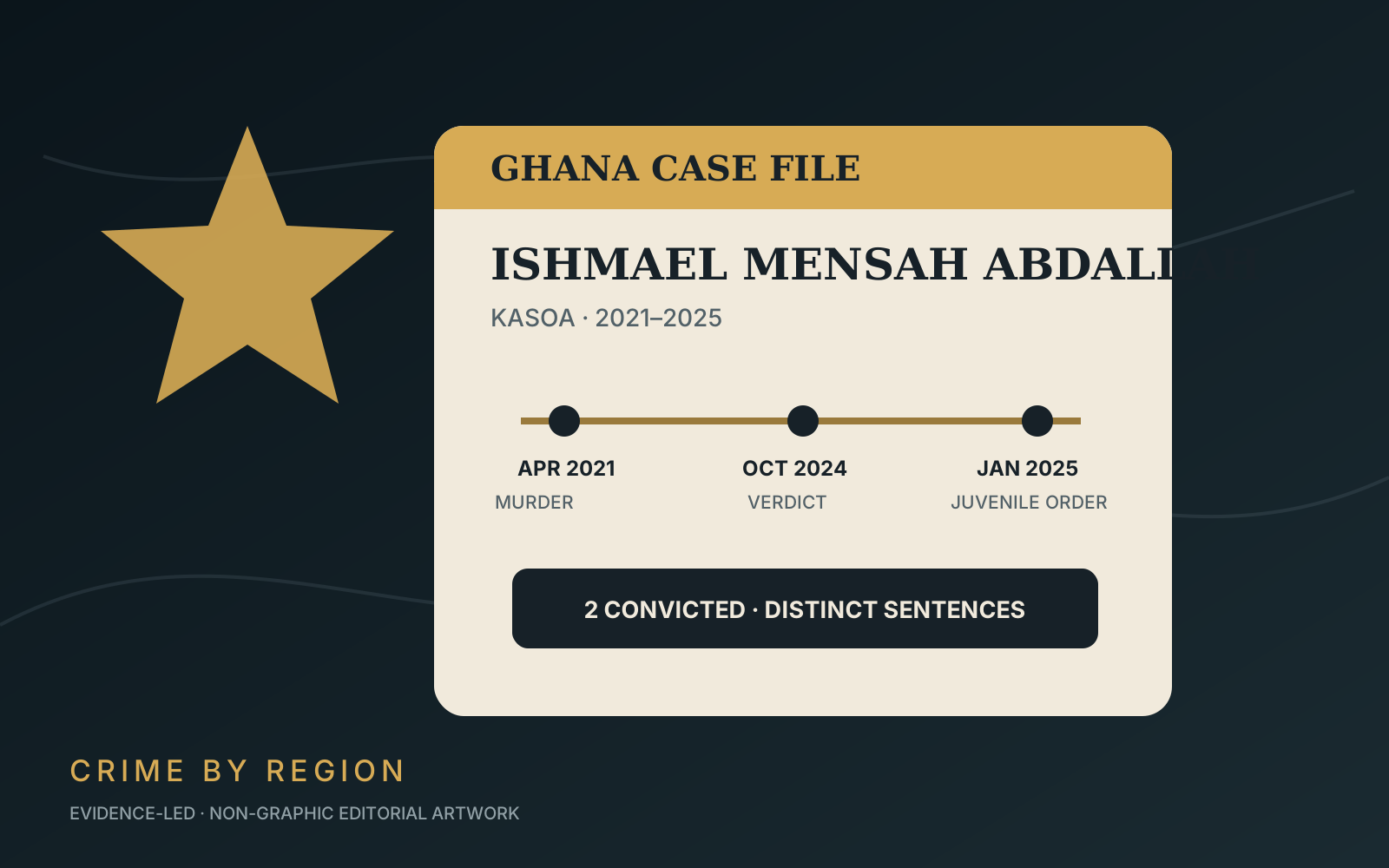
Victim and status note: Ishmael was a child, and this file avoids graphic detail. The second defendant is not named because he was a juvenile when the offence occurred. “Solved / adjudicated” reflects convictions, while the adult and juvenile sentences are recorded under their different legal frameworks.
Ishmael and the Kasoa community
Ishmael Mensah Abdallah lived in the Kasoa area and was ten years old. On April 3, 2021, he encountered two boys he knew in the neighborhood. The prosecution later argued that they drew him toward an unfinished building near their homes.
The killing generated national attention because all three children or young people were from the same community and because early reporting associated the crime with promises of rapid wealth. Responsible coverage must not let that label eclipse Ishmael's identity or turn a child's death into folklore.
April 3, 2021
The prosecution case was that the two defendants planned to kill a person after seeking instructions connected to an alleged money ritual. Ishmael was lured into the building and killed. His body was concealed before the crime was discovered.
This page omits the physical detail repeated in some reports. The essential facts are that Ishmael was deliberately attacked, that efforts were made to hide what had happened, and that the two defendants were arrested soon afterward.
Police and court reports initially described Ishmael as ten or eleven. Later Ghanaian court coverage consistently used ten. The discrepancy reflects ordinary age reporting in the first hours of a case, not uncertainty about the victim's identity.
What the “ritual” label means
News coverage widely called the event the Kasoa ritual murder. Prosecutors said the defendants had encountered claims that a killing could lead to money. That is a description of the alleged motive and belief presented in court; it does not validate supernatural claims or establish that any promised ritual had real power.
The label also created intense public discussion about sensational media, online content, poverty and children's exposure to schemes promising wealth. Those debates provide context, but they do not replace the criminal evidence against the two defendants.
No spiritual practitioner was convicted in the completed trial described here. The page therefore does not assign criminal responsibility to unnamed television figures, religious workers or online personalities based only on public suspicion.
Why juvenile procedure mattered
Both defendants were initially treated as minors. Their ages and legal capacity determined which court could hear the case and what punishments were available. Proceedings were adjusted after age assessment showed that Nicholas Kini could be tried under the adult framework while the second defendant remained subject to juvenile protections.
Ghana News Agency reported in 2022 that the case would not proceed as an ordinary joint jury trial because a juvenile cannot be tried in the same manner as an adult. The later process nevertheless produced a High Court verdict before the younger defendant's sentencing was transferred to the Juvenile Court.
Protecting a juvenile's identity is not a concession about guilt. It is a legal and editorial safeguard designed to recognize age, rehabilitation and the distinct rules governing children in conflict with the law.
Evidence and the High Court trial
The prosecution presented witness testimony and circumstantial evidence about planning, the defendants' presence, the scene and their actions after the killing. The defense contested responsibility. A jury was required to decide whether the prosecution had proved murder beyond reasonable doubt.
Early arrest reports and remand orders did not establish guilt. This archive dates the adjudicated status to the verdict, not to the public reaction in April 2021. The distinction is especially important in a case involving young defendants and intense media coverage.
Two convictions in October 2024
In October 2024, the High Court jury returned guilty verdicts against Nicholas Kini and the juvenile defendant. Kini, by then treated as an adult for sentencing, received life imprisonment.
The High Court deferred the juvenile's sentence because the Juvenile Justice Act required the appropriate juvenile court to impose a disposition within the limits applicable to a person who was a child when the offence occurred.
The convictions establish the responsibility of the two people tried. They do not prove every claim made during the national debate or authorize punishment of others who were never defendants.
The juvenile sentence in January 2025
On January 21, 2025, the Juvenile Court sentenced the younger defendant to twelve months at a correctional centre. Reports noted that time already spent in custody and the statutory limits for juvenile punishment shaped the outcome.
Some October 2024 reports summarized the expected juvenile consequence as up to three years or referred loosely to a three-year term before the separate sentencing hearing. The January 2025 report provides the later, specific disposition: twelve months. This page uses the later verified sentence and preserves the reason earlier accounts differed.
Comparing the life term and the juvenile sentence without the legal context can mislead readers. They arose from the same verdict but from different age classifications and statutory sentencing systems.
Current case status
No reliable published appellate decision overturning either conviction was located in the review completed on September 12, 2026. The file therefore records the High Court convictions, Kini's life sentence and the Juvenile Court's twelve-month order as the latest verified outcomes.
Completion of the juvenile disposition does not undo the conviction. Similarly, a life sentence is a judicial penalty, not proof that every factual question or social factor behind the crime has been resolved.
Questions beyond the judgments
The court process answered the central question of criminal responsibility for the two defendants. Public sources provide less complete information about how the alleged scheme reached them, whether other adults knowingly encouraged a crime, and what prevention measures were adopted after the national debate.
Those issues should not be filled with rumor. Future reporting should distinguish new evidence or charges from political commentary and should continue protecting the victim's dignity and the juvenile defendant's identity.
Frequently asked questions
Who was Ishmael Mensah Abdallah?
He was a ten-year-old boy killed in Kasoa on April 3, 2021.
Why was the case called a ritual murder?
Prosecutors said the defendants pursued a supposed money-making ritual. The term describes the alleged motive, not proof of supernatural power.
Who was convicted?
Nicholas Kini and a second defendant who was a juvenile at the time of the offence were convicted in October 2024.
What sentence did Kini receive?
He received life imprisonment.
What happened to the juvenile defendant?
A Juvenile Court imposed twelve months at a correctional centre in January 2025. His name is withheld here.