What is the current status of the case?
Direct answer: the assassination remains unsolved as a criminal case. Maïnassara was killed at Niamey’s military airfield on 9 April 1999, and the contemporary record identified the death as an assassination during the coup. Yet the reliable sources reviewed for this archive do not record a criminal prosecution or conviction of any person for carrying out or ordering the killing.
A major judicial ruling did follow. On 23 October 2015, the ECOWAS Community Court of Justice held that Niger violated the family’s right of access to justice and Maïnassara’s right to life. It ordered the state to pay a total of 435 million CFA francs to his widow, five children and eleven siblings. That was a human-rights judgment against the state, not a murder trial of individual defendants.
The distinction controls this archive’s label. A court can establish that a state failed to protect life or provide an effective remedy without determining each participant’s criminal guilt beyond a reasonable doubt. Because the fatal attack has not produced individual criminal convictions, this file is classified unsolved.
Political context before 9 April 1999
Maïnassara, a career military officer, took power in a January 1996 coup and later won a disputed presidential election. Those facts form the political setting; they do not reduce the state’s obligation to protect life or the family’s right to a genuine investigation.
By April 1999, political tension had intensified. On the morning of 9 April, Maïnassara went to the military airfield in Niamey for an official journey to the interior. The ECOWAS case record says he was passing the honour guard and preparing to return to his helicopter when gunfire struck him.
Amnesty International’s research and the later court record describe the killing as part of the coup that removed his government. Three other people accompanying him were also killed, according to Amnesty’s 2000 report and the facts recounted in the ECOWAS proceedings. This page centers the judicially documented case concerning Maïnassara while acknowledging those additional deaths without assigning unproved individual responsibility.
The killing at the Niamey military airfield
The family’s account before the ECOWAS Court stated that shots came from a pickup truck fitted with a heavy machine gun. The judgment reproduced witness material gathered by Amnesty International, including the allegation that firing resumed after soldiers said Maïnassara was still alive. These were evidentiary assertions presented in the regional case; the judgment was not a criminal verdict against named individuals.
Within hours, the prime minister announced on radio that the president had died in an “unfortunate accident.” Power shifted to a military council led by the head of the presidential guard. Amnesty International rejected the accident account and documented consistent testimony that Maïnassara had been deliberately shot.
Care is needed when describing perpetrators. Contemporary institutional reporting attributes the assassination broadly to members of the security or presidential guard during the coup. No individual was convicted in a criminal trial. This archive therefore reports the institutional record without turning allegations about named people into findings of guilt.
A brief inquiry and missing investigative steps
Maïnassara’s family filed a complaint against unnamed persons on 27 May 1999. A gendarmerie report followed in August. The family argued that, despite the time formally allowed, core inquiry work was carried out in only a few days and failed to test basic evidence.
The ECOWAS judgment records the family’s criticism that investigators did not secure television footage of the events, examine the bullet-damaged presidential vehicle or interview several central witnesses. Those included members of the close guard, the helicopter crew, the doctor who issued the death certificate and military officials. Amnesty International separately described the inquiry as rushed and inadequate.
The court did not itself reconstruct every shot or identify each participant. Its focus was whether the state respected the family’s rights after the killing. The thin domestic record mattered because later legal barriers made it increasingly difficult to repair those omissions.
The amnesty that blocked domestic proceedings
A new constitution, promulgated in August 1999 after a July referendum, granted amnesty in connection with the coups of January 1996 and April 1999. Implementing legislation followed in January 2000. Prosecutors and courts relied on the amnesty when rejecting or halting the family’s attempts to obtain a criminal investigation.
The procedural history is long. A first complaint was closed in October 1999. A second filing in November 1999 was rejected in May 2000. Appellate proceedings were stayed while the constitutional question was considered; a 2002 decision treated the amnesty as an obstacle to prosecution. Later efforts in 2010 and 2011 also failed, and correspondence seeking an inquiry remained unanswered.
Amnesty International warned in 1999 and 2000 that the measures entrenched impunity. The organization argued that the assassination and other political killings should be investigated and that those responsible should be brought to justice. The family’s repeated filings later gave the ECOWAS Court a detailed record of attempted remedies and refusals.
The 2015 ECOWAS Court judgment
The widow, children and siblings of Maïnassara filed their regional application in December 2013. In its judgment of 23 October 2015—case ECW/CCJ/APP/25/13, judgment ECW/CCJ/JUD/23/15—the ECOWAS Court treated the matter as a human-rights claim against the Republic of Niger.
The court concluded that the way state institutions applied the amnesty produced a denial of justice. It emphasized that amnesty could not extinguish the victims’ right to know the truth or their civil right to reparation. The court also held that Maïnassara’s right to life had been violated because Niger had a duty to protect him as head of state and failed to do so.
The award was specific: 75 million CFA francs to his widow, 50 million CFA francs to each of five children and 10 million CFA francs to each of eleven siblings—435 million CFA francs in total—plus costs. The court rejected the remaining claims and said it lacked jurisdiction over the separate equality argument.
What the judgment did—and did not—establish
The judgment established that Niger violated protected rights and denied the family an effective path to justice. It preserved the procedural history, recognized the continuing importance of truth and awarded compensation. Those are consequential findings.
It did not conduct a criminal trial of alleged shooters or commanders. No person was placed in the dock, tested through the safeguards of a criminal prosecution and convicted of murder. The compensation order therefore cannot be translated into a solved-case label.
This distinction also prevents a common factual error: saying that the ECOWAS Court “convicted Niger of the murder.” States bear international responsibility; natural persons bear criminal responsibility. The regional court’s ruling concerned the former.
Why the case remains a live justice question
The passage of time has not converted an unresolved killing into a solved one. In February 2025, Niger’s national news agency reported that participants in national consultations called for justice in several major cases, explicitly including Maïnassara’s assassination. In April 2026, the same agency reported commemorations and renewed public attention on the killing.
Those reports do not prove that a new criminal investigation is under way. They do show that the case continues to be discussed as an unresolved demand for justice. No reliable source reviewed for this publication records a later criminal conviction.
For that reason, the status should be revisited if Niger announces a documented investigation, charge, trial or final judgment. Until then, the most accurate concise description is: unresolved assassination; human-rights liability established against the state; no individual criminal convictions.
A victim-aware reading of the record
The victim held political power and had himself taken office in a coup. Neither fact changes the legal and human importance of investigating his killing. A responsible account can describe the political record without suggesting that unlawful death was inevitable or deserved.
The family’s litigation also shows why “case status” cannot be reduced to a single dramatic event. The harm described in the ECOWAS judgment included the killing, the inability to obtain an adequate inquiry, years of unanswered applications and the burden of displacement and raising a family after the death.
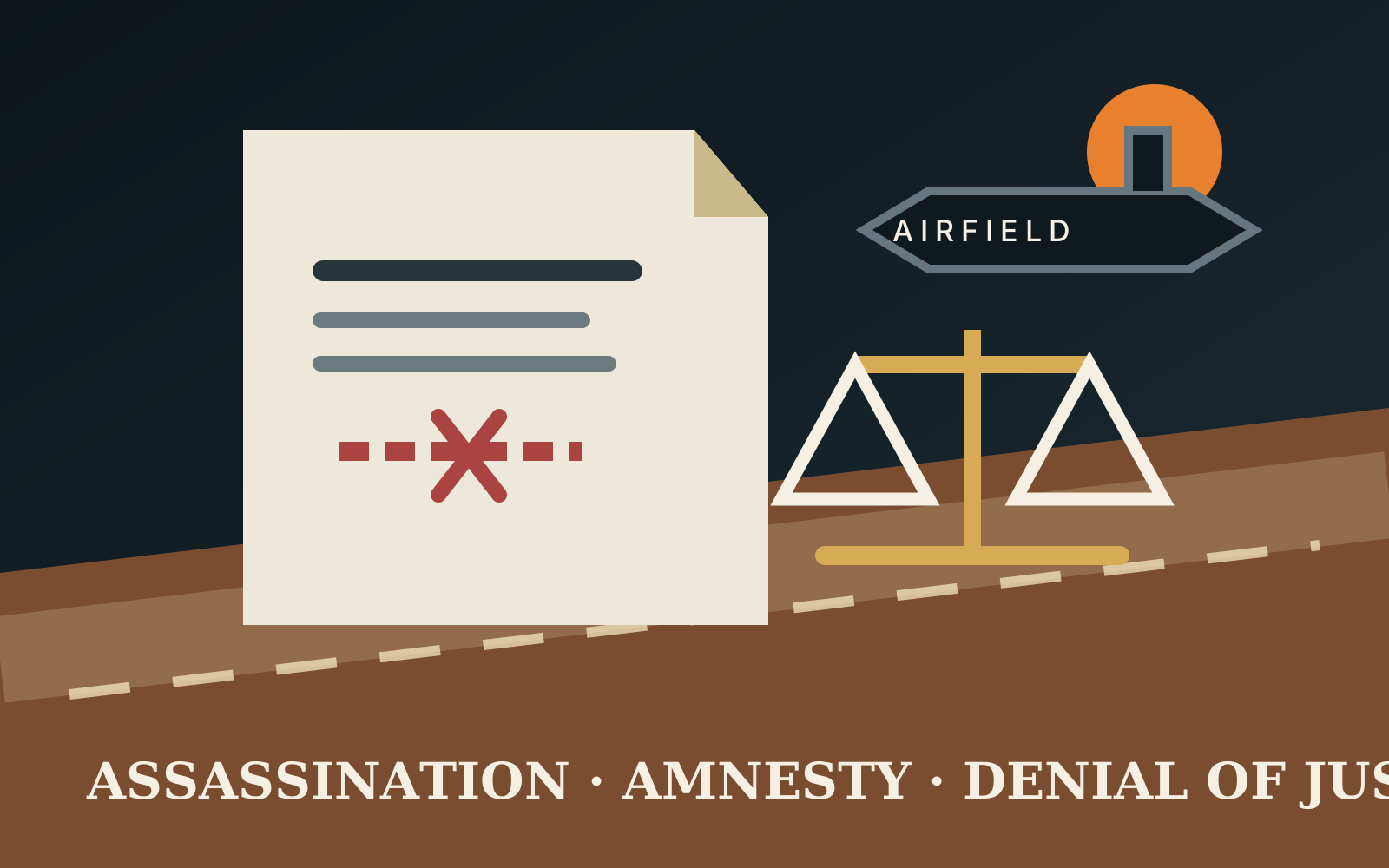
Symbolic artwork is used for the same reason. A stylized airfield, interrupted file and scales of justice explain the themes without fabricating a photograph of the attack or implying that an unidentified figure is a real perpetrator.
Case timeline
- 27 January 1996 — Maïnassara takes power in a military coup.
- 9 April 1999 — He is killed by gunfire at the military airfield in Niamey during a coup; three others are also reported killed.
- 27 May 1999 — His family files a complaint against unnamed persons.
- August 1999 — A brief gendarmerie inquiry reports on the killing; the family challenges its adequacy.
- August 1999–January 2000 — Constitutional and legislative amnesty measures become the central barrier to domestic proceedings.
- 1999–2012 — The family pursues complaints, appeals and requests for an independent inquiry without obtaining a criminal trial.
- 12 December 2013 — The family’s application reaches the ECOWAS Court.
- 23 October 2015 — The court finds violations of access to justice and the right to life, ordering 435 million CFA francs in compensation.
- February 2025 — National-consultation participants again call for justice in the assassination.
- April 2026 — The 27th anniversary brings renewed public commemoration; no criminal conviction is reported.
Questions readers ask
When and where was Ibrahim Baré Maïnassara killed?
He was killed by gunfire on 9 April 1999 at the military airfield in Niamey, Niger, as he prepared to travel by helicopter.
Was anyone convicted of the assassination?
No reliable source reviewed for this archive records a criminal prosecution or conviction for the assassination. The case is therefore classified as unsolved.
What did the ECOWAS Court decide in 2015?
The ECOWAS Community Court of Justice held that Niger violated the family’s right of access to justice and Maïnassara’s right to life, and ordered the state to pay 435 million CFA francs in total compensation.
Did the ECOWAS judgment solve the murder?
No. It was a human-rights judgment against the state, not a criminal trial of individual suspects. It did not identify or convict the people who fired the fatal shots or ordered the killing.
Why did the domestic investigation fail to produce a trial?
The family challenged a brief and incomplete inquiry, while courts and prosecutors repeatedly relied on an amnesty connected to the 1999 coup. The ECOWAS Court later found that the resulting denial of access to justice violated the family’s rights.
Why does this archive use symbolic artwork?
There is no need to imitate a victim, suspect or crime scene. The illustration uses an airport runway, legal file and broken investigative trail to explain the record without presenting invented imagery as evidence.