Case-status note: Onyum is a convicted defendant, not merely a suspect. His appeal means the judgment is subject to appellate review. The death penalties are sentences; the reviewed sources do not establish that an execution occurred.
Four children at an early-learning centre
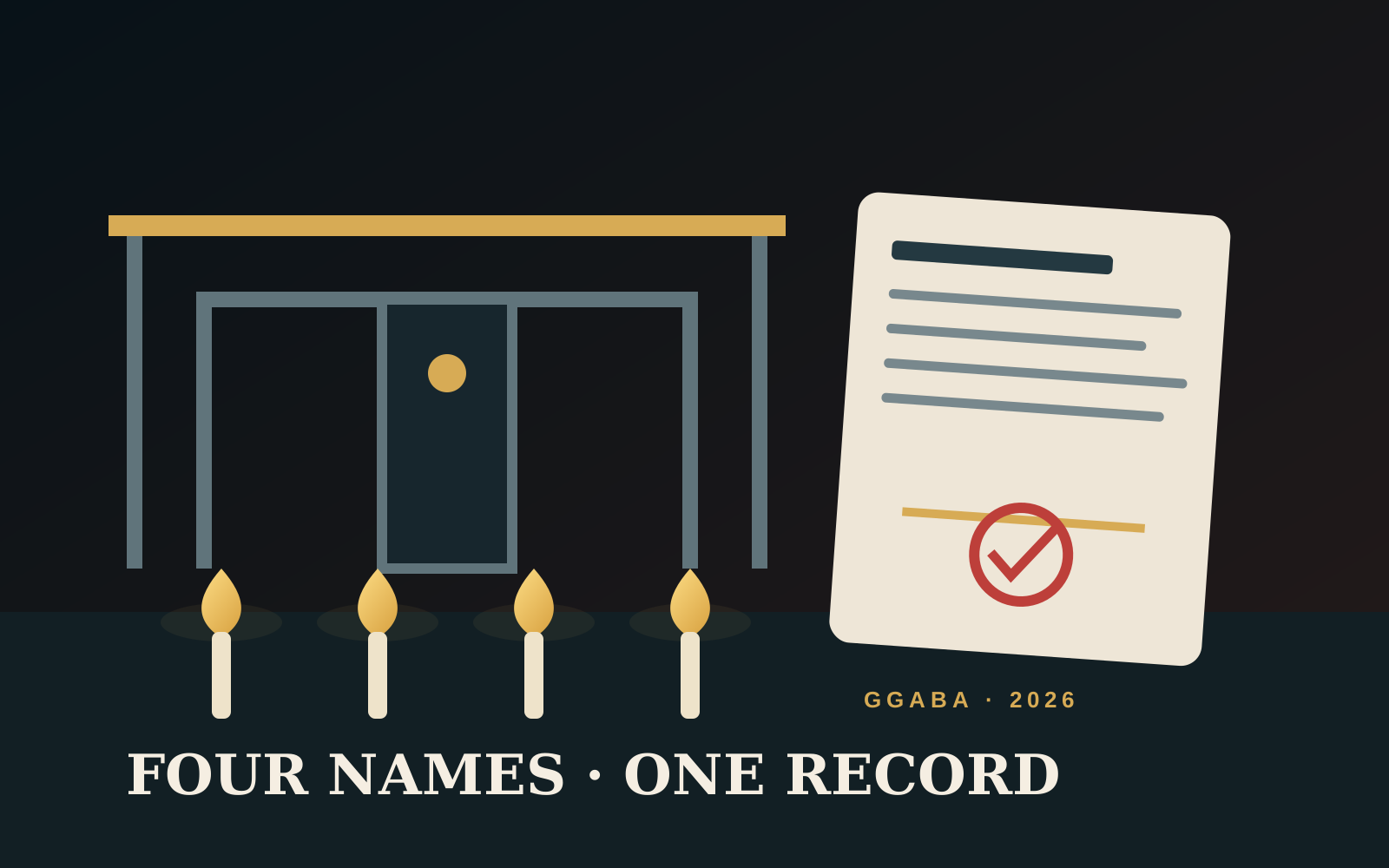
The Uganda Police Force identified the children as Gideon Eteku, Kaise Alungat, Ignatius Sserwange and Ryan Odeke. Police and independent reports placed their ages at two and three. All four were pupils at the Ggaba Early Childhood Development Program.
Names are included because police made them public and because the case should not be remembered only through the defendant. The children were at a place intended for care, play and learning. Coverage can establish what happened without dwelling on graphic injury or turning their deaths into spectacle.
April 2, 2026
Police received the report at about 11 a.m. The man who entered the centre had presented himself as a parent interested in enrolling a child. Associated Press reporting said he briefly spoke with administrators, then locked the gate before attacking children inside.
Four children died. Other pupils were removed safely. A guard subdued the attacker, and police took him into custody after intervening when an angry crowd tried to attack him. Christopher Okello Onyum was arrested at the scene.
Early reporting used both “Gaba” and “Ggaba” for the Kampala neighborhood and school. This archive uses “Ggaba,” the spelling adopted in later Ugandan reporting, while recognizing that the AP source uses “Gaba.” They refer to the same case.
The investigation and four murder charges
Investigators examined the scene and Onyum's electronic devices. At trial, the prosecution presented evidence from the devices, witness accounts and the circumstances of his entry into the school. Reuters reported that the court considered searches such as “schools near me” and material associated with extremist violence when assessing planning.
Those searches were evidence in a criminal proceeding; they do not by themselves establish ideological membership or a wider organization. No reliable source reviewed for this file showed that another person or group directed the attack.
Onyum faced four counts of murder, one for each child. He pleaded not guilty. Reports before and during trial discussed several possible explanations, but a motive was not judicially fixed as a separate finding in the sources reviewed. The page therefore does not repeat speculative claims as fact.
A fast-tracked mobile court
President Yoweri Museveni publicly called for a rapid trial. Proceedings began on April 13, only eleven days after the killings, through a mobile session of the High Court held in a large tent at Ggaba Community Church grounds near the crime scene.
The format allowed hundreds of community members to observe. The judiciary described it as an approach that brought justice closer to the public. The Uganda Law Society objected that executive pressure, speed and the charged setting threatened the defendant's fair-trial rights.
Both facts belong in the record: the court was legally constituted and delivered a conviction, and professional lawyers raised serious procedural concerns. Reporting the criticism does not erase the verdict. Reporting the verdict does not prove that every criticism of the process was answered.
The mental-health defense
Onyum's lawyers argued that he was mentally unwell and should be acquitted under an insanity defense. Reporting also referred to a history of psychiatric treatment. A criminal court must distinguish a clinical history from the legal test for criminal responsibility at the time of an offense.
Judge Alice Komuhangi Khaukha rejected the defense. According to AP and Reuters, the judge found that Onyum had not supplied evidence sufficient to establish legal insanity and that the sequence of actions showed planning. The judgment therefore treated him as criminally responsible.
This page does not diagnose Onyum. It records the defense position and the court's ruling, avoiding the common error of presenting courtroom behavior as a medical conclusion.
Conviction and sentencing
On April 30, 2026, the High Court convicted Onyum of murdering all four children. Judge Khaukha imposed a death sentence on each count. The public proceeding concluded less than a month after the attack.
Uganda retains capital punishment, but Reuters and AP noted that executions are rare and had not occurred for roughly two decades. That national context does not determine the outcome of Onyum's sentence. It explains why the words “sentenced to death” must not be rewritten as “executed.”
The judgment resolved trial-level criminal responsibility for the four murders. It did not end review of whether the conviction, evidence, defense and sentence complied with Ugandan law.
The appeal
In June 2026, Onyum filed a memorandum of appeal raising three grounds against the conviction and death sentence. Uganda Radio Network and The Independent reported the filing through records in the judiciary's electronic case-management system.
Daily Monitor reported on August 13 that the appeal was not moving on the same accelerated timetable as the trial. No final Court of Appeal judgment was located in the review completed September 13, 2026.
Accordingly, the case is classified as solved and adjudicated at trial, with the appellate outcome pending. The defendants' legal challenge remains part of the current status, not an afterthought.
Questions that remain
The trial established who the High Court found responsible, but the source record leaves questions about motive, the defendant's mental-health history and the effects of the fast-track mobile-court model. The pending appeal may address some legal issues without necessarily answering every broader question.
There is also a public-policy question: how should schools protect children without transforming an extremely unusual attack into fear directed at visitors, parents or people with mental-health conditions? The case itself does not support collective suspicion.
Current status
As of September 13, 2026, Christopher Okello Onyum stood convicted of four counts of murder and under death sentences imposed by the High Court. His appeal had been filed and remained unresolved in the reliable public record located for this page.
Nothing in this classification diminishes the four victims. Gideon Eteku, Kaise Alungat, Ignatius Sserwange and Ryan Odeke are remembered by name, while the legal record is described precisely enough to distinguish arrest, conviction, sentence and appeal.
Frequently asked questions
Who were the children killed?
Police identified Gideon Eteku, Kaise Alungat, Ignatius Sserwange and Ryan Odeke. They were two and three years old.
Who was convicted?
Christopher Okello Onyum was convicted of four counts of murder on April 30, 2026.
What sentence was imposed?
The High Court imposed a death sentence on each count. A sentence is not an execution, and no execution is claimed.
Why was the trial controversial?
It was fast-tracked and held as a public mobile-court session near the crime scene. The Uganda Law Society raised fair-trial concerns; the judiciary defended public access.
Is the case on appeal?
Yes. Onyum filed an appeal in June 2026. No final appellate judgment was located by September 13, 2026.