A series spanning two regions
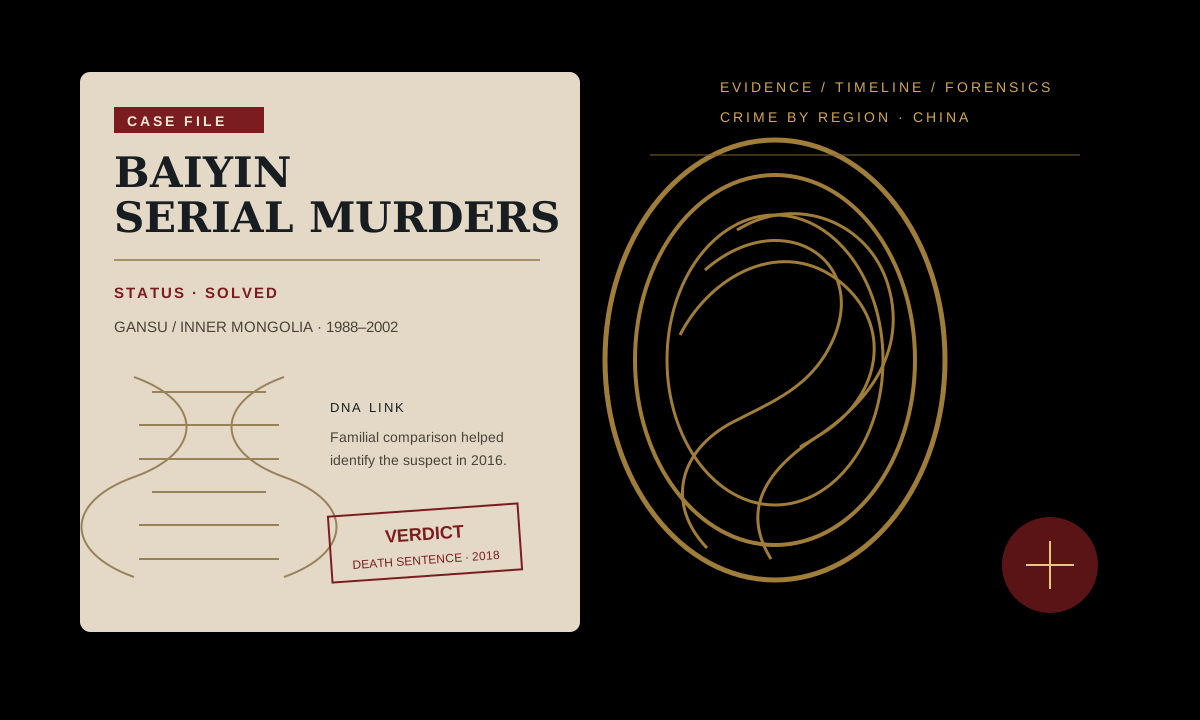
According to the Baiyin court record as summarized by Xinhua and China Daily, Gao Chengyong killed 11 female victims between May 1988 and February 2002. The crimes were committed in Baiyin, a city in Gansu Province, and in Baotou in the neighboring Inner Mongolia Autonomous Region.
The victims included adult women and an eight-year-old girl. Court reporting described the offenses as involving homicide, robbery and rape. Because of the nature of the crimes and the privacy of the victims, Gao's 2017 trial was not open to the public. This archive does not reproduce graphic descriptions of the attacks.
Why the investigation lasted so long
The killings became one of China's longest-running serial-murder investigations. Police possessed biological material and other evidence, but for years there was no database match capable of identifying a suspect. In 2004, China's Ministry of Public Security combined the investigations from Gansu and Inner Mongolia, reflecting the belief that the crimes formed a connected series.
By the time Gao was identified, investigators had been pursuing the offender for roughly 28 years. The case illustrates an important distinction in forensic investigations: having DNA evidence is not the same as having a name. A genetic profile can exclude or connect evidence, but identification still depends on a comparison that points toward a person or family line.
The familial-DNA lead
The breakthrough came after a relative of Gao became involved in a separate criminal matter and provided a biological sample in 2015. Reporting from Xinhua and China Daily says the resulting DNA comparison led police toward Gao's family. Chinese reporting on the investigation specifically discussed the use of Y-STR analysis, which can help identify genetic relationships along a paternal line.
Investigators then compared Gao's DNA with biological evidence preserved from the crime scenes. Gao was arrested on August 26, 2016, at a grocery store in Baiyin. China Daily reported that he admitted the crimes during the investigation and later pleaded guilty in court.
Trial and death sentence
Prosecutors charged Gao with intentional homicide, rape, robbery and mutilation of corpses. His trial was held in July 2017 at the Baiyin Intermediate People's Court. On March 30, 2018, the court found him guilty and sentenced him to death, also ordering lifelong deprivation of political rights and confiscation of his personal property.
China Daily reported that Gao said he would not appeal the judgment. Under Chinese law, a death sentence requires review by the Supreme People's Court before it can be carried out.
Execution and final legal status
The Supreme People's Court approved the death sentence. On January 3, 2019, authorities in Gansu carried out Gao Chengyong's execution. Xinhua's report on the execution again stated that he had been convicted of killing 11 women in Gansu and Inner Mongolia and that the 2015 DNA link involving a relative had led to his arrest the following year.
Because the perpetrator was identified, convicted and the judgment became final, Crime by Region classifies the Baiyin serial murders as Solved. The classification refers to legal responsibility for this documented series; it does not imply that every historical question about investigative delay or every detail surrounding the crimes has been independently resolved in the public record.
Why this case matters in forensic history
The case is frequently cited in Chinese reporting as an example of how advances in DNA analysis can revive an investigation long after the original offenses. The crucial development was not a new witness or confession appearing after decades, but a genetic relationship that allowed investigators to narrow an otherwise enormous suspect pool.
It also demonstrates why source discipline matters in older serial cases. The reliable record supports 11 court-proven victims in the series for which Gao was convicted. This page uses that judicially established number rather than larger speculative totals sometimes associated with notorious offenders online.
Timeline
May 1988: the period of killings later attributed to Gao begins.
1988–2002: 11 female victims are killed in Baiyin and Baotou.
February 2002: the last killing in the court-established series occurs.
August 2004: China's Ministry of Public Security combines investigations from Gansu and Inner Mongolia.
March 2015: a biological sample from one of Gao's relatives in another case creates the familial-DNA lead later used by investigators.
August 26, 2016: Gao Chengyong is arrested in Baiyin.
July 2017: Gao stands trial in a closed proceeding.
March 30, 2018: the Baiyin Intermediate People's Court sentences him to death.
January 3, 2019: after Supreme People's Court approval, Gao is executed in Gansu.
Current status
Gao Chengyong's case is legally concluded. He was convicted of the 11 murders, his death sentence passed the required top-court review, and the sentence was carried out in 2019. The case remains notable for the length of the investigation and the role of familial DNA in identifying a suspect decades after the first killing.
Sources
- Xinhua — “Serial killer executed in northwest China,” January 3, 2019
- Xinhua — “Chinese serial killer sentenced to death,” March 30, 2018
- China Daily — “Serial killer gets death penalty for 11 murders,” March 31, 2018
- China Daily — “Y-STR proves to be evidential link,” April 2, 2018
- China Daily — “Serial killer executed,” January 3, 2019