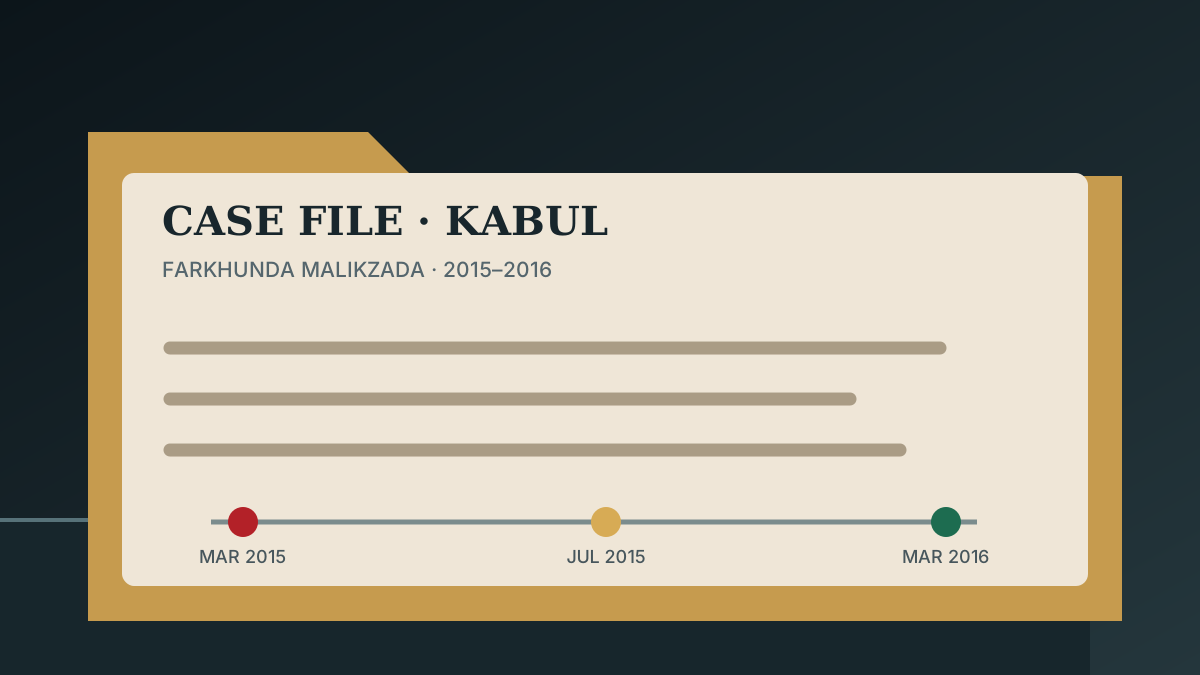
Classification note: Crime by Region classifies this file as Solved / adjudicated, with broader accountability incomplete. A final-stage Afghan court ruling confirmed prison sentences against 13 men. The label does not imply that every person visible in the crowd was identified or prosecuted, that police failures were fully addressed, or that sentence enforcement after Afghanistan's 2021 change of government can be established from the reviewed case-specific record.
Who was Farkhunda Malikzada?
Farkhunda Malikzada was a 27-year-old Afghan woman and a student of Islamic law in Kabul. Contemporary reporting described her as religiously observant. Those facts are important because the accusation used to incite the crowd was not only unproven; it contradicted the later official finding that there was no evidence she had burned the Quran.
Her name is often shortened to Farkhunda in coverage of the case. This archive uses her full name where possible and avoids graphic detail. The evidentiary and public-interest questions are the false accusation, the collective attack, police failure, the court record and the limits of accountability.
The false accusation near Shah-Do Shamshira
On March 19, 2015, Farkhunda was near the Shah-Do Shamshira shrine in central Kabul. Reporting linked the confrontation to criticism of the sale of amulets at the site. During the dispute, she was accused of burning the Quran. The allegation spread quickly and drew a crowd.
Later police findings reported by established outlets found no evidence that Farkhunda had burned the Quran. That distinction must remain explicit: the accusation was the trigger used by members of the crowd, not an established act by Farkhunda. Repeating the allegation without its disproven status would reproduce the misinformation that preceded her death.
Radio Free Europe/Radio Liberty later identified the amulet seller Zainuddin as the person who fabricated the story and reported that the Supreme Court confirmed a 20-year sentence against him. That is a reported judicial outcome, not a basis for expanding claims beyond the court record.
The attack and the failure to protect her
A large crowd attacked and killed Farkhunda in public. Bystanders recorded parts of the event on mobile phones, and the footage later became important to public understanding and the prosecution. Crime by Region does not reproduce or describe the graphic images.
Police were present but did not prevent the killing. Human Rights Watch later wrote that officers stood by and that the justice process failed to account adequately for both attackers and official inaction. The presence of video helped establish that many people were involved, but video evidence alone does not automatically identify every participant, prove an individual mental state or replace a fair judicial process.
VOA, carrying Associated Press reporting, said that 30 civilians and 19 police officers were arrested and charged either with participating in the attack or failing to stop it. The two groups faced different allegations and must not be merged into a single claim of direct responsibility.
Verification that the accusation was unfounded
Afghan officials confirmed after the killing that there was no evidence Farkhunda had desecrated the Quran. The correction transformed public discussion of the case, but it came after the false claim had already been accepted and amplified by members of the crowd.
The case therefore illustrates two different evidentiary failures: the crowd acted without verification, and the justice system later faced the challenge of assigning individual responsibility within a large, recorded event. The first does not excuse weaknesses in the second. Rejecting mob action and requiring reliable proof in court are parts of the same rule-of-law principle.
Funeral, protests and public response
Farkhunda's killing prompted demonstrations in Kabul. Contemporary Time reporting described men and women marching with her image and demanding justice after officials confirmed the accusation was false. The protests focused attention on violence against women, the power of inflammatory allegations and police responsibility.
Women carried Farkhunda's coffin at her funeral, an act widely reported as a break with local convention and a public statement of solidarity. The funeral and protests are part of the case's social history, but they should not be used to reduce Farkhunda to a symbol. She was an individual victim whose life and reputation were harmed first by the accusation and then by the violence committed in response to it.
The 2015 trial and initial judgments
The first trial began quickly, within weeks of the murder. The proceedings drew exceptional attention because video captured numerous participants and because the killing had generated nationwide outrage. Four defendants initially received death sentences, while other defendants received prison terms and some were acquitted.
Speed did not guarantee completeness. Human Rights Watch later described the proceedings as rushed and affected by serious procedural errors, including lack of counsel for many defendants. The organization also said police failed to arrest several attackers identifiable in footage. These concerns do not erase every conviction; they limit how confidently the process can be described as comprehensive.
A separate part of the proceedings addressed officers accused of failing to intervene. Human Rights Watch reported that 11 of 19 prosecuted police officers received limited discipline. This archive records that institutional-accountability concern without labeling the officers as direct perpetrators of the murder.
The closed appeal and reduced sentences
In July 2015, an appeals court vacated the four death sentences. VOA reported that three defendants received 20-year prison terms and a fourth received a 10-year term because he was 17 at the time of the crime. The appeal was held behind closed doors without journalists or Farkhunda's family present.
The change is sometimes summarized only as cancellation of capital punishment. For accurate status reporting, both parts matter: the death sentences did not remain in force, but substantial prison convictions did. Crime by Region does not treat a reduced sentence as an acquittal.
The reviewed reporting does not provide a complete published appellate opinion explaining the evidence and legal reasoning for every defendant. That absence is described as a source limitation rather than filled with inference.
The March 2016 Supreme Court decision
On March 7, 2016, Radio Azadi / RFE/RL reported that Afghanistan's Supreme Court confirmed prison sentences against 13 men. Three received 20-year terms, one received 10 years because he had been a minor, and nine others had 16-year terms confirmed. A spokesman for Afghanistan's attorney general described the rulings as the final stage of the Afghan appeals process.
The Supreme Court decision provides the clearest procedural endpoint in the reliable public record reviewed for this page. It supports an adjudicated classification because named defendants received convictions that survived the available appeal path.
Human Rights Watch criticized the outcome and the broader investigation, arguing that many people who participated were never brought to justice and that official failures were inadequately punished. A final judgment can coexist with credible criticism of how narrow or flawed the accountability process was.
What is established, adjudicated and incomplete?
- Established: Farkhunda Malikzada was attacked and killed near the Shah-Do Shamshira shrine on March 19, 2015.
- Established: the crowd acted after an accusation that she had burned the Quran; police later confirmed there was no evidence supporting it.
- Documented: police were present and failed to prevent the killing, and separate cases addressed alleged failures to intervene.
- Adjudicated: Afghanistan's Supreme Court confirmed prison sentences ranging from 10 to 20 years against 13 men in March 2016.
- Corrected: four initial death sentences were vacated on appeal and replaced with prison terms; this page does not repeat the superseded penalties as the final outcome.
- Incomplete: rights monitors reported participants who were not arrested, procedural defects and limited police accountability.
- Unverified after 2021: the public sources reviewed do not establish a later case-specific retrial, reversal or complete sentence-enforcement record following the Taliban takeover.
The result is narrower than “fully solved.” The murder produced final-stage convictions against 13 defendants, but the wider event involved a much larger crowd and serious official failures. The label “adjudicated, with broader accountability incomplete” keeps both facts visible.
Source and status methodology
The event date, false accusation, official correction and protests were checked against contemporary Time reporting based on Associated Press coverage. The July 2015 appeal was checked against VOA's report, which identifies the replacement sentences and closed hearing. The Supreme Court endpoint was checked against Radio Azadi / RFE/RL reporting that cites Afghanistan's attorney general.
Human Rights Watch analysis was used for procedural context: it documents rushed trials, defendants without counsel, attackers not arrested and limited accountability for officers. Those are attributed assessments, not substituted for the holdings of the courts.
The source review was completed through September 11, 2026. Afghanistan's legal institutions changed fundamentally after August 2021, but this archive found no reliable public case-specific record establishing a new judgment in Farkhunda's case. It therefore reports the last verified procedural endpoint and labels later enforcement as unverified rather than assuming continuity or reversal.
Frequently asked questions
Who was Farkhunda Malikzada?
She was a 27-year-old Afghan woman and student of Islamic law in Kabul.
Did she burn the Quran?
No evidence supported the accusation. Afghan police later confirmed that there was no evidence she had burned the Quran.
Were people convicted of her murder?
Yes. Afghanistan's Supreme Court confirmed prison sentences ranging from 10 to 20 years against 13 men in March 2016.
Were the original death sentences carried out?
No. The four initial death sentences were vacated on appeal and replaced with three 20-year terms and one 10-year term.
Why is accountability described as incomplete?
Rights monitors documented participants who were not arrested, procedural failures and limited punishment of officers who failed to intervene.
Did the Taliban later change the verdicts?
The reliable public record reviewed through September 11, 2026 did not establish a later case-specific retrial or reversal. The page therefore preserves the March 2016 judicial endpoint without assuming post-2021 enforcement.