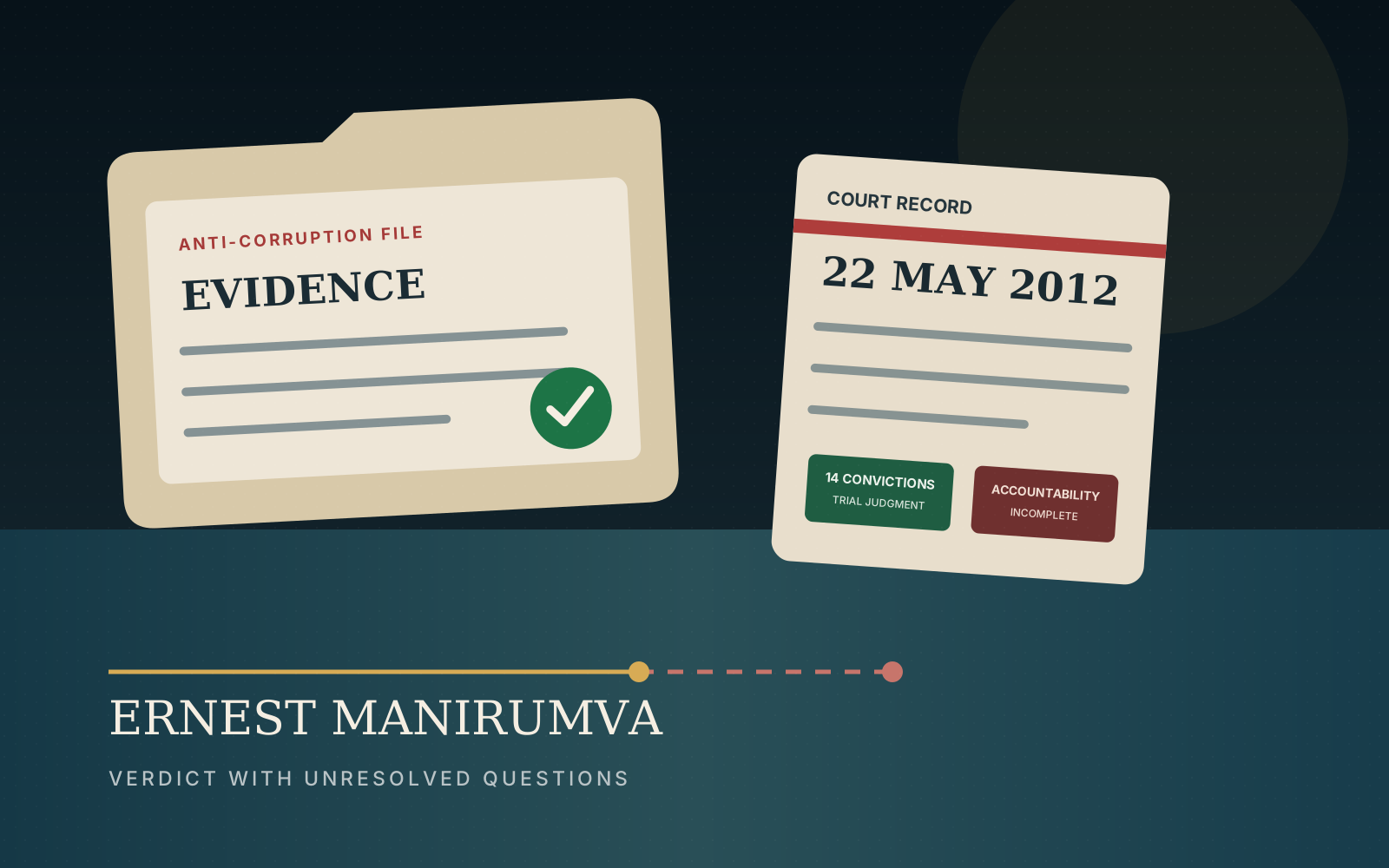
Status boundary: Fourteen convictions are a verified court outcome. They do not establish every alleged participant, prove every proposed motive or answer the concerns raised about unexamined FBI and commission-of-inquiry evidence. This page separates the judgment from those unresolved questions.
Who was Ernest Manirumva?
Ernest Manirumva was a respected economist and vice president of the Observatory for the Fight against Corruption and Economic Embezzlement, commonly known by its French acronym OLUCOME. The independent organization investigated alleged corruption in Burundi’s public institutions and private sector.
From January 2009, Manirumva was also vice president of an official body regulating public procurement. Human Rights Watch reported that his work included sensitive inquiries into alleged large-scale police corruption and illegal weapons purchases. Those subjects provide context for why investigators and civil-society organizations examined whether the killing was linked to his work, but no complete judicial finding on motive is presented here.
What happened on the night of 8–9 April 2009?
In the early hours of 9 April, assailants entered Manirumva’s home in Bujumbura and killed him. Neighbors found his body outside the house. Human Rights Watch reported that files had been strewn around the room and that a bloodstained folder lay empty on the bed, suggesting that documents may have been removed.
Amnesty International’s contemporaneous urgent action said local media and human-rights defenders believed the assailants had been looking for documents connected to government corruption. Human Rights Watch also recorded signs of possible entry into Manirumva’s office at the Ministry of Agriculture. These observations supported calls for a thorough, independent inquiry; they did not, by themselves, establish who ordered the killing or precisely what was taken.
The page avoids graphic detail. The essential documented facts are that Manirumva was deliberately killed, his home appeared to have been searched, and the death immediately raised concern about the safety of anti-corruption and human-rights work in Burundi.
How was the murder investigated?
Burundian authorities created several commissions of inquiry. The first two were criticized by civil-society groups for inactivity and lack of independence. A third commission made more progress and led to arrests.
At the Burundian government’s request, the United States Federal Bureau of Investigation provided technical assistance. According to the joint statement published by Human Rights Watch after the verdict, the FBI report recommended further work, including interviews and DNA sampling involving people cited in its findings.
The existence of FBI assistance is sometimes summarized as if the agency itself solved or prosecuted the case. It did not. Burundi retained jurisdiction, and Burundian investigators and prosecutors decided which leads to pursue and whom to charge.
What happened before and during the trial?
The case opened in court in July 2010 but was postponed repeatedly. In June 2011, the prosecution requested further investigation without publicly specifying all of the intended work. Lawyers representing Manirumva’s family and OLUCOME asked for interviews, cross-examinations, telephone-record checks and DNA testing related to people named in the FBI and third commission reports.
When the public hearing resumed in March 2012, the court rejected the civil party’s request for those additional steps on the ground that the substantive hearing should begin. After a long period of delay, the main trial was completed in three hearing days between 5 and 11 April 2012.
Monitoring organizations also raised due-process concerns affecting defendants, including prolonged pretrial detention and uncertainty about how some charges were handled. Reporting these concerns does not decide an appeal or erase a conviction; it explains why the proceeding remained contested by both defense lawyers and groups seeking broader accountability.
What did the 22 May 2012 judgment decide?
The Higher Instance Court of Bujumbura convicted 14 people. Contemporary reports stated that eight received life sentences for murder, three received 20-year terms for complicity in murder, and three received 10-year terms for failure to inform public authorities or for non-assistance to a person in danger.
Reuters confirmed that the sentences ranged from 10 years to life. A Justice Ministry spokesperson reported the result, while defense counsel said an appeal was planned. The verdict is the basis for placing the case in this archive’s solved-at-trial section.
The court outcome must be stated precisely. Fourteen convictions do not mean that every convicted person received the same offense or sentence, and they do not establish criminal responsibility for people who were discussed in investigative reports but never tried.
Why did observers say the verdict was incomplete?
A coalition of 20 Burundian and international organizations said potentially important evidence had not been pursued. Their statement reported that none of the police or military officials mentioned in the FBI report had been investigated and that the prosecutor had not followed key recommendations from the FBI or the national commission of inquiry.
The civil party argued that those gaps prevented the court from establishing the full truth. It declined to seek damages in the proceeding because it had lost confidence that all available evidence would be considered. Reuters separately recorded criticism from APRODH and the Forum for the Strengthening of Civil Society, while noting that Burundi’s Justice Ministry declined to comment.
These are attributed criticisms, not substitute verdicts. Crime by Region does not declare the convicted people innocent, identify untried officials as perpetrators, or claim a motive that no judgment established. The responsible conclusion is narrower: the court adjudicated charges against 14 people, while credible questions about the wider crime remained.
What is known about appeals and later status?
Defense counsel told Reuters after the judgment that an appeal was planned. The civil party representing the family and OLUCOME appealed to Burundi’s Supreme Court on 11 June 2013. In April 2019, Human Rights Watch reported that no decision had been issued on that civil-party appeal.
In April 2026, SOS Médias Burundi reported that OLUCOME was still asking authorities to establish the full truth and said the investigation had made no significant progress for years. That report does not overturn the convictions. It supports the more limited conclusion that broader accountability and the organization’s demand for answers remained unresolved.
No reliable later court judgment changing the 14 convictions was identified in the sources reviewed for this page. Because absence of a published record is not proof that no procedural event occurred, the archive states the dated, verified findings rather than claiming more.
Why is the case classified as solved at trial?
Crime by Region places a case in the solved section when a competent court has entered a judgment establishing individual criminal responsibility. This file meets that minimum because:
- the Higher Instance Court of Bujumbura convicted 14 people;
- the judgment distinguished murder, complicity and other offenses;
- the court imposed specific prison terms ranging from 10 years to life; and
- the convictions are documented by both independent monitoring organizations and Reuters.
The qualifier is essential. Important investigative leads were not pursued, the civil-party appeal had no reported decision in the latest detailed legal review, and OLUCOME continued to call for fuller accountability in 2026. “Solved at trial” describes the verified judgment; it is not a claim that the complete truth or every responsible actor has been established.
Case timeline
- January 2009
Manirumva becomes vice president of Burundi’s public-procurement regulatory body while continuing his leadership work at OLUCOME. - Night of 8–9 April 2009
Assailants enter his Bujumbura home and kill him; files appear to have been searched and documents may have been removed. - April 2009
Burundian authorities begin an investigation and the United States agrees to provide FBI assistance. - 2009–2010
Successive commissions of inquiry examine the case; civil-society groups criticize the first two and the third leads to arrests. - July 2010
The trial formally opens but is postponed repeatedly. - 30 March 2012
Public hearings resume; the court rejects the civil party’s request for additional investigative steps. - 5–11 April 2012
The substantive trial is completed over three hearing days. - 22 May 2012
The court convicts 14 people and imposes terms from 10 years to life. - 11 June 2013
The civil party appeals to Burundi’s Supreme Court. - 9 April 2019
Human Rights Watch reports that no decision has been issued on that appeal. - 11 April 2026
OLUCOME publicly renews its call for the full truth and wider accountability.
Sources and verification
Human Rights Watch — first investigation and background (16 April 2009)
Amnesty International — contemporaneous urgent action (21 April 2009)
Human Rights Watch and partners — verdict, sentences and unpursued leads (23 May 2012)
Reuters — 14 convictions and appeal plans (24 May 2012)
Human Rights Watch — ten-year review and Supreme Court appeal status (9 April 2019)
SOS Médias Burundi — OLUCOME renews its call for full accountability (13 April 2026)
Editorial method: The killing, investigation, trial judgment, monitoring criticism and later accountability status were cross-checked across contemporary and follow-up sources. Allegations about motive or untried people are not presented as findings of fact. Last reviewed 18 October 2026.
Frequently asked questions
Why is the case classified as solved at trial?
The Higher Instance Court of Bujumbura convicted 14 people on 22 May 2012. Because important investigative leads and wider responsibility remained unresolved, the archive uses the qualified label “solved at trial; full accountability unresolved.”
Who was Ernest Manirumva?
He was a Burundian economist, vice president of the anti-corruption organization OLUCOME and vice president of an official public-procurement regulatory body.
How many people were convicted?
Fourteen people were convicted. Contemporary monitoring reported eight life sentences for murder, three 20-year sentences for complicity and three 10-year sentences for failure to inform authorities or assist a person in danger.
Did the FBI investigate the murder?
The FBI assisted at the request of Burundi’s government. Human-rights organizations said recommendations and leads in the FBI report were not fully pursued by prosecutors.
Did the verdict settle who planned the killing?
No. The judgment convicted 14 people, but monitoring organizations said possible involvement by senior police and security figures was not adequately investigated.
Was the case fully resolved by October 2026?
No. The convictions remain the verified trial outcome, while OLUCOME continued to seek the full truth and broader accountability in 2026.