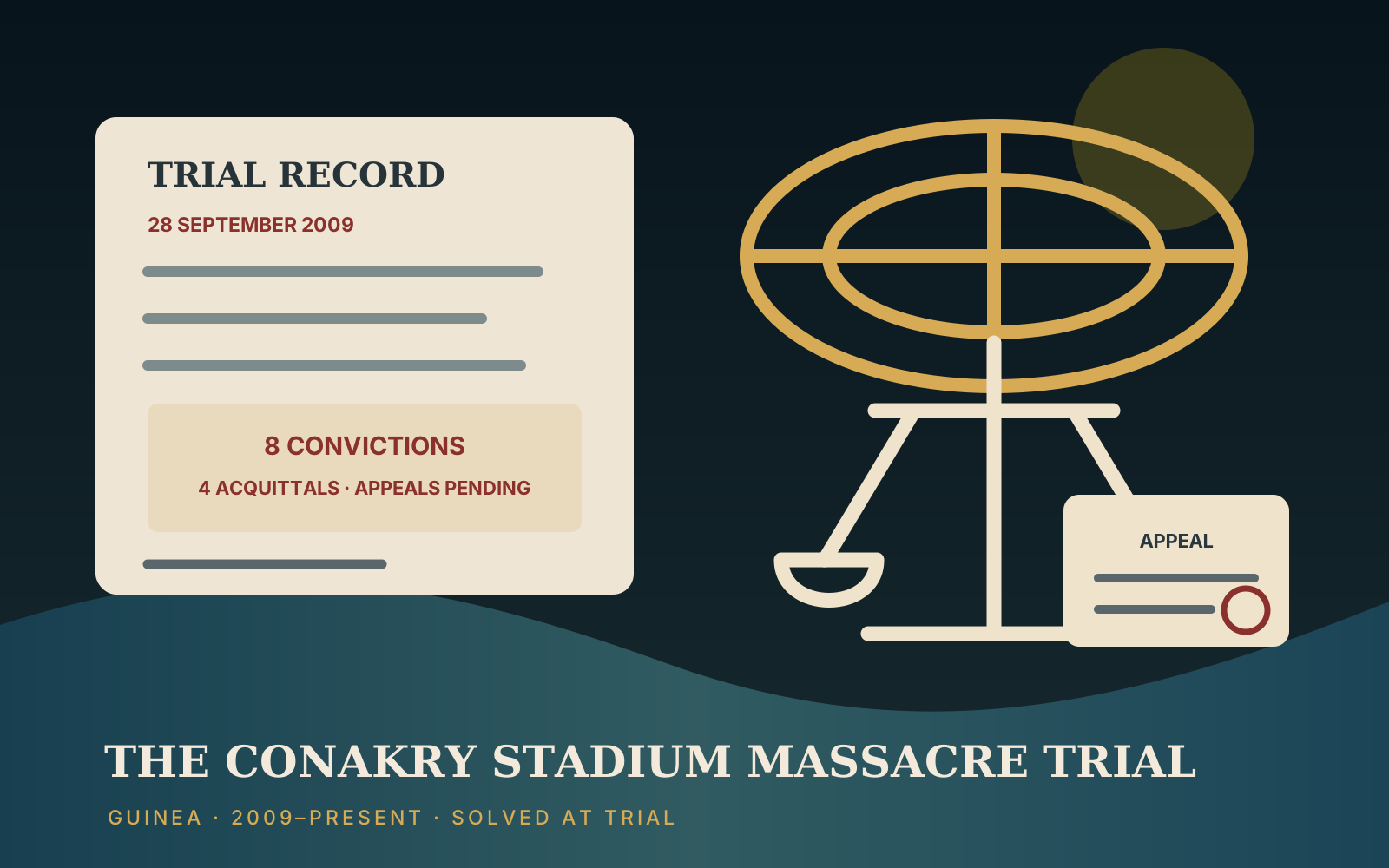
Status boundary: The 2024 judgment established the criminal responsibility of eight defendants at trial and acquitted four others. It did not make every allegation a judicial finding, conclude pending appeals, settle the legal effect of the 2025 pardon, compensate every victim or identify every person who may have participated.
Why was the rally held?
Guinea’s long-time president Lansana Conté died in December 2008, and a military group calling itself the National Council for Democracy and Development, or CNDD, seized power. Captain Moussa Dadis Camara became the junta’s leader and initially said members of the military government would not contest the planned election. As uncertainty grew over whether he would stand, opposition parties and civil-society groups organized a rally for 28 September 2009.
Tens of thousands of people moved toward Conakry’s 28 September Stadium. Human Rights Watch’s field investigation described the gathering as a challenge to a possible Camara candidacy and a call for a return to civilian rule. The stadium’s name commemorated the date of Guinea’s 1958 independence referendum; it was not a reference created after the attack.
What happened at the stadium?
Security units entered the stadium complex and attacked rally participants. Human Rights Watch, after interviewing about 240 people, attributed most documented killings, sexual assaults and other abuses to the Presidential Guard, while also identifying gendarmes, police and armed men in civilian clothes among the perpetrators. Its report found evidence that the violence was organized rather than an isolated loss of discipline.
Established accounts report that more than 150 people were killed. Investigators also documented widespread sexual violence against women and girls, hundreds of injuries, arbitrary detention, torture and abuses that continued outside the stadium. The record includes allegations that security forces sealed the site and morgues, removed bodies and obstructed an accurate death count.
This page does not reproduce graphic testimony. The evidentiary importance lies in the breadth of witness, medical and institutional documentation and in the later court’s decision to treat the charged conduct as crimes against humanity.
How did the investigation develop?
The International Criminal Court opened a preliminary examination in October 2009 because Guinea had been an ICC member since 2003. The ICC does not automatically replace national courts; under the complementarity principle, it monitors whether domestic proceedings genuinely address conduct within its jurisdiction.
Guinean judges began a national investigation, but progress was slow and repeatedly delayed. The Coalition for the International Criminal Court records that investigating judges concluded the national investigation in December 2017 and referred the case to a criminal court. After further delay, the trial opened on 28 September 2022—exactly 13 years after the attack.
What did the national trial examine?
The proceeding before the Court of First Instance of Dixinn heard defendants, survivors, witnesses and civil parties over nearly two years. The charges addressed killings, sexual violence, torture, abduction and related conduct arising from the stadium attack and its aftermath.
In March 2024, the court reclassified the alleged conduct as crimes against humanity. That legal category concerns specified acts committed as part of a widespread or systematic attack directed against a civilian population. It does not mean every defendant was automatically guilty; the prosecution still had to establish each person’s responsibility, and the court later acquitted four defendants.
Trial monitoring by Guinean and international organizations was especially important because the case tested whether a domestic court could address alleged crimes by senior military and government figures. The proceeding also gave survivors a forum to seek recognition and reparations after years of delay.
What was the 31 July 2024 verdict?
The court convicted Moussa Dadis Camara and seven other defendants of crimes against humanity. Reuters reported that Camara and Moussa Tiegboro Camara each received 20-year prison terms, Aboubacar Sidiki “Toumba” Diakité received 10 years, and Claude Pivi was sentenced to life imprisonment in absentia. Other convicted defendants received prison terms within the range reported by trial monitors.
Four defendants were acquitted. The distinction matters: the verdict did not establish criminal responsibility for everyone who stood trial, and this archive does not treat an indictment or accusation as equivalent to conviction.
The judgment was widely described as the first crimes-against-humanity prosecution completed in Guinea. The ICC prosecutor’s office welcomed the verdict as a domestic accountability step after years of preliminary examination and cooperation.
What happened after the verdict?
Most convicted defendants and other parties filed appeals. By 31 July 2025, FIDH and partner organizations reported that no appeal hearings had been held, leaving both defendants and victims without a final appellate outcome. The page therefore does not describe the trial verdict as a final judgment after appeal.
Claude Pivi, who received a life sentence in absentia, was arrested outside Guinea and returned in September 2024, according to subsequent reporting. That development concerned enforcement of the judgment; it did not resolve the broader appeals.
Organizations assisting victims also reported difficulties with the compensation mechanism. A trial award may establish a legal entitlement, but payment, access and fair administration are separate questions. Those implementation issues are part of why the archive uses “accountability incomplete.”
What did the 2025 presidential pardon change?
On 28 March 2025, transitional president Mamadi Doumbouya pardoned Moussa Dadis Camara on stated health and reconciliation grounds, and Camara was released. Amnesty International said the measure jeopardized access to justice and effective remedies for victims.
A September 2025 joint letter from Human Rights Watch and partner organizations stressed two legal boundaries: Camara was pardoned while appeals were pending, and the pardon did not absolve criminal responsibility or remove the duty to provide reparations. He was not acquitted and did not win an appeal. The page therefore records “pardoned and released” separately from conviction status.
Why is the case classified as solved at trial?
Crime by Region places a case in the solved section when a competent court has entered a judgment establishing individual criminal responsibility. This case meets that minimum because:
- a national court conducted a public trial lasting nearly two years;
- the court convicted eight defendants of crimes against humanity;
- the judgment imposed specific prison sentences; and
- four acquittals demonstrate that the status is tied to adjudicated outcomes, not mere accusation.
The qualifier is equally important. Appeals were unresolved in the latest detailed follow-up, one principal defendant received a contested pardon, compensation remained incomplete and alleged responsibility beyond the convicted defendants was not fully adjudicated. “Solved at trial” describes the judgment; it is not a claim that justice is complete.
Case timeline
- December 2008
The CNDD military junta takes power after President Lansana Conté’s death, and Moussa Dadis Camara becomes its leader. - 28 September 2009
Security forces attack an opposition rally at Conakry’s 28 September Stadium. - October 2009
The ICC prosecutor opens a preliminary examination of the situation in Guinea. - December 2009
Human Rights Watch publishes its field investigation, Bloody Monday. - 29 December 2017
Investigating judges conclude the national investigation and refer the case to a criminal court. - 28 September 2022
The national trial opens in Conakry, 13 years after the attack. - 4 March 2024
The court reclassifies the alleged conduct as crimes against humanity. - 31 July 2024
Eight defendants are convicted and four are acquitted. - 28 March 2025
Moussa Dadis Camara is pardoned and released while appeals are pending. - 31 July 2025
Victim-support organizations report that appeal hearings have not begun and reparation problems persist.
Sources and verification
Human Rights Watch — Bloody Monday field investigation (17 December 2009)
Reuters — national court verdict and sentences (31 July 2024)
Coalition for the International Criminal Court — trial timeline and civil-society reaction
FIDH — one year after the verdict: appeals and reparations (31 July 2025)
Editorial method: Event facts are cross-checked against the contemporaneous field investigation and later trial reporting. Trial conviction, acquittal, sentence, appeal, pardon and reparation status are described as separate procedural facts. Last reviewed 17 October 2026.
Frequently asked questions
Why is the case classified as solved at trial?
The Court of First Instance of Dixinn convicted eight defendants of crimes against humanity on 31 July 2024. Because most appeals remained pending and wider accountability was incomplete, the archive uses the qualified label “solved at trial; accountability incomplete.”
How many people were convicted?
Eight defendants were convicted and four were acquitted. Moussa Dadis Camara received a 20-year sentence; the other prison terms reported by trial monitors ranged from 10 years to life.
Was Moussa Dadis Camara acquitted or released on appeal?
No. He was pardoned and released on 28 March 2025 while appeals were pending. A pardon is not an acquittal and, according to a joint human-rights letter, does not erase criminal responsibility or reparation obligations.
What happened at the stadium on 28 September 2009?
Security forces attacked an opposition rally in Conakry. Investigations documented more than 150 deaths, widespread sexual violence, injuries, arbitrary detention and an alleged effort to remove bodies and conceal evidence.
Why did the case take so long to reach trial?
The national investigation advanced slowly and faced repeated delay. The trial finally opened on 28 September 2022, exactly 13 years after the attack, and continued until the July 2024 judgment.
Is the case completely finished?
No. The trial judgment established criminal responsibility for eight defendants, but appeals, compensation, enforcement and accountability for additional alleged perpetrators remained unresolved in the latest sources reviewed.