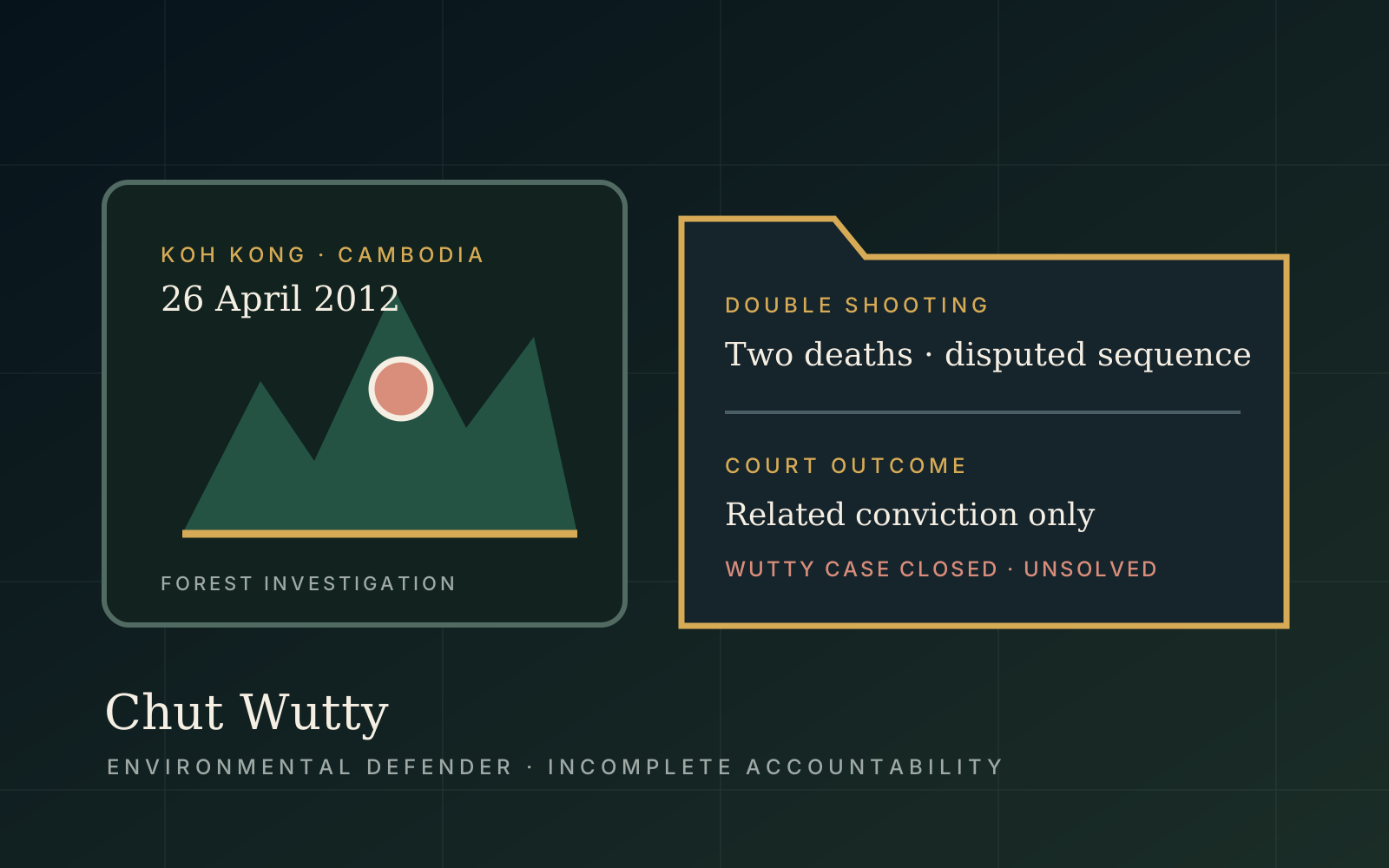
Case-status note: Cambodian authorities attributed Wutty's shooting to In Rattana, who also died. That official account was not tested in a trial for Wutty's killing. Ran Boroth was convicted only for causing Rattana's death. The page therefore records official conclusions as claims and does not label any untried person a convicted murderer.
What happened to Chut Wutty?
On April 26, 2012, Chut Wutty traveled with two journalists to a forest area in Mondul Seima district, Koh Kong Province. They were documenting timber that they believed had been illegally cut and transported. At Veal Bei, military police and company-linked security personnel confronted the group and demanded that photographs be surrendered.
A shooting followed near Wutty's vehicle. Wutty died from gunshot wounds. Military police officer In Rattana was also killed. The two reporters survived and were initially prevented from leaving, making their observations central to early reporting about the confrontation.
Authorities soon announced that Rattana had shot Wutty after an argument, then died when Timber Green security guard Ran Boroth accidentally fired while trying to disarm him. That account supplied a closed narrative but did not produce a trial for Wutty's death. Witness accounts, the handling of physical evidence and changes in official explanations led Cambodian and international rights groups to demand an independent inquiry.
The forest investigator
Wutty founded and directed the Natural Resource Protection Group. His work focused on Cambodia's forests, land concessions and the role of powerful commercial and security interests in timber extraction. He traveled to remote areas, documented logging and worked with communities, campaigners and journalists.
The Koh Kong trip was part of that work. The journalists were investigating timber activity around a protected forest and photographed stockpiles and vehicles. Wutty's presence gave them access and local knowledge, but it also placed him again in contact with armed authorities and private actors operating around contested natural resources.
Motive cannot be established merely from a victim's occupation. The archive therefore does not state that a named company or official ordered the killing. It records the verified context: Wutty was documenting suspected illegal logging, the confrontation concerned the photographs and timber, and the investigation did not resolve whether the shooting was spontaneous or connected to broader interests.
The double shooting at Veal Bei
Contemporary reports agreed that shots were fired during a confrontation beside Wutty's vehicle, but the sequence was disputed almost immediately. Some early police accounts suggested Rattana died after a bullet ricocheted. Later official statements said Boroth fired while attempting to take Rattana's weapon after Rattana shot Wutty.
The difference was not minor. A ricochet, an accidental discharge during a struggle and a deliberate second shooting imply different physical evidence and legal responsibility. Investigators needed to preserve the weapons, vehicle, bullet paths, positions and witness testimony well enough to test the sequence.
Rights organizations criticized the speed and opacity of the inquiry. The two surviving journalists described being detained and questioned after witnessing the deaths. Their accounts did not eliminate every uncertainty, but they made it inappropriate to treat the government's final reconstruction as an uncontested fact.
The government investigation
The Cambodian government formed an investigation committee after domestic and international pressure. The United Nations human rights office called for a full and transparent inquiry. Reuters reported that UN officials questioned whether the early response could satisfy that standard.
The committee's announced conclusion attributed Wutty's death to Rattana and Rattana's death to Boroth. Because Rattana was dead, there could be no criminal trial testing whether he intentionally killed Wutty, acted accidentally or was responsible at all. The inquiry consequently depended on an account that placed the first shooting on someone who could neither answer the charge nor expose contradictions through a defense.
An effective investigation would also examine whether anyone directed the confrontation, interfered with evidence or had an interest in stopping the journalists' work. Public records did not show those broader questions being fully litigated.
The Ran Boroth case
Ran Boroth was charged over the death of In Rattana, not the death of Chut Wutty. In October 2012, the Koh Kong Provincial Court convicted him of unintentional homicide and imposed a two-year sentence. Eighteen months were suspended, and time already spent in detention meant his release followed shortly afterward.
The court accepted the account that Boroth accidentally shot Rattana while trying to disarm him. This verdict did not establish that Rattana shot Wutty beyond a reasonable doubt in a murder prosecution; Rattana was not a defendant, and Wutty's killing was not the offense for which Boroth was convicted.
Global Witness and Cambodian rights groups criticized the short proceeding and the absence of witnesses capable of testing the full sequence. Their criticism is an advocacy assessment, not a judgment that Boroth committed a different crime. The verified point is narrower: the only conviction arising from the scene concerned Rattana's death.
Closing the Wutty inquiry
On October 4, 2012, the provincial court declared the inquiry into Wutty's killing closed on the theory that his alleged shooter was dead. That decision prevented a public trial focused on Wutty, the physical evidence and the possible responsibility of others.
Closing a case is not equivalent to solving it. It can reflect a prosecutorial or procedural conclusion without proving the underlying account. Here, no living defendant was convicted of murdering Wutty, and the official attribution to Rattana was never tested through a completed adversarial proceeding.
Later anniversary statements from LICADHO, the Cambodian Center for Human Rights, OMCT and Global Witness continued to call for the investigation to be reopened. Through the review date of September 15, 2026, no reliable source located a later conviction for Wutty's killing.
What remains unanswered?
The central unanswered question is who fired the shot or shots that killed Wutty and with what intent. The official answer named Rattana, but the inquiry's evidentiary weaknesses and lack of trial mean the archive cannot present that attribution as a final criminal finding.
Other questions concern the second shooting, the handling of the weapons and vehicle, discrepancies between successive accounts, and whether the confrontation was independently initiated or connected to people benefiting from the timber operation. No reliable judgment located for this file resolves those questions.
The correct classification is therefore “Unsolved.” It acknowledges that authorities closed the file and that one related death produced a conviction while refusing to turn either fact into a solved murder case for Wutty.
Impact and victim-centered record
Wutty's death removed one of Cambodia's most visible forest defenders. Colleagues and communities continued his work, and his name became associated internationally with the dangers faced by land and environmental activists.
In Rattana was also a victim of the scene. Recording his death does not endorse the allegation that he killed Wutty. It preserves the full double-fatality sequence and separates the one adjudicated offense from the unresolved killing.
The two journalists survived a confrontation in which their reporting material was at issue and two people died. Their testimony helped prevent the event from being reduced to a single untested official explanation. A credible case record therefore keeps their observations, institutional findings and rights-group critiques in their proper evidentiary categories.
Frequently asked questions
Who was Chut Wutty?
He was a Cambodian environmental investigator and founder of the Natural Resource Protection Group.
Where was he killed?
He was shot at Veal Bei in Mondul Seima district, Koh Kong Province, on April 26, 2012.
Who else died?
Military police officer In Rattana was also shot and killed at the scene.
What was the official explanation?
Authorities said Rattana shot Wutty and Boroth accidentally shot Rattana while attempting to disarm him. Rights groups disputed the adequacy of the inquiry.
Was anyone convicted for killing Wutty?
No. Boroth's unintentional-homicide conviction concerned Rattana's death.
Why is the case unsolved?
The court closed the inquiry into Wutty's death without a murder prosecution or a conviction establishing who killed him.