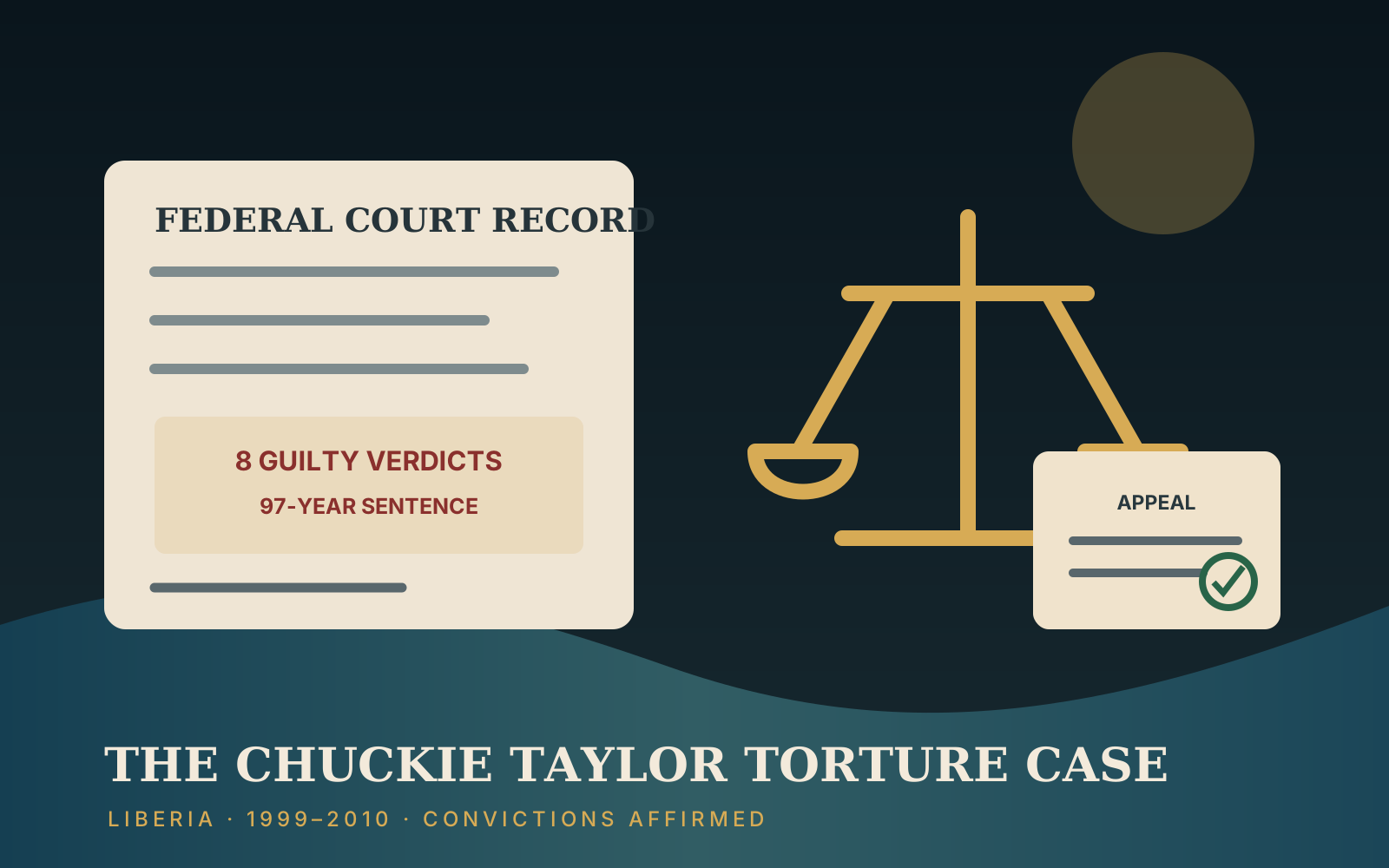
Status boundary: The jury convicted Taylor on torture, conspiracy and firearm charges; the court of appeals affirmed the entire judgment. The case did not adjudicate every abuse committed during Liberia’s conflicts, and it is separate from the Special Court for Sierra Leone prosecution of his father, former president Charles Taylor.
Who is Roy Belfast Jr., known as Chuckie Taylor?
Roy M. Belfast Jr. was born in the United States and is also identified in the appellate record as Charles McArthur Emmanuel, Charles Taylor Jr. and “Chuckie” Taylor. He is the son of former Liberian president Charles Taylor. The Eleventh Circuit recorded that he returned to Liberia before his father won the presidency in 1997 and was then placed in charge of creating and overseeing the Anti-Terrorist Unit, or ATU.
The ATU was presented as a security force for the president, government facilities and dignitaries. Human Rights Watch reported that its role expanded after renewed insurgency in 1999. The criminal case focused on Taylor’s conduct and leadership within that unit, not on family association alone.
What was Liberia’s Anti-Terrorist Unit?
The published appellate opinion describes the ATU as a state security and paramilitary organization operating during Charles Taylor’s presidency. Its principal training and detention site was Gbatala Base, southwest of Gbarnga. Witnesses described prison pits and other detention areas at the base, and testified that Taylor was recognized by unit members as their commander.
That context mattered legally because the Torture Act requires qualifying conduct under color of law. Prosecutors did not ask the jury to infer responsibility merely because Taylor held a title. They presented testimony from survivors, former bodyguards, ATU members and federal investigators about his direct actions, orders and command role.
What did survivors tell the jury?
The Eleventh Circuit summarized testimony from several people detained by the ATU, including Sierra Leonean refugees Sulaiman Jusu and Momoh Turay and Liberian detainees Rufus Kpadeh and Blahyee Dulleh. The court record describes detention without legal process, severe beatings, burns, electrical shocks, cutting and confinement in dangerous conditions. Some witnesses also described killings used to terrorize other detainees.
This archive does not repeat the most graphic details. The relevant evidentiary point is that survivors testified under oath, their accounts were tested during a six-week trial, and the jury returned guilty verdicts on every charged count. Human Rights Watch separately reported that more than 20 witnesses appeared for both prosecution and defense.
Why was the case prosecuted in the United States?
The prosecution was brought under 18 U.S.C. §§ 2340 and 2340A, commonly called the federal Torture Act. The statute reaches qualifying torture committed outside the United States when jurisdiction exists. In Taylor’s case, the appellate court said no “present-in” theory was needed because he was a United States citizen.
Taylor was arrested after attempting to enter the United States at Miami International Airport on 30 March 2006. The Department of Justice first prosecuted false statements connected to his passport. He pleaded guilty to passport fraud, while federal investigators developed the separate torture case.
The torture prosecution was the first completed U.S. case under the federal statute for torture committed abroad. That historical importance does not replace proof of the individual counts; it explains why the jurisdictional and constitutional questions received extensive appellate review.
What charges reached the jury?
After the six-week trial, the jury convicted Taylor on all eight counts on 30 October 2008:
- five counts of torture;
- one count of conspiracy to commit torture;
- one count of using a firearm during a crime of violence; and
- one count of conspiracy to use a firearm during a crime of violence.
The charged conduct occurred in Liberia between April 1999 and July 2003. The verdict did not rest on a single generalized allegation. Separate torture counts addressed conduct involving different survivors and episodes, while the conspiracy counts addressed coordinated activity.
Why was the sentence 97 years?
On 9 January 2009, U.S. District Judge Cecilia M. Altonaga sentenced Taylor to 97 years in federal prison. The Department of Justice stated that the term reflected the five torture convictions, the torture conspiracy and the firearm-related convictions.
The Eleventh Circuit later explained an important boundary: Taylor was sentenced for the federal offenses of conviction, not convicted in that case of separate kidnapping or murder counts. The sentencing court could nevertheless consider proven related conduct when calculating the advisory guideline range. This page therefore does not relabel the judgment as a murder conviction.
What did the Eleventh Circuit decide?
Taylor challenged the constitutionality of the Torture Act, its application to conduct outside the United States, the firearm convictions, trial procedure and the sentence. On 15 July 2010, a published Eleventh Circuit opinion rejected those arguments and affirmed the convictions and sentence in full.
The appellate court held that Congress could enact the Torture Act to implement the Convention Against Torture, that both torture and conspiracy could be criminalized, and that the statute could be applied to Taylor’s overseas conduct. It also upheld the extraterritorial application of the firearm statute in the circumstances of the case and found no reversible trial or sentencing error.
Why is the case classified as solved?
Crime by Region uses “solved” when reliable judicial material establishes individual criminal responsibility. This case meets that standard because:
- the defendant was tried before a federal jury;
- the jury returned guilty verdicts on all eight counts;
- a federal judge imposed sentence; and
- a published appellate decision affirmed the convictions and sentence in every respect.
The classification is narrower than a claim that justice for Liberia’s civil-war era is complete. The U.S. case determined Taylor’s responsibility for the charged torture offenses. It did not resolve every alleged crime by the ATU or every abuse attributed to other actors.
How is this different from Charles Taylor’s Sierra Leone case?
Two defendants and two legal proceedings must not be merged. Former Liberian president Charles Taylor was convicted by the Special Court for Sierra Leone for crimes committed in Sierra Leone. This page concerns his son, Roy Belfast Jr., and a U.S. federal conviction for torture committed in Liberia.
The cases overlap historically because both arose from regional conflicts and involved members of the same family, but they have different courts, charges, victims, evidentiary records and judgments. The separate Charles Taylor case file covers the Special Court proceeding.
Case timeline
- 1997
Charles Taylor becomes Liberia’s president, and Roy Belfast Jr. is placed in charge of organizing the Anti-Terrorist Unit. - April 1999–July 2003
The period of torture-related conduct charged in the federal case. - 30 March 2006
Taylor is arrested while attempting to enter the United States at Miami International Airport. - 6 December 2006
Federal authorities announce the first U.S. indictment under the Torture Act for overseas conduct. - 29 September 2008
The federal trial begins in Miami. - 30 October 2008
The jury convicts Taylor on all eight counts. - 9 January 2009
Judge Cecilia M. Altonaga imposes a 97-year prison sentence. - 15 July 2010
The Eleventh Circuit affirms the convictions and sentence in full. - 16 October 2026
The archive rechecks official and institutional sources; no later reversal of the judgment is located.
What can the available sources prove?
The published appellate opinion is the strongest source for the factual record presented at trial, the statutory questions raised on appeal and the final direct-appeal result. The Justice Department’s sentencing release confirms the exact eight convictions, date of sentence, 97-year term and investigation history.
Human Rights Watch supplies contemporaneous context on the ATU, the trial’s witnesses and the significance of the first verdict under the federal overseas-torture law. An OHCHR-hosted Amnesty submission and current ICE material independently preserve the conviction in institutional records. Together, these sources support the case classification without relying on unsourced biographies or sensational retellings.
Frequently asked questions
Who is Chuckie Taylor?
Roy M. Belfast Jr., also known as Charles McArthur Emmanuel and Charles “Chuckie” Taylor Jr., is a U.S. national and the son of former Liberian president Charles Taylor. He commanded Liberia’s Anti-Terrorist Unit during his father’s presidency.
What was Chuckie Taylor convicted of?
A federal jury convicted him of five counts of torture, one count of conspiracy to torture, one firearm count connected to a violent crime and one conspiracy count connected to a firearm offense.
What sentence did he receive?
On 9 January 2009, U.S. District Judge Cecilia M. Altonaga sentenced him to 97 years in federal prison.
Why could the United States prosecute conduct in Liberia?
Taylor was a U.S. national. The federal Torture Act provides jurisdiction over qualifying torture committed outside the United States when the offender is a U.S. national or is present in the United States.
Was the conviction upheld on appeal?
Yes. On 15 July 2010, the Eleventh Circuit affirmed all convictions and the 97-year sentence in full.
Why is this case classified as solved?
Individual criminal responsibility was established by eight jury convictions after trial, sentence was imposed, and the federal appellate court affirmed the result. This does not mean the wider pattern of abuses in Liberia was fully adjudicated.
Sources and further reading
- U.S. Court of Appeals for the Eleventh Circuit — United States v. Belfast, published opinion, 15 July 2010Primary judicial source for the trial record, legal issues and full affirmance of the convictions and sentence.
- U.S. Department of Justice — Roy Belfast Jr. sentenced on torture charges, 9 January 2009Official record of the eight convictions, 97-year sentence, charged period and investigative agencies.
- U.S. Immigration and Customs Enforcement — Investigation and conviction record, updated 9 June 2025Current institutional summary of the prosecution and sentencing.
- Human Rights Watch — First verdict for overseas torture, 30 October 2008Contemporaneous account of the verdict, trial witnesses, ATU background and legal significance.
- Human Rights Watch — Chuckie Taylor indicted for torture, 1 February 2007Pretrial context and documentation of the allegations against the ATU.
- OHCHR-hosted Amnesty International submission for Liberia’s Universal Periodic ReviewInstitutional record noting the torture conviction and wider accountability context.
Verification date: 16 October 2026. Core facts were cross-checked against the published appellate judgment, federal agency records, an OHCHR-hosted submission and contemporaneous Human Rights Watch reporting. The Eleventh Circuit’s 2010 decision affirmed the judgment in full; no later reversal was found in the official and institutional sources reviewed.