What the case established
Charles Ghankay Taylor was president of neighboring Liberia, not Sierra Leone. The Special Court nevertheless prosecuted him for his contribution to crimes committed in Sierra Leone by the Revolutionary United Front and the Armed Forces Revolutionary Council. That distinction explains both the country's place in this archive and the care required in describing the judgment: the court assessed an external leader's criminal responsibility for a defined set of crimes, not the entire history of the conflict.
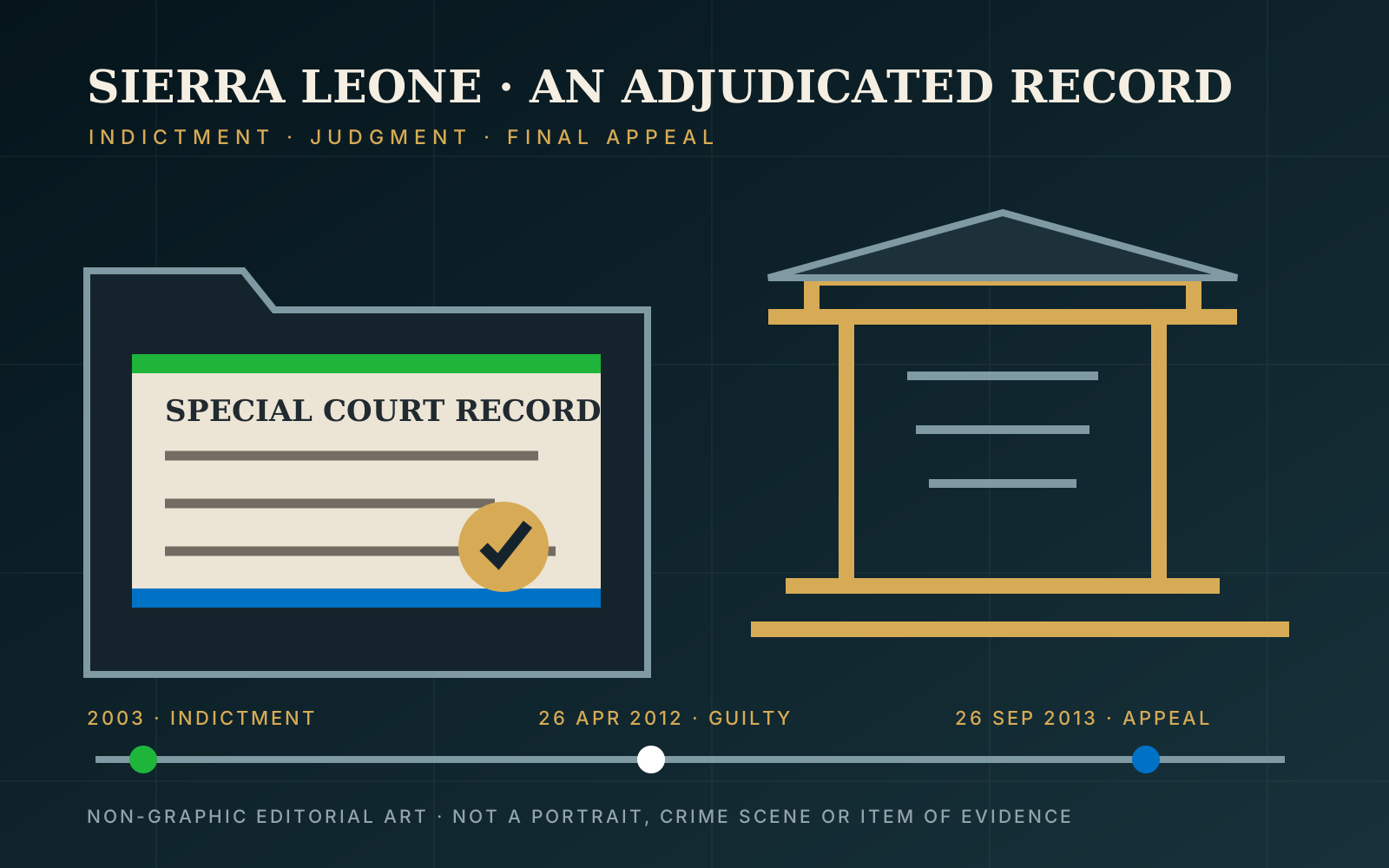
On April 26, 2012, Trial Chamber II found Taylor guilty on all 11 counts. The court's official case summary states that he planned crimes and aided or abetted crimes committed by rebel forces. On May 30, the judges imposed a single 50-year prison sentence. The Appeals Chamber upheld the convictions and sentence on September 26, 2013.
The judgment was legally significant because it placed a former head of state before an internationalized court and reached a final conviction after a full trial and appeal. Significance does not erase limits. The findings must be read count by count and defendant by defendant; they cannot be converted into a verdict against a population, a country or everyone who appeared in the historical narrative.
The Special Court and its mandate
The Special Court for Sierra Leone was created by agreement between the United Nations and the Government of Sierra Leone. Its mandate focused on those bearing the greatest responsibility for serious violations of international humanitarian law and Sierra Leonean law committed in the country after November 30, 1996. It was a hybrid institution: international and Sierra Leonean judges, law and personnel worked within a court established specifically for the conflict.
Taylor's original indictment was approved on March 7, 2003 and unsealed on June 4 while he was still Liberia's president. The charging document was later amended to 11 counts. The counts concerned acts of terrorism against civilians, murder, violence to life and cruel treatment, rape, sexual slavery, outrages upon personal dignity, other inhumane acts, enslavement, pillage, and the recruitment and use of children under 15.
Listing charges is not the same as reproducing graphic evidence. The legal labels identify what the court adjudicated. This archive avoids sensational detail and centers the procedural record: how the accused entered custody, how the parties presented evidence, what the judges decided and what remained outside the case.
Arrest, transfer and venue
Taylor left power in Liberia in 2003 and lived in Nigeria. He was arrested on March 29, 2006 and transferred to the Special Court in Freetown. At his initial appearance, he pleaded not guilty. These milestones matter because an indictment alone would not justify calling the case solved; custody and trial were still required.
For security reasons, the proceeding was moved from Freetown to The Hague under arrangements authorized by United Nations Security Council Resolution 1688. The change of courtroom did not turn it into a different country's prosecution. The Special Court retained jurisdiction, its judges controlled the proceeding, and the charged conduct remained crimes committed in Sierra Leone.
The trial opened on June 4, 2007. Evidentiary hearings resumed on January 7, 2008. The prosecution called 100 witnesses, and the defence case included Taylor and 20 other witnesses, according to the court's case record. A long evidentiary process followed before the judges delivered their judgment.
The theory of responsibility
The Trial Chamber did not convict Taylor merely because he was a powerful regional figure or because crimes occurred while he held office. It evaluated modes of individual criminal responsibility. Its final findings distinguished planning from aiding and abetting and connected those forms of responsibility to the crimes proved at trial.
In plain language, planning concerns a substantial contribution to the design of criminal conduct, while aiding or abetting concerns practical assistance, encouragement or moral support that substantially affects crimes. Those labels are legal conclusions grounded in the judgment; they are more precise than saying Taylor personally carried out every underlying act or commanded every offender.
The chamber found that Taylor supplied forms of support to the RUF and AFRC and that this assistance contributed to their operational capacity. It also examined communications, relationships, arms and ammunition, diamonds, advice and the accused's knowledge of the crimes. The full judgment contains the evidentiary reasoning. This page summarizes the result without treating every allegation heard at trial as a separate judicial finding.
The 11-count guilty judgment
On April 26, 2012, the Trial Chamber found Taylor guilty on every count in the amended indictment. The decision made clear that the court was assigning responsibility for planning certain attacks and aiding or abetting crimes committed by rebel forces in Sierra Leone. The judgment did not accept every aspect of the prosecution's case: notably, it did not convict Taylor on the broad theory that he exercised command responsibility over all rebel operations.
That distinction protects accuracy. A shorthand claim that Taylor “controlled everything” would overstate the judgment, just as describing him as only a political supporter would understate it. The official outcome rests on the specific modes of liability the judges found proved beyond reasonable doubt.
The chamber's findings covered multiple categories of war crimes and crimes against humanity. They arose from a campaign in which civilians were subjected to killings, sexual violence, forced labor, pillage, terror, mutilation and the recruitment and use of children. The archive names those categories because they are elements of the judicial record, while avoiding graphic narration that would turn victimization into spectacle.
The 50-year sentence
On May 30, 2012, the Trial Chamber sentenced Taylor to 50 years' imprisonment. Sentencing was separate from the guilty judgment: the parties made submissions and the judges assessed the gravity of the crimes, Taylor's role and relevant aggravating or mitigating considerations.
The court rejected both the idea that the sentence should be symbolic and the idea that former political office insulated the accused. The 50-year term reflected the scale and gravity of the adjudicated conduct while remaining a sentence imposed on one person for the counts before the chamber.
Crime by Region therefore records the sentence as part of the case's core status, not as a measure of whether every survivor received justice. Criminal punishment, truth recovery, victim recognition and reparations are related but distinct outcomes.
Appeal and final judgment
Both the defence and prosecution raised issues on appeal. On September 26, 2013, the Appeals Chamber upheld Taylor's convictions and the 50-year sentence. The court issued the related sentence order on October 4. The appellate judgment made the result final within the Special Court system.
A final appeal is the key reason the case is classified as adjudicated rather than merely charged or tried. Taylor was not listed here because he was suspected, indicted or politically blamed. He was convicted after an evidentiary trial, sentenced, and the judgment survived appellate review.
Finality is not universality. Other Special Court cases addressed other defendants, and many experiences of the war never became a count in Taylor's indictment. The archive can later add distinct cases under their own facts and status without using this judgment as a substitute.
What the judgment does—and does not—mean
The Residual Special Court describes Taylor as the first former head of state convicted by an international court since the post-Second World War trials. The case demonstrated that official position did not prevent prosecution and that cross-border support to armed groups could be tested through individual criminal-liability rules.
But institutional importance can become misleading when reduced to a slogan. The court did not put Sierra Leone's entire war on trial. It did not issue a comprehensive finding about every Liberian or Sierra Leonean actor. It did not transform uncharged allegations into convictions. And it did not make the experiences of victims interchangeable.
A responsible case page keeps those boundaries visible. It identifies Taylor as Liberian, locates the charged crimes in Sierra Leone, identifies The Hague as the courtroom, and describes the Special Court as the adjudicating institution. Each entity and location serves a different role.
Verified timeline
- March 7, 2003: The Special Court approves the original indictment.
- June 4, 2003: The indictment is unsealed while Taylor is Liberia's president.
- March 16, 2006: The prosecution files the amended 11-count indictment.
- March 29, 2006: Taylor is arrested and transferred to the Special Court in Freetown.
- June 4, 2007: Trial opens in The Hague.
- January 7, 2008: Evidentiary proceedings resume.
- April 26, 2012: Trial Chamber II finds Taylor guilty on all 11 counts.
- May 30, 2012: The chamber imposes a 50-year sentence.
- September 26, 2013: The Appeals Chamber upholds the convictions and sentence.
- October 4, 2013: The court issues the appeal sentence order.
Why Crime by Region marks it solved
The site's classification distinguishes an accusation from a final criminal outcome. Taylor pleaded not guilty, received a multi-year trial, was convicted on all counts, was sentenced, and completed the available appeal. “Solved / adjudicated” accurately describes that procedural position.
The qualifier is essential. It limits the label to Taylor and the 11 counts. Civil-war history, harms outside the indictment, other perpetrators, reparations and the individual stories of victims cannot be compressed into a single solved marker.
Frequently asked questions
What was Charles Taylor convicted of?
The Special Court convicted him on all 11 counts for planning and aiding or abetting war crimes and crimes against humanity committed by rebel forces in Sierra Leone.
When was he convicted and sentenced?
The guilty judgment was delivered on April 26, 2012. The 50-year sentence followed on May 30, 2012.
What happened on appeal?
The Appeals Chamber upheld the convictions and the 50-year sentence on September 26, 2013.
Why was the trial in The Hague?
The case was moved from Freetown for security reasons. It remained a Special Court for Sierra Leone proceeding.
Was Taylor president of Sierra Leone?
No. He was Liberia's former president. The case concerned his responsibility for crimes committed in neighboring Sierra Leone.
Does this verdict cover every crime from the war?
No. It is limited to Taylor's responsibility on the 11 counts adjudicated by the Special Court.
Sources and source-quality review
- Residual Special Court for Sierra Leone — Charles Taylor case recordOfficial case chronology, indictment, arrest, witness totals, convictions, sentence and appeal outcome.
- RSCSL — Taylor Trial Chamber decisionsOfficial index linking the April 26, 2012 judgment and May 30, 2012 sentencing judgment.
- RSCSL — Taylor Appeals Chamber decisionsOfficial index linking the September 26, 2013 appeal judgment and October 4 sentence order.
- United Nations Security Council Resolution 1688 (2006)Primary document addressing the trial's transfer to The Hague and security arrangements.
Editorial review: all procedural dates and status claims were checked against the court's official case and decision indexes. The page separates indictment, conviction, sentence and appeal; limits “solved” to one defendant; and uses non-graphic artwork that is explicitly not evidence.