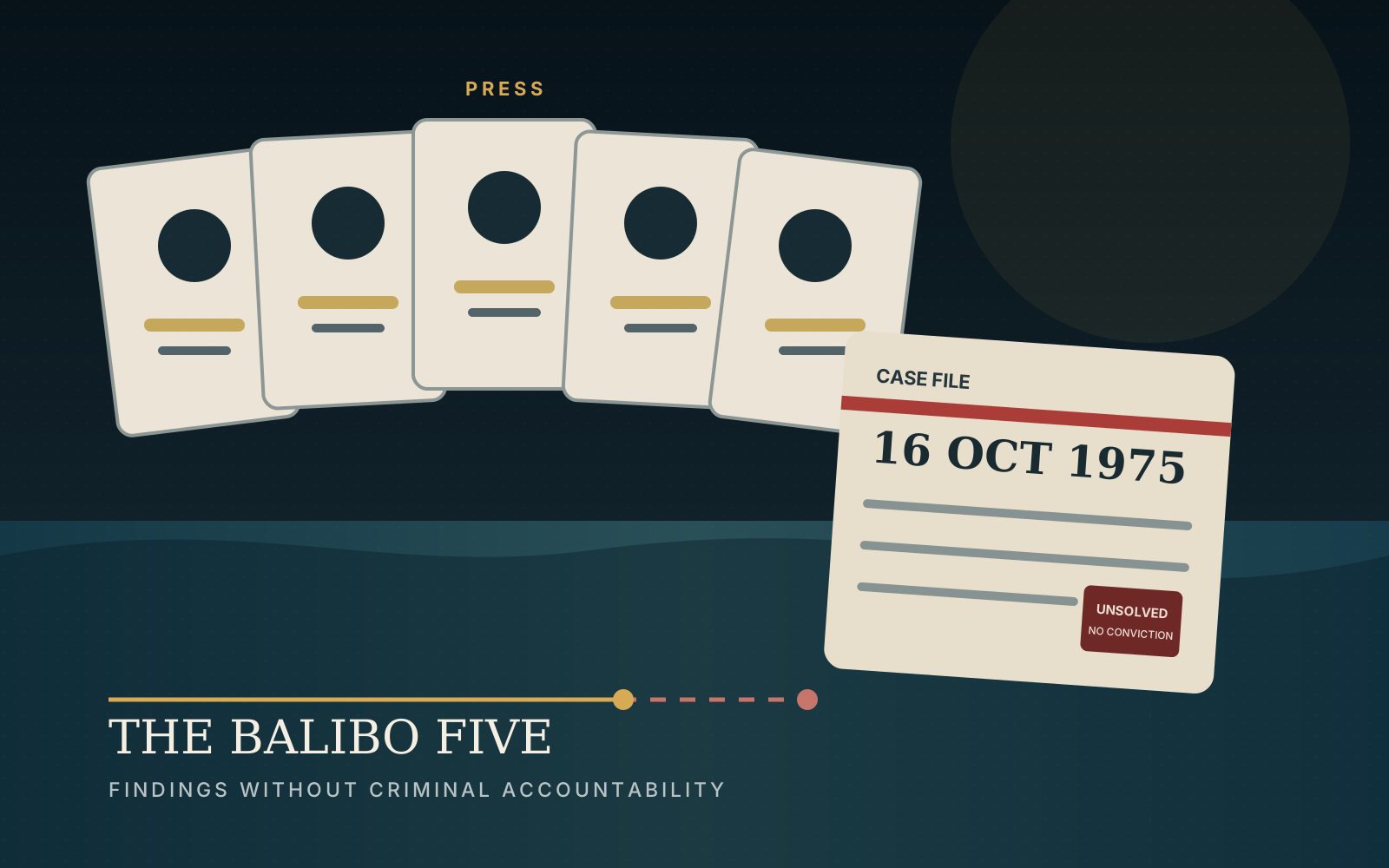
Status boundary: The 2007 inquest is an authoritative judicial fact-finding record, but it was not a criminal trial. Its findings do not amount to a conviction, and this page does not describe any named person as criminally guilty without a criminal judgment.
Who were the Balibo Five?
The Balibo Five were two television crews working for Australian networks. Reporter Greg Shackleton, sound recordist Tony Stewart and camera operator Gary Cunningham worked for Channel Seven. Reporter Malcolm Rennie and camera operator Brian Peters worked for Channel Nine. Peters and Rennie were British, Cunningham was from New Zealand, and Shackleton and Stewart were Australian; all five were based in Australia.
They travelled separately into Portuguese Timor during a rapidly deteriorating decolonization crisis. By October 1975, Indonesian forces and Timorese allies were conducting cross-border operations before Indonesia’s full-scale invasion in December. The journalists went to Balibo, near the border, to document fighting and the presence of forces whose role had not been publicly acknowledged.
The five are grouped under one case name because they were killed during the same attack and because the later coronial finding concerning Brian Peters expressly addressed the circumstances of all five deaths. Treating the group as one case does not erase their individual lives, nationalities or professional roles.
What were they reporting?
The crews were covering the conflict between Timorese political factions and the covert Indonesian advance. Balibo was strategically important because it stood close to the border and on a route toward the interior. The journalists had filmed evidence relevant to whether Indonesian regular or special forces were participating directly.
Greg Shackleton’s final televised report showed the Australian flag painted on the house where the Channel Seven team stayed. The image later became central to public memory, but the legal question was not whether the symbol could protect them. The inquest examined what attacking forces knew about the journalists, the warnings available to the crews and the purpose attributed to their deaths.
What happened on 16 October 1975?
Indonesian and aligned forces attacked Balibo in the early morning. For decades, official accounts maintained that the journalists had died accidentally in crossfire. Witness evidence, communications material and other records produced a competing account: that they had survived the immediate fighting, identified themselves as journalists and were then deliberately killed.
The 2007 inquest concluded that Peters and the other four men died from wounds sustained when they were shot or stabbed deliberately, not in the heat of battle. The finding said the purpose was to prevent them revealing that Indonesian special forces had participated in the attack on Balibo. It identified members of the force whom the evidence connected to the operation and described Captain Yunus Yosfiah as giving the order.
Committee to Protect Journalists reported that the coroner also found efforts had been made to disguise the circumstances after the deaths, including photographing bodies in Portuguese uniforms and burning them. These are findings of the inquest, not findings from a criminal trial, and the distinction remains essential.
Why did the public account remain disputed?
The crossfire explanation and the deliberate-killing conclusion are not interchangeable versions with equal legal weight. The former was the official Indonesian position recorded after the event; the latter followed a public six-week coronial process in Australia that examined testimony and documentary evidence. Indonesian officials invited to participate did not give evidence to the inquest, and Indonesia continued to reject the coroner’s conclusion.
Early Australian inquiries and diplomatic records did not produce a criminal process. Over time, declassified documents, witness accounts, journalistic investigations and the work of Timor-Leste’s truth and reconciliation process challenged the accidental-death narrative. The New South Wales proceeding became the first open Australian judicial inquiry to make a formal finding on how the men died.
This archive reports the coroner’s conclusion as an official finding while also making clear that a contested historical account is not itself a conviction. Criminal liability requires a court with jurisdiction, charges, a fair trial and proof under the applicable criminal standard.
What did the 2007 coronial inquest decide?
Deputy State Coroner Dorelle Pinch conducted the inquest because Brian Peters had lived in New South Wales. The proceeding examined the attack on Balibo, opportunities to leave, Indonesian and Australian knowledge, the treatment and identification of the bodies, and evidence of cover-up and denial.
On 16 November 2007, the coroner found that the journalists had been deliberately killed to prevent disclosure of Indonesian special-forces involvement. The finding said the deaths could constitute grave breaches of the Geneva Conventions and referred the record to the Australian Attorney-General for consideration of prosecution.
The inquest resolved a central factual question—whether the deaths were accidental crossfire—but could not return a criminal verdict. It heard evidence about particular individuals and a command structure, yet no defendant stood trial before it. Crime by Region therefore uses the finding as the strongest source on manner and purpose of death while preserving the unresolved criminal status.
What happened to the Australian police investigation?
Following the coronial referral, the Australian Federal Police opened a war-crimes investigation in 2009. The existence of an official finding did not remove the practical and legal burdens facing investigators: events had occurred decades earlier, in another jurisdiction, during an armed conflict, and cooperation and admissible evidence were significant issues.
In October 2014, the AFP announced that it would take no further action. Its statement, reported by the Australian Broadcasting Corporation, said investigators had encountered challenges establishing jurisdiction, had continued trying to overcome them and had ultimately concluded that there was insufficient evidence to prove an offence. The agency said it had exhausted all inquiries then available.
Closing the investigation did not overturn the coronial finding or affirm the crossfire account. It meant the AFP did not believe the available evidence could sustain an Australian criminal case. No acquittal occurred because no prosecution had begun.
What was the position fifty years later?
On 16 October 2025, Timor-Leste marked the fiftieth anniversary of the deaths at Balibo and celebrated National Press Freedom Day. The Government of Timor-Leste described the event as the anniversary of the assassination of the five journalists and linked their legacy to the country’s independence struggle and to the international search for truth.
President José Ramos-Horta posthumously conferred the Collar of the Order of Timor-Leste on journalists killed during the independence struggle, including the Balibo Five. These acts recognize memory and national significance; they do not substitute for prosecution.
Recent university and press-freedom assessments continued to state that no one had been held criminally accountable. The archive’s review through 17 October 2026 located no later official criminal judgment or conviction. Because that status can change, the review date is stated and the case should be updated if a competent authority begins new proceedings or reaches a judgment.
Why is the case classified as unsolved?
Crime by Region classifies the Balibo Five case as unsolved because:
- the 2007 proceeding was a coronial inquest, not a criminal prosecution;
- no individual conviction for the five killings was identified;
- the AFP investigation closed in 2014 without a charge; and
- official commemorations and current reporting still described accountability as outstanding fifty years after the deaths.
“Unsolved” does not mean nothing is known. The historical and coronial record is unusually detailed, and the inquest reached a clear conclusion about manner, purpose and forces involved. The label identifies the missing element: adjudicated individual criminal responsibility.
Case timeline
- Early October 1975
Two Australian television crews enter Portuguese Timor to report on the conflict and covert cross-border military activity. - 16 October 1975
Greg Shackleton, Tony Stewart, Gary Cunningham, Brian Peters and Malcolm Rennie are killed during the attack on Balibo. - 7 December 1975
Indonesia launches its full-scale invasion of East Timor. - September 2000
Committee to Protect Journalists reports that the United Nations is investigating the five deaths. - 5 February 2007
The New South Wales inquest into Brian Peters’s death opens in Sydney. - 16 November 2007
The coroner finds that all five journalists were deliberately killed and refers the matter for possible war-crimes prosecution. - 2009
The Australian Federal Police opens a war-crimes investigation. - 21 October 2014
The AFP confirms that it has closed the investigation without charge, citing jurisdictional challenges and insufficient evidence to prove an offence. - 16 October 2025
Timor-Leste marks the fiftieth anniversary, honors the journalists and renews the public call to preserve truth and memory. - 17 October 2026
This archive review finds no later charge or criminal conviction for the five killings.
Sources and verification
Coroners Court of New South Wales — executive summary of findings
Australian Broadcasting Corporation — AFP statement closing the investigation (21 October 2014)
Committee to Protect Journalists — coronial findings and accountability response (19 November 2007)
Government of Timor-Leste — fiftieth-anniversary commemoration (16 October 2025)
Presidency of Timor-Leste — posthumous national honors for journalists (16 October 2025)
University of the Sunshine Coast — fifty-year accountability review (October 2025)
Editorial method: The page treats the coronial findings, disputed historical accounts, the AFP investigative decision and the absence of prosecution as separate facts. It does not convert a coroner’s conclusion into a criminal conviction or attribute guilt beyond the wording and legal scope of the cited records. Last reviewed 17 October 2026.
Frequently asked questions
Why is the case classified as unsolved?
The New South Wales coronial inquest made findings about the five deaths, but no person has been criminally convicted. The later Australian Federal Police investigation ended without charge.
Who were the Balibo Five?
They were Greg Shackleton, Tony Stewart, Gary Cunningham, Brian Peters and Malcolm Rennie, two television crews based in Australia and reporting from Balibo.
What did the 2007 coroner find?
Deputy State Coroner Dorelle Pinch found that the journalists were deliberately shot or stabbed by members of Indonesian special forces to stop them revealing the forces’ participation in the attack on Balibo.
Did the coronial finding convict anyone?
No. A coronial inquest determines facts surrounding a death; it is not a criminal trial and cannot substitute for a conviction.
Why did the AFP close its investigation?
In 2014 the Australian Federal Police said it had exhausted its inquiries, faced jurisdictional challenges and had insufficient evidence to prove an offence.
Had anyone been held criminally accountable by October 2026?
No criminal judgment or conviction for the five killings was identified in the official and reputable sources reviewed through 17 October 2026.