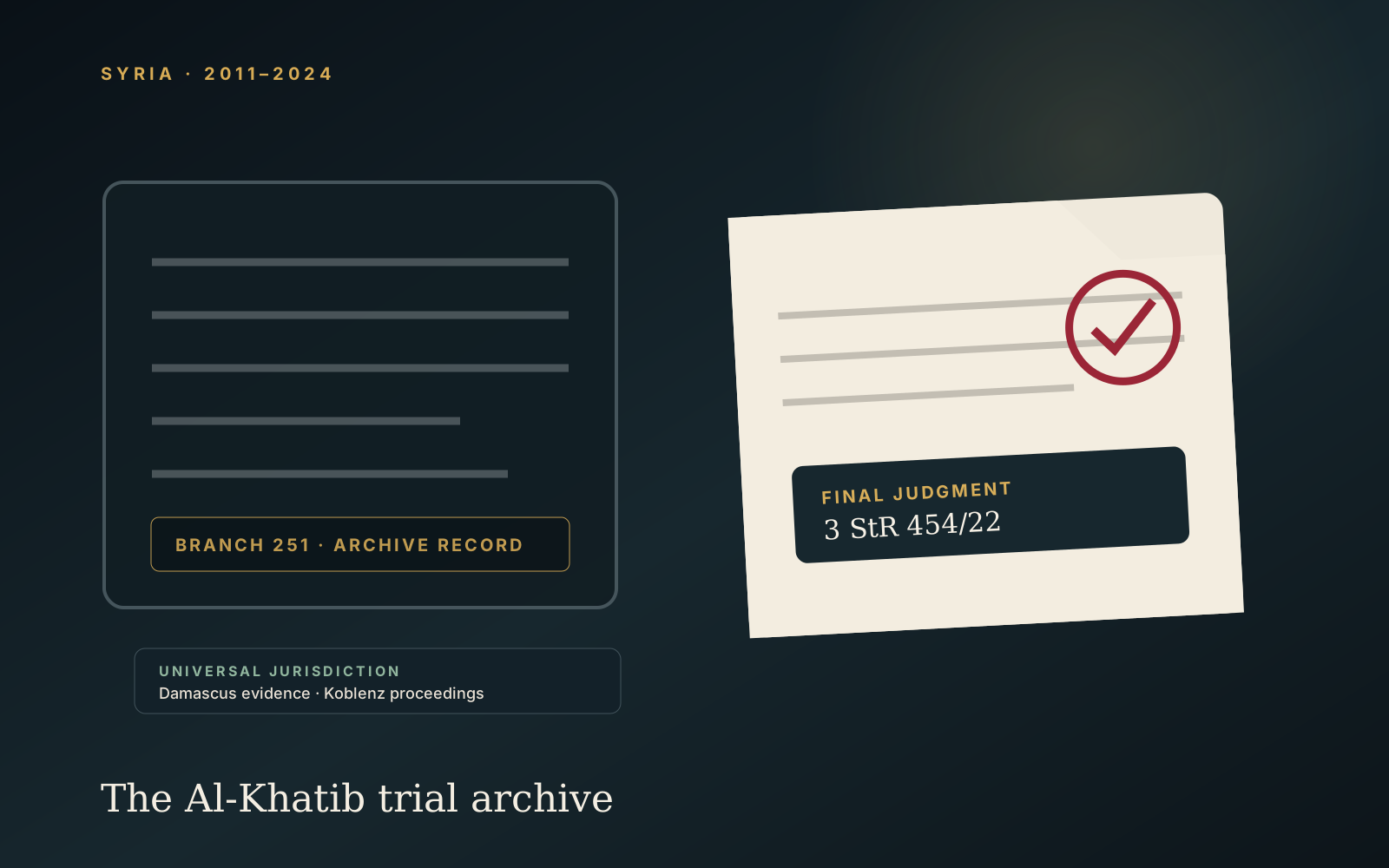
Status boundary: “adjudicated” describes Anwar Raslan's final conviction and the conduct proved against him. It does not mean that every official connected to Branch 251, every disappearance, or Syria's wider detention system has been fully investigated or judged.
What the case concerned
Branch 251—also called the Al-Khatib branch—was a facility of Syria's General Intelligence Directorate in Damascus. The German proceedings examined crimes committed there during the violent suppression of protests that began in 2011. Witnesses and documentary evidence described a system in which detainees were held in extreme conditions, interrogated and subjected to torture. The case did not treat those acts as isolated assaults: prosecutors and the court addressed them within a broader attack on the civilian population.
Anwar Raslan had served in the Syrian intelligence apparatus. The period central to his case ran from at least 29 April 2011 to 7 September 2012, when he headed the investigations section at Branch 251. The Open Society Justice Initiative's case record describes the branch as responsible for Damascus and Rural Damascus and notes that high-level detainees were transferred there. Raslan later left Syria and eventually entered Germany.
Accounts of the case sometimes mix the indictment with the verdict. The prosecution allegations referred to more than 4,000 detainees and 58 deaths. The January 2022 judgment, as summarized by the European Center for Constitutional and Human Rights, convicted Raslan as a co-perpetrator of torture, 27 murders, sexual violence and other crimes. This archive uses the verdict formulation when describing what was judicially established and labels charge-stage figures as allegations.
Why Germany could prosecute
The crimes occurred in Syria, the accused was Syrian and many survivors were Syrian. Germany nevertheless had jurisdiction under its Code of Crimes against International Law. The principle involved is universal jurisdiction: for a limited group of the gravest international crimes, a national court may investigate and prosecute conduct committed abroad without the ordinary territorial or nationality connection.
Universal jurisdiction does not transfer ownership of the history away from Syrians. It supplies a forum when territorial proceedings are unavailable or inadequate. Syrian survivors, lawyers, civil-society organizations and documentation groups were central to building the record. Several survivors participated in the trial as joint plaintiffs, a role under German procedure that allowed their lawyers to take part alongside the public prosecutor.
The Federal Court of Justice later addressed an important legal boundary. Its 2024 decision confirmed that general functional immunity does not shield state officials from prosecution for crimes under international law. That conclusion concerned the law applied to this defendant; it did not decide the responsibility of officials who were not before the court.
Arrest, indictment and opening of trial
German police arrested Raslan on 12 February 2019. The Federal Prosecutor's Office filed the indictment in October 2019, and the trial opened at the Higher Regional Court in Koblenz on 23 April 2020. The proceeding was widely described as the first criminal trial worldwide to examine Syrian state torture as crimes against humanity.
Raslan was initially tried alongside former intelligence employee Eyad al-Gharib. Their outcomes must not be merged. Al-Gharib's case was severed, and the Koblenz court sentenced him in February 2021 to four years and six months for aiding and abetting crimes against humanity involving 30 detainees. The present case file centers on Raslan, whose later judgment involved a different level of responsibility and a different sentence.
The trial heard survivors who described detention and interrogation, as well as experts and investigators who situated Branch 251 within the Syrian security structure. Documentary work conducted before the arrests also mattered. Civil-society organizations had collected witness accounts and other material and shared dossiers with German prosecutors. The criminal court, however, remained responsible for testing evidence and deciding guilt under the applicable standard.
The 2022 verdict
On 13 January 2022, the Higher Regional Court in Koblenz convicted Raslan of crimes against humanity and sentenced him to life imprisonment. ECCHR's verdict summary states that the court found him to be a co-perpetrator of torture, 27 murders, cases of sexual violence and other crimes at Al-Khatib. Amnesty International likewise recorded a conviction including torture, murder and rape of detainees.
The court's crimes-against-humanity finding was important because it recognized the acts as part of a widespread or systematic attack rather than merely a collection of unrelated offenses. Sexual violence was treated within that international-crimes framework. ECCHR also noted a limit: enforced disappearance, despite its repeated appearance in survivor testimony and its importance to Syrian families, was not separately convicted in Raslan's judgment.
A life sentence did not end the case immediately. Raslan filed an appeal on points of law, asking the Federal Court of Justice to review claimed legal errors. An appeal of that kind is not a new trial of every witness; it examines whether the lower court's judgment can stand under the law and procedure.
The final appeal decision
The Third Criminal Panel of Germany's Federal Court of Justice decided the appeal on 20 March 2024. In a press release issued on 5 August 2024, the court announced that it had rejected Raslan's appeal and confirmed the Koblenz judgment. The conviction and life sentence therefore became final.
The appeal record is the key reason this archive classifies the case as solved or adjudicated rather than merely charged or tried. There is a first-instance conviction, a sentence and completed review by the country's highest criminal court for the questions raised. The date distinction is preserved: 20 March is the date of the judicial decision; 5 August is the date the Federal Court of Justice publicly announced it.
Finality does not make the wider history final. The judgment is a completed legal determination about one defendant. It does not establish the identity or responsibility of every person who worked at the detention site, settle every missing person's fate, or provide a judgment concerning every branch of Syria's security system.
Survivors and the evidentiary record
The case depended on people who described deeply traumatic detention experiences in a public legal process. Reporting on the proceeding should therefore avoid reducing survivors to the methods of abuse used against them. Their significance was not only that they supplied details. Their testimony helped the court assess how the facility operated, how authority was exercised and whether the crimes formed part of an organized attack.
Fourteen joint plaintiffs and other affected Syrians were supported by ECCHR and partner lawyers. Their participation gave survivors a formal place in the proceeding while still preserving the prosecutor's duty to prove the case and the defense's right to challenge evidence. The judgment did not repair every harm, but it produced a public, reviewable record and an enforceable sentence.
The archive deliberately does not reproduce graphic descriptions. Readers can understand the legal findings, the institutional setting and the court's reasoning without spectacle. The non-graphic artwork likewise uses records and architecture rather than invented portraits or simulated detention scenes.
Why the classification is bounded
Crime by Region marks the case “Solved / adjudicated — bounded.” The solved element rests on the final conviction. The boundary preserves the difference between individual criminal responsibility and a country's entire record of mass abuse. Raslan's judgment cannot be used as a verdict against people who were never defendants, and it cannot close investigations into other detention centers or chains of command.
The wording also separates this case from al-Gharib's earlier conviction. Both proceedings formed part of the Al-Khatib trial history, but each defendant had his own charges, judgment and sentence. A source discussing both men does not justify merging their responsibility into a single outcome.
Finally, the classification avoids presenting universal jurisdiction as a claim that Germany resolved the Syrian conflict. The German court performed a specific judicial task: it determined whether the prosecution proved crimes under German and international criminal law against the accused before it.
Verified timeline
- 29 April 2011: The period identified in case records for Raslan's leadership of investigations at Branch 251 begins.
- 7 September 2012: The charged conduct period at the branch ends.
- 12 February 2019: German police arrest Raslan in Berlin.
- 22 October 2019: Germany's Federal Prosecutor's Office indicts Raslan and al-Gharib before the Koblenz court.
- 23 April 2020: The Al-Khatib trial opens at the Higher Regional Court in Koblenz.
- 24 February 2021: Al-Gharib receives a separate four-year-and-six-month sentence for aiding and abetting crimes against humanity.
- 13 January 2022: The court convicts Raslan of crimes against humanity and sentences him to life imprisonment.
- 20 March 2024: The Federal Court of Justice decides to reject Raslan's appeal on points of law.
- 5 August 2024: The Federal Court of Justice publicly announces the decision and confirms that the Koblenz judgment stands.
Frequently asked questions
What was the Al-Khatib trial?
It was a German universal-jurisdiction prosecution concerning crimes against humanity committed at Branch 251, a Syrian intelligence detention facility in Damascus.
Who was Anwar Raslan?
He was a former Syrian intelligence officer who headed the investigations section at Branch 251 during the period examined by the court.
What was Raslan convicted of?
The Koblenz court convicted him of crimes against humanity and found him responsible as a co-perpetrator for torture, 27 murders, sexual violence and other crimes.
What sentence did he receive?
He received life imprisonment on 13 January 2022.
Did the conviction become final?
Yes. The Federal Court of Justice rejected his appeal in a decision of 20 March 2024, announced on 5 August 2024.
Does the verdict resolve all Syrian detention crimes?
No. It establishes Raslan's responsibility for conduct adjudicated in this case; other officials, victims and detention crimes require separate proceedings.
Sources and source-quality review
- Federal Court of Justice — judgment confirmed5 August 2024 · official announcement of the 20 March 2024 decision rejecting Raslan's appeal, case 3 StR 454/22.
- International Crimes Database — appeal judgmentCase 3 StR 454/22 · decision metadata, legal issues and the final appeal record.
- ECCHR — Koblenz verdict summary13 January 2022 · life sentence, crimes-against-humanity finding, 27 murders, torture and sexual violence.
- Amnesty International — verdict and context13 January 2022 · independent human-rights account of the conviction, survivor context and universal jurisdiction.
- Open Society Justice Initiative — case recordCase chronology · role at Branch 251, arrest, indictment, trial opening and survivor participation.
- Syrian Justice and Accountability Centre — trial monitoringDetailed public monitoring of hearings and the procedural history of both defendants.
Editorial review: finality was verified against Germany's Federal Court of Justice; the conviction, sentence and adjudicated crime counts were cross-checked through ECCHR, Amnesty International and the appeal database. Charge-stage allegations are not presented as verdict findings, and Raslan's outcome is not merged with al-Gharib's separate judgment.