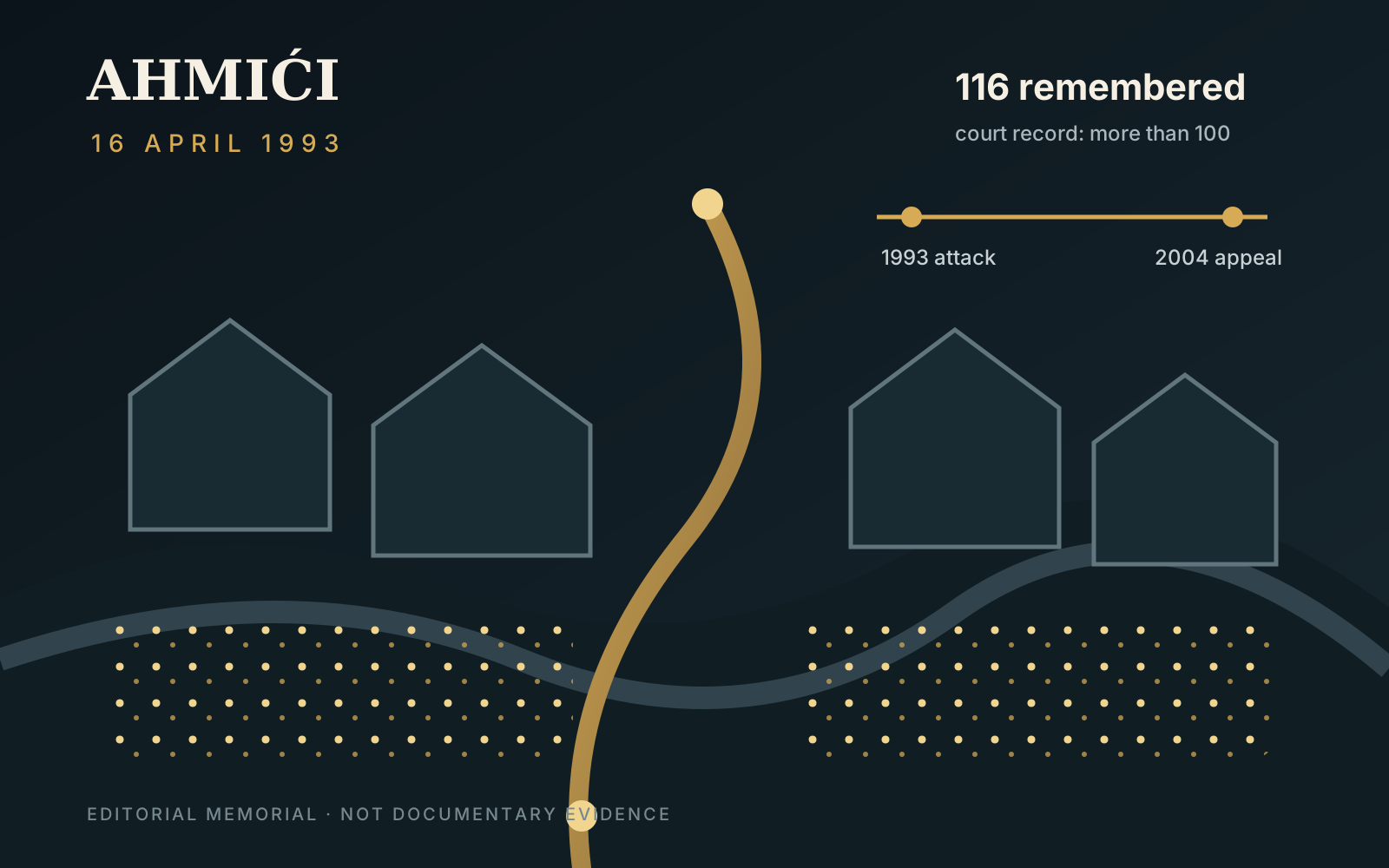
Case-status note: “Solved / adjudicated in part” means final tribunal judgments established individual criminal responsibility for defined conduct. It does not mean that every direct perpetrator was identified, prosecuted or convicted. Mario Čerkez was specifically acquitted of the Ahmići massacre charges even though he was convicted of other crimes.
What happened at Ahmići?
Ahmići was a mixed village in the Lašva Valley, near the road linking Busovača and Vitez. By early 1993, relations between the Bosnian Croat and Bosniak communities had deteriorated as the conflict between the Croatian Defence Council, known as the HVO, and the Army of Bosnia and Herzegovina intensified in central Bosnia.
The ICTY Trial Chamber found that the April attack was not a spontaneous exchange of fire. HVO units launched a coordinated operation against Ahmići and associated hamlets on the morning of April 16. The predominantly Bosniak upper part of the village was surrounded and attacked. Civilians were killed, Bosniak houses were burned, and the village's two mosques were destroyed. The chamber described the operation as designed to remove the Bosniak population from the area.
The court record also matters for what it does not say. A violent episode in an armed conflict does not make every resident, soldier or member of an ethnic group criminally responsible. The judgments assessed named defendants and specific evidence; this archive does the same.
How many victims were killed?
The trial judgment recorded that more than 100 people died, including 32 women and 11 children under the age of 18. The tribunal's later witness record uses the formulation “at least 100 Bosnian Muslim civilians.” Contemporary commemoration in Bosnia and Herzegovina identifies 116 victims.
Those figures are not silently merged. The court's “more than 100” language describes what its record established in the proceeding. The figure 116 belongs to the memorial and later public record. Both document the scale of the crime, but they answer slightly different archival questions.
What did survivor evidence establish?
Abdulah Ahmić testified before the ICTY on June 10 and 11, 1999. The tribunal's witness profile records that his father and brother were killed in front of him, that he survived being shot, and that his mother and three sisters were also killed. He described homes burning, soldiers moving through the village and his attempts to remain hidden until neighbors helped him.
His testimony is cited here because it connects the legal record to the people whose families and community were attacked. The archive omits gratuitous forensic detail. Survivor evidence should explain the crime and the investigation, not turn suffering into spectacle.
How was the crime investigated?
International investigators and prosecutors built the Ahmići record through witness testimony, military and political documents, expert evidence and material concerning the wider Lašva Valley campaign. The Kordić and Čerkez trial lasted from April 1999 until December 2000; the written judgment was issued on February 26, 2001.
The judgment examined not only killings but also unlawful attacks on civilians, destruction, plunder, detention and persecution. Its account of Ahmići was part of a much larger case concerning crimes in Vitez, Busovača, Kiseljak and other locations. That breadth is why this page does not reduce the entire prosecution to a single village or suggest that every count concerned Ahmići.
What was Dario Kordić convicted of?
Dario Kordić was a senior Bosnian Croat political figure. The Trial Chamber convicted him of crimes against humanity, grave breaches of the Geneva Conventions and violations of the laws or customs of war. It found him responsible for planning and instigating crimes in Ahmići and elsewhere and sentenced him to 25 years in prison.
On December 17, 2004, the Appeals Chamber affirmed the 25-year sentence. Its public summary stated that Kordić, as the responsible regional politician, planned and instigated the crimes committed at Ahmići and associated hamlets on April 16, 1993. The appeal allowed limited grounds concerning some locations but left the core Ahmići findings and sentence intact.
Why was Mario Čerkez's result different?
Mario Čerkez commanded the HVO's Viteška Brigade. At trial he was convicted of crimes committed in the Vitez area and received 15 years. The Appeals Chamber later reduced that sentence to six years after allowing most of his appeal grounds.
Crucially, Čerkez was acquitted of charges relating to the Ahmići massacre. The Trial Chamber concluded that his troops did not participate in the initial assault and ensuing massacre, and the Appeals Chamber affirmed that result. Reporting him simply as “convicted for Ahmići” would therefore be inaccurate.
What accountability remained incomplete?
The ICTY itself stressed in the appeal summary that it could not try every person alleged to be among those responsible for crimes in the Lašva Valley. Each chamber could decide only the responsibility of defendants properly before it, on the evidence introduced in that case.
Other proceedings addressed other participants and connected crimes, but no single judgment constitutes a complete roster of the people who planned, ordered, enabled or directly carried out every killing and act of destruction at Ahmići. The strongest editorial status is therefore adjudicated in part: substantial final accountability exists, while the wider record remains larger than the named convictions.
Current status
The Kordić and Čerkez appeal judgment is final. Kordić's 25-year sentence and his responsibility for the Ahmići crimes were affirmed; Čerkez's six-year sentence applied to other crimes, not participation in the massacre. The village's victim commemoration continues to use 116 names, while the tribunal judgment remains the controlling source for the legal findings described here.
No later judgment was located that reverses the final Ahmići findings against Kordić or converts Čerkez's acquittal on those charges into a conviction. Any future update should preserve that defendant-by-defendant distinction.
Questions the record does not close
- Which direct participants were never identified or prosecuted?
- How should later memorial identifications be reconciled with the narrower numerical language used in particular judgments?
- What additional domestic proceedings or archival releases may further document individual roles?
Victim-aware editorial treatment
The victims were civilians with families, homes and a community, not a statistic or a device for dramatic copy. The artwork uses a non-graphic village silhouette, memorial lights and a court timeline. It does not fabricate a face, reenact an attack or present illustration as documentary evidence.
Frequently asked questions
What happened in Ahmići on April 16, 1993?
HVO forces carried out a coordinated attack on the predominantly Bosniak part of the village. Civilians were killed, homes were burned and religious buildings were destroyed.
How many people were killed?
The ICTY judgment recorded more than 100 deaths, including 32 women and 11 children. Contemporary commemorative reporting identifies 116 victims; this file keeps the source contexts separate.
Who was convicted?
The ICTY affirmed Dario Kordić's 25-year sentence and responsibility for planning and instigating crimes at Ahmići. Mario Čerkez was acquitted of the massacre charges while convicted for other crimes.
Was every direct perpetrator convicted?
No. The final judgments address defined defendants and conduct, not every individual participant.
Why is the status “adjudicated in part”?
Important final convictions exist, but the massacre involved a wider set of actors than any single proceeding could adjudicate.