What happened at Abu Salim Prison?
Abu Salim was a high-security prison in Tripoli run by Libya’s Internal Security Agency under Muammar Gaddafi’s government. Many detainees were held for political or security-related reasons, and rights organizations documented long periods without trial, restricted family contact, poor medical care and harsh conditions.
Human Rights Watch’s 2006 investigation remains one of the earliest detailed public accounts. It reported that prisoners protested conditions on 28 June 1996 and took two guards hostage. According to former prisoner Hussein al-Shafa’i, officials negotiated with detainee representatives and promised improvements. The next day, he said, prisoners from several blocks were moved into courtyards and security personnel opened fire from surrounding positions.
Human Rights Watch explicitly said it could not independently verify every part of al-Shafa’i’s account. It nevertheless found his description consistent with a second account obtained by a Libyan exile group. Al-Shafa’i, who worked in the prison kitchen, estimated that around 1,200 prisoners were killed by comparing the number of meals prepared before and after the event.
How strong is the evidence?
The record contains different kinds of evidence that should not be collapsed into a single claim. The occurrence of large-scale killings is supported by survivor testimony, later official acknowledgments, family notifications, UN scrutiny and Libya’s own criminal case. The precise sequence, number of victims and alleged methods of disposing of remains require more caution.
In 2004, Gaddafi publicly acknowledged that killings had taken place and said families had a right to know what happened. In 2005, the head of the Internal Security Agency told Human Rights Watch that an investigation had opened, but supplied no timetable or findings. In 2007, the UN Human Rights Committee recorded that Libya still could not explain the inquiry’s status eleven years after the event.
The indictment summarized in Libya’s Supreme Court record contains detailed allegations against dozens of defendants, including intentional killing and concealment of bodies. Those statements describe the prosecution’s case, not facts established after trial. This page therefore does not repeat the indictment’s most graphic details as proven history.
The number “1,200” is also an estimate. Some Libyan reporting and family groups use 1,269; Human Rights Watch’s early report used “up to 1,200” and explained the witness’s basis. Without a complete public victim list, recovered remains and independent forensic work, false precision would be misleading.
Families, delayed notification and missing remains
For years after June 1996, many families received no reliable information. Human Rights Watch reported that authorities began informing some families in 2001 and 2002 that relatives had died, but did not return bodies or provide causes of death. That pattern transformed the case from a hidden prison event into a prolonged struggle over truth, identification and burial.
Public demonstrations by relatives in Benghazi became an important part of Libya’s later political history. This page does not reduce those families to a background note: the lack of remains and individual answers is one reason the case cannot be described as closed even if a court eventually rules on some defendants.
Human Rights Solidarity, a Libyan victims’ rights organization, said on the thirtieth anniversary in June 2026 that families still did not know where their relatives’ remains lay. Its advocacy statement is not a judicial finding, but it is relevant evidence of the unresolved human consequences and the relief families continue to seek.
The official inquiry never delivered public closure
The UN Human Rights Committee’s 2007 concluding observations are a key independent institutional checkpoint. The Committee expressed concern about enforced disappearances and extrajudicial executions and noted Libya’s inability to provide information on the commission investigating Abu Salim. It called for an urgent investigation, prosecution of those responsible, reparations for victims and publication of the inquiry’s report.
No report answering those requirements emerged from the pre-2011 process. Amnesty International continued to call for truth and justice in 2014, emphasizing the long wait experienced by victims’ families. Later political fragmentation and insecurity weakened Libya’s justice system and complicated a case already delayed for years.
A lack of early investigation has lasting effects. Potential physical evidence deteriorates, witnesses disappear or die, documents become inaccessible and memories are harder to test. Those obstacles do not excuse inaction, but they explain why even an active trial three decades later may struggle to answer every factual question.
From the 2019 dismissal to the 2021 Supreme Court ruling
Libya’s prosecution charged dozens of defendants in connection with the killings. The accessible Supreme Court record identifies the allegations and the procedural path, while withholding many names in the public text. It shows that the Tripoli Court of Appeal ruled on 15 December 2019 that the offenses were time-barred, except where proceedings had already ended because defendants had died.
The public prosecutor appealed. On 2 May 2021, Libya’s Supreme Court held that the lower court had erred in applying limitation rules. It relied on Libya’s ratification of the convention on the non-applicability of statutory limitations to war crimes and crimes against humanity, together with Libyan legislation specifically addressing Abu Salim.
The Supreme Court quashed the judgment in full and remanded the case to a different criminal panel of the Tripoli Court of Appeal. This was an important procedural decision because it reopened a path to trial. It was not a verdict on guilt, and it did not prove the indictment’s allegations against any individual defendant.
That distinction is essential. Courts can decide jurisdiction, admissibility, limitation periods and venue without deciding whether the prosecution proved the crime against a named person beyond the required standard. Treating the 2021 judgment as a conviction would materially misstate the record.
Jurisdiction detour and resumed proceedings
Human Rights Watch reported that in June 2022 the Tripoli Appeals Court referred the case against dozens of defendants to the military prosecution, citing lack of jurisdiction. The move added another procedural layer to a case already marked by delays. Subsequent reporting shows that the matter later returned to a criminal chamber of the Tripoli Court of Appeal.
By 2025 and 2026, court reports described repeated hearings and adjournments. Several defendants remained in custody, while others appeared remotely. Their detention or appearance does not establish guilt. It shows only that the prosecution remained active and that the court had not reached a final disposition.
The latest reliable court update located for this review was published on 15 June 2026. The Libya Observer reported that the Second Criminal Chamber adjourned the seventeenth hearing to 19 July 2026 and ordered the continued detention of defendants already in custody. The prosecution argued that payments made to some families under the former government did not constitute a legal settlement. The court had not yet issued a final judgment.
Current status as of 11 October 2026
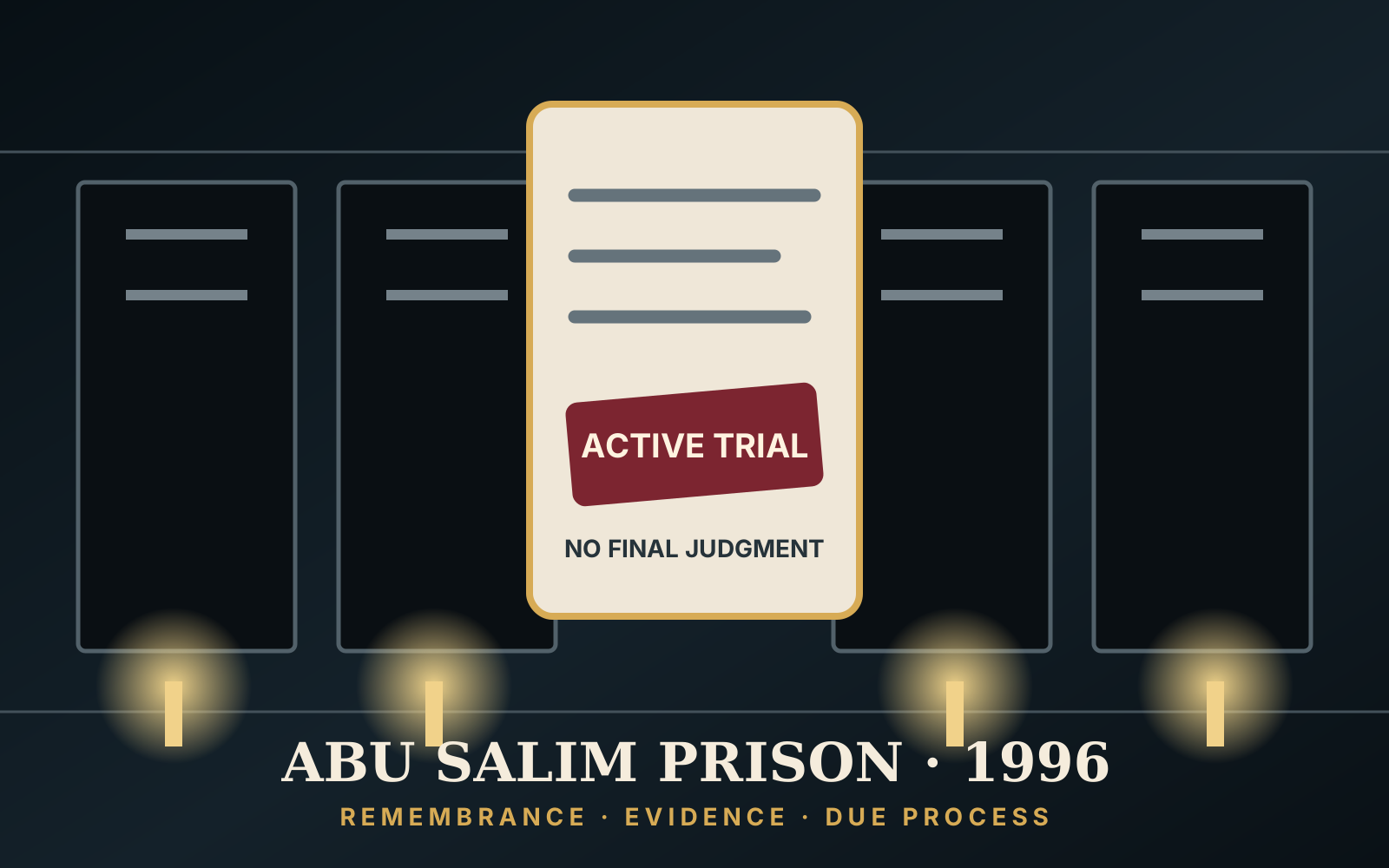
A search of reliable, accessible sources through 11 October 2026 did not locate a final judgment after the July hearing date. The defensible status is therefore active trial / no final criminal judgment, not solved.
This label will need revision if the Tripoli Court of Appeal publishes a judgment, if a higher court later reviews it, or if reliable reporting documents another dispositive ruling. A conviction at first instance would also need to be described with its appeal status rather than automatically treated as irrevocable.
Even a final criminal judgment may not answer every family’s question. Criminal liability concerns proof against particular defendants. A full historical and forensic accounting also requires verified identities, locations of remains, return of remains where possible and a public explanation of institutional responsibility.
Procedural caution: Abdullah al-Senussi, Mansour Dhao and other people named in current reporting are defendants. Their participation in the trial is not a finding of guilt. This page reports charges and procedural events without adopting the prosecution’s allegations as fact.
Verified timeline
- 28 June 1996 — Prisoners protest conditions and take guards hostage; negotiations follow, according to survivor accounts collected by Human Rights Watch.
- 29 June 1996 — A large number of detainees are killed inside Abu Salim Prison. The exact toll and full sequence remain disputed.
- 2001–2002 — Authorities begin notifying some families of deaths without returning bodies or explaining causes, according to Human Rights Watch.
- April 2004 — Muammar Gaddafi publicly acknowledges that killings occurred and says families have a right to know what happened.
- November 2007 — The UN Human Rights Committee records that Libya cannot provide the inquiry’s status and calls for investigation, prosecution, reparations and publication.
- 15 December 2019 — A Tripoli criminal panel rules that the prosecution is time-barred.
- 2 May 2021 — Libya’s Supreme Court quashes that ruling and remands the case to a different Tripoli Court of Appeal panel.
- June 2022 — The Appeals Court refers the case to military prosecution on jurisdictional grounds, according to Human Rights Watch.
- 15 June 2026 — The Second Criminal Chamber adjourns its seventeenth hearing to 19 July and continues the detention of defendants already in custody.
- 11 October 2026 — No reliable final judgment is located; the case remains classified as unsolved with active proceedings.
What is established and what remains unresolved
Strongly established
- Large-scale killings took place at Abu Salim Prison on 29 June 1996 after unrest began the previous day.
- Authorities withheld information from many families for years and did not return remains.
- Libya’s pre-2011 inquiry did not produce the transparent public accounting requested by the UN Human Rights Committee.
- Libyan prosecutors charged dozens of people, and a 2019 limitation ruling temporarily halted the case.
- The Supreme Court quashed that ruling in 2021 and ordered a new hearing before a different panel.
- The criminal proceedings were active in June 2026 without a final judgment.
Still unresolved or disputed
- The exact number and complete identities of people killed.
- The location and condition of all victims’ remains.
- The precise role and criminal responsibility of each defendant.
- Whether the resumed trial will produce a final, enforceable judgment consistent with due-process safeguards.
- The full chain of institutional decision-making and whether every responsible person has been investigated.
Sources and verification
- Libyan Legal Society — Supreme Court criminal appeal No. 512/67QPrimary legal record dated 2 May 2021; used for the charges, 2019 ruling, legal reasoning, reversal and remand. Allegations are identified as allegations.
- Human Rights Watch — Libya: June 1996 Killings at Abu Salim PrisonPublished 28 June 2006; used for the survivor account, verification limits, estimate and family notifications.
- UN Human Rights Committee — Concluding observations on Libya (CCPR/C/LBY/CO/4)Adopted in 2007; records the missing inquiry status and requests investigation, prosecution, reparations and publication.
- Amnesty International — End the long wait for justice for Abu Salim victimsPublished 27 June 2014; used for the continuing accountability and family-rights context.
- Human Rights Watch — World Report 2023: LibyaUsed for the June 2022 jurisdiction referral and broader justice-system context.
- The Libya Observer — Tripoli Appeals Court adjourns trial to 19 JulyPublished 15 June 2026; current procedural update from the seventeenth hearing.
- Human Rights Solidarity — Thirty years after Abu SalimPublished 29 June 2026; a Libyan victims’ rights organization’s account of continuing family demands and missing remains.
Frequently asked questions
What happened at Abu Salim Prison in June 1996?
After prisoners protested conditions on 28 June, Libyan security forces killed a large number of detainees on 29 June. Human Rights Watch reported a former prisoner’s estimate of around 1,200 deaths but could not independently verify his full account; the exact toll remains unresolved.
Why is the Abu Salim case classified as unsolved?
Libya has prosecuted dozens of defendants, but the proceedings have not produced a final criminal judgment establishing individual responsibility. Families also continue to seek a complete victim accounting and the location of remains.
Was anyone convicted for the Abu Salim killings?
No final conviction for the 1996 killings was located as of 11 October 2026. A 2019 ruling treated the prosecution as time-barred, but Libya’s Supreme Court quashed that ruling in 2021 and returned the case for a new hearing.
What did Libya’s Supreme Court decide in 2021?
The Supreme Court held that the lower court had erred in applying limitation rules, quashed the judgment in full and remanded the case to a different criminal panel of the Tripoli Court of Appeal. It did not convict the defendants.
How many people were killed?
The exact number is not independently settled. Libyan groups and later rights reporting commonly cited about 1,200 or 1,269 victims. This page uses 'around 1,200' only with attribution and does not claim a verified final count.
What is the current status of the trial?
The latest reliable proceeding located was the seventeenth hearing on 15 June 2026, when the Tripoli Court of Appeal adjourned the case to 19 July 2026 and continued the detention of defendants already in custody. No final judgment was located by 11 October 2026.