The Murders of Vanja Gjorchevska and Panche Zhezhovski
Two linked 2023 kidnappings and murders led to four life sentences in 2025. The appellate court upheld those sentences in July 2026; a fifth defendant had been acquitted.
Direct answer: The North Macedonia archive currently contains one solved case file: the 2023 kidnappings and murders of 14-year-old Vanja Gjorchevska of Skopje and 74-year-old Panche Zhezhovski of Veles. On 25 June 2025, the Skopje Criminal Court convicted Ljupcho Palevski, Velibor Manev, Bore Videvski and Vlatko Keshishev and sentenced each to life imprisonment for the murders, with concurrent kidnapping sentences. The Skopje Appellate Court upheld the life sentences on 15 July 2026. A fifth defendant, Vanja's father Aleksandar Gjorchevski, was acquitted at trial because guilt was not proved beyond a reasonable doubt.
Original editorial illustration; not a photograph, crime-scene image or depiction of either victim, any defendant or physical evidence.
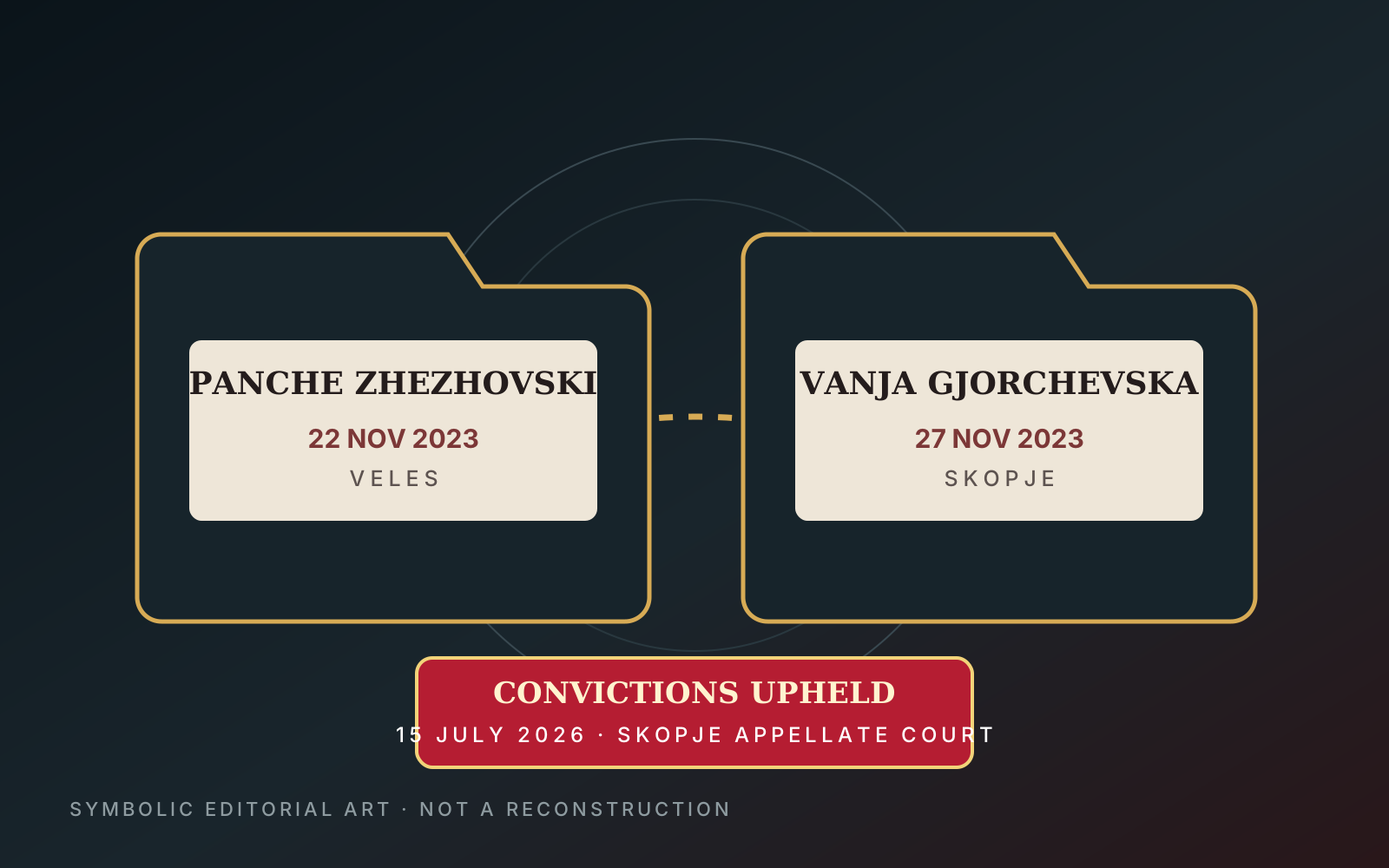
Cases appear here only when reliable records establish criminal responsibility through a documented judgment or equivalent final resolution.
Documented cases in which no judgment has established criminal responsibility or the perpetrator remains unidentified.
The archive identifies the four convicted defendants only because the trial court entered murder convictions and the appellate court later upheld the life sentences.
Aleksandar Gjorchevski was charged in the same proceeding but acquitted. He is not grouped with the four people convicted of kidnapping and murder.
The solved label describes the adjudicated murders. It does not convert every earlier allegation into a proven fact or imply that every related inquiry had the same outcome.
One: the 2023 murders of Vanja Gjorchevska and Panche Zhezhovski.
Yes. Four defendants were convicted and sentenced to life imprisonment, and the appellate court upheld those sentences in July 2026.
Vanja Gjorchevska was 14 and lived in Skopje. Panche Zhezhovski was 74 and lived in Veles.
No. Aleksandar Gjorchevski was acquitted because the court found that the prosecution had not proved his guilt beyond a reasonable doubt.
The indictment contains allegations. The verdict records what the court found proved and which charge was not proved.