True crime cases from Djibouti
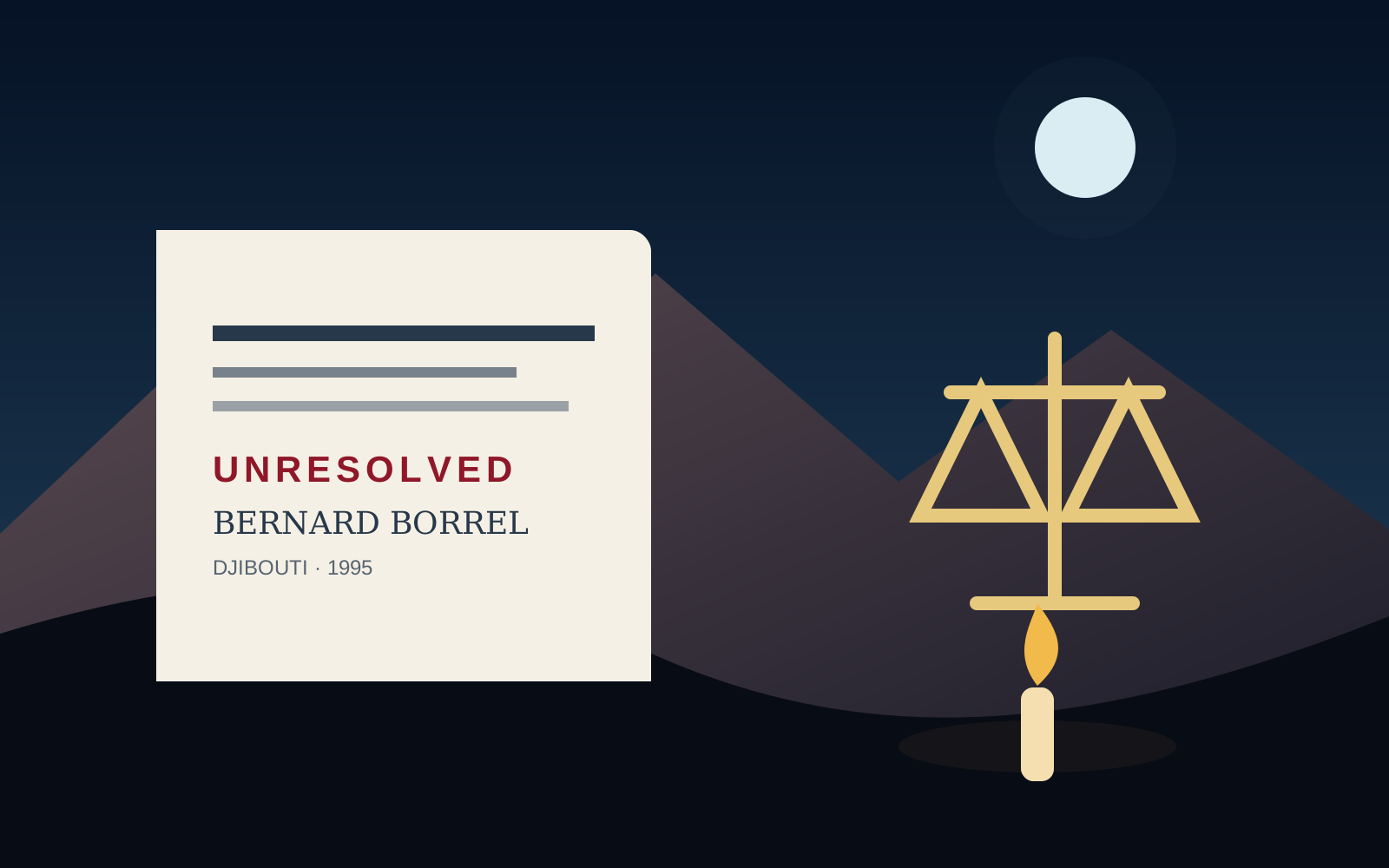
This source-led archive begins with the unresolved death of French magistrate Bernard Borrel, found near Djibouti City in October 1995. The death was first presented as suicide; later French forensic examinations established a criminal origin. No killer has been convicted.

Symbolic country artwork based on Djibouti's flag, Red Sea setting and dry mountain landscape.
One documented case with a confirmed criminal origin but no conviction
The hub contains one substantive case file. It is unsolved because investigators established that Borrel's death was criminal, yet no person has been convicted and the investigation remained active in 2026.
Cases resolved by supported court outcomes
Only completed and verifiable criminal resolutions appear here.
Cases without an identified and convicted perpetrator
Forensic conclusions are separated from unproven claims about responsibility.
How this archive treats the record
Forensics are bounded
“Criminal origin” does not identify a perpetrator or motive.
Allegations stay allegations
Claims concerning named people are not presented as findings of guilt.
Courts had different roles
The ICJ and ECHR proceedings did not decide who caused the death.
Victim-aware reporting
The file avoids graphic reconstruction and focuses on verified procedure.
Djibouti archive answers
How many case files are published?
One: the unresolved killing of Judge Bernard Borrel.
Why is it unsolved?
Experts established a criminal origin, but no perpetrator has been convicted.
Did an international court identify the killer?
No. The ICJ decided a mutual-assistance dispute, not criminal guilt.
Are political allegations stated as fact?
No. Contested allegations are not treated as proven.