The Zodiac Killer
Coded letters, disputed clues and five confirmed deaths created one of America’s most enduring unidentified-offender investigations.
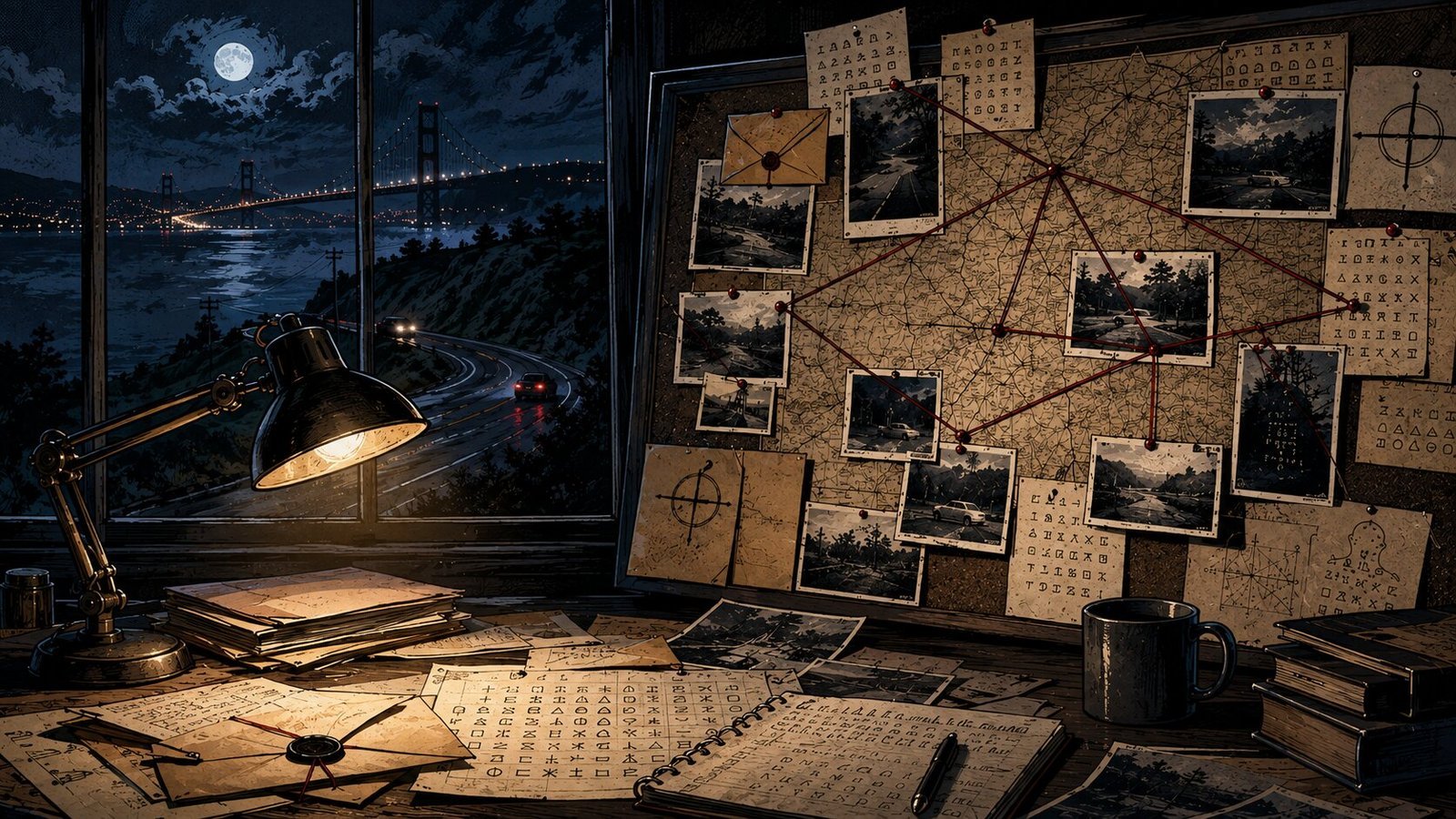
Between December 1968 and October 1969, a sequence of attacks in Northern California was attributed to an unidentified offender who later called himself “the Zodiac.” Five people were killed and two survived in the attacks generally accepted as connected. The name became known through letters mailed to newspapers, where the writer demanded publication and used a crosshair-like symbol as a signature.
The people at the center of the case
The case is often remembered for the offender’s letters, but it began with people whose lives were cut short or permanently changed. David Faraday and Betty Lou Jensen were killed near Lake Herman Road in December 1968. Darlene Ferrin was killed at Blue Rock Springs in July 1969; Michael Mageau survived. Cecelia Shepard died after the September 1969 attack at Lake Berryessa; Bryan Hartnell survived. San Francisco taxi driver Paul Stine was killed in October 1969.
Keeping the victims and survivors visible matters. The correspondence was designed to pull attention toward the writer. A responsible archive should document that strategy without allowing it to erase the people harmed.
A concise timeline
- Lake Herman Road
David Faraday and Betty Lou Jensen were attacked near Benicia. Both died.
- Blue Rock Springs
Darlene Ferrin was killed and Michael Mageau survived an attack near Vallejo.
- Three letters arrive
Newspapers received closely related letters and portions of a 408-symbol cipher, along with a demand that the material be printed.
- Lake Berryessa
Bryan Hartnell and Cecelia Shepard were attacked. Hartnell survived; Shepard died two days later.
- Presidio Heights
Taxi driver Paul Stine was killed in San Francisco. A piece of his shirt was later mailed with a letter.
- The Z340 cipher
A 340-character cryptogram was mailed to the San Francisco Chronicle. It resisted solution for 51 years.
- Z340 is solved
A private international team announced a solution later verified by the FBI. The message did not reveal the writer’s identity.
The letters and ciphers
The correspondence transformed a local investigation into a public spectacle. Some letters included facts or physical material intended to establish authenticity; others generated debate about whether every message came from the same person. The first major cipher, known as the Z408, was solved in August 1969 by Donald and Bettye Harden. Its plaintext expressed violent fantasies but did not provide a name.
The Z340 became the most famous unsolved message. In 2020, David Oranchak, Sam Blake and Jarl Van Eycke announced a solution produced through a combination of software, pattern testing and manual analysis. The FBI confirmed that the cipher had been solved, while emphasizing that the investigation remained open. Two much shorter attributed cryptograms are still unresolved, and their limited length makes any proposed solution difficult to verify.
How the investigation expanded
Several police departments investigated the attacks because they occurred across different jurisdictions. The FBI supported local authorities with handwriting, fingerprint and cryptanalytic work, but it was not the lead investigative agency. Over time, tips, questioned documents and claims about additional crimes produced an enormous record—and also a large amount of noise.
Many people have been publicly proposed as suspects by authors, relatives or independent researchers. None has been conclusively identified as the Zodiac through a criminal conviction or universally accepted forensic evidence. For that reason, this archive does not present an uncharged person as the offender. A theory is not the same thing as a verified finding.
Evidence, uncertainty and modern testing
Handwriting comparisons, fingerprints, witness descriptions and the mailed materials have all played roles in the case. Yet public accounts frequently overstate what a particular sample can prove. Questions remain about the origin, preservation and completeness of biological material reportedly recovered from correspondence. Modern genetic genealogy has solved other historical cases, but it requires a suitable, reliable sample and careful legal and investigative work.
The central difficulty is not a lack of names. It is the absence of a publicly demonstrated chain of evidence strong enough to identify one person and withstand scrutiny. New claims should therefore be judged by their sources, forensic basis and confirmation from the agencies that hold the original evidence.
Current status and unanswered questions
No one has been convicted as the Zodiac Killer. The five confirmed deaths, two surviving victims and authenticated correspondence remain the core of the case. Questions continue about which letters were genuine, whether any additional attacks were connected, whether usable forensic material still exists and whether the remaining short ciphers contain meaningful information.
The case endures because communication was part of the offense. The writer created puzzles that encouraged the public to participate, and decades of retelling have often blurred documented facts with speculation. Returning to original records and clearly labeling uncertainty is the most responsible way to study it.
Follow another evidence trail
Sources and further reading
- Federal Bureau of Investigation — The Zodiac Killer
- FBI Vault — Zodiac Killer files
- History — The Zodiac Killer: A Timeline
Last reviewed: August 9, 2026