What happened at Xitaxi
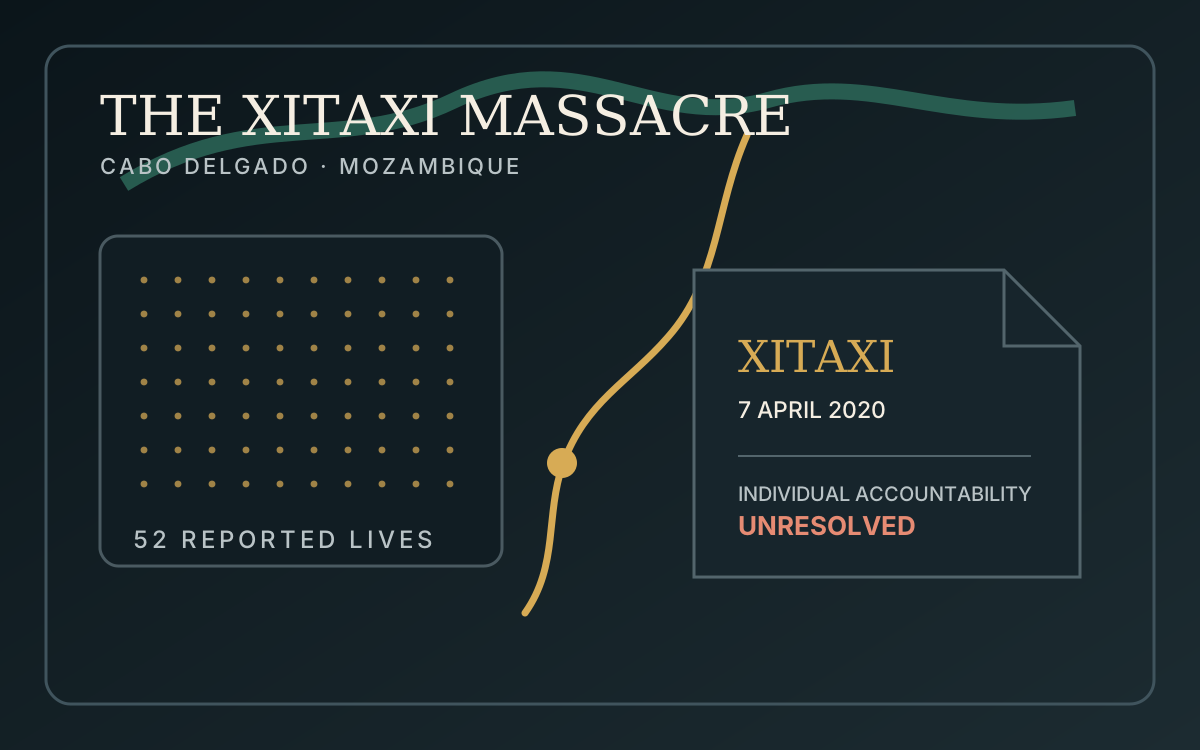
Xitaxi is a village in Muidumbe District, in Mozambique's northern Cabo Delgado province. On 7 April 2020, insurgents attempted to recruit local young men, according to the account later given by national police spokesman Orlando Mudumane. When the residents resisted, the attackers killed 52 people.
The killings were not reported publicly at once. Details emerged about two weeks later, after police described the event to state broadcasting and international news organizations carried the account. Reuters, the Guardian and Al Jazeera independently reported the same central official facts: the date, Xitaxi as the location, 52 people killed and resistance to recruitment as the trigger described by police.
The delay and the restricted access to the conflict zone matter editorially. This archive does not claim a complete list of victims, a forensic reconstruction or a verified account of each death. It records the strongest common core in the available reporting.
Cabo Delgado before April 2020
An armed insurgency had been expanding in Cabo Delgado since 2017. The group was known locally by several labels, including Al-Sunna wa Jama'a and al-Shabab, although it was not the Somali organization of the same name. By early 2020, fighters had attacked villages, government positions and district centers, and some attacks were claimed or promoted through Islamic State channels.
This shifting set of names can create false certainty. Contemporary reports broadly described the Xitaxi attackers as Islamist insurgents active in Cabo Delgado. They also connected the wider movement to the Islamic State's Central Africa Province. A movement-level description, however, is not evidence identifying each participant at Xitaxi.
Human Rights Watch's review of 2020 documented killings, abductions and property destruction by the armed group across northern Mozambique, while also recording alleged abuses by government forces. That broader conflict record supplies context, but it should not be used to attribute unrelated incidents or unnamed perpetrators to this specific massacre.
The victims and the reported toll
Police described the victims as young villagers who had resisted recruitment. Reuters reported “about 52” killed; other outlets repeated the official figure as 52. Without a publicly available named roll or accessible court record, the responsible formulation is therefore “52 according to police.”
That qualifier does not minimize the loss. It prevents an official wartime count from being mistaken for a complete forensic inventory. The page avoids graphic detail because the essential fact is already stark: civilians were killed after refusing to join an armed group.
Later humanitarian reporting placed the massacre inside a rapidly worsening displacement crisis. By the end of 2020, violence in Cabo Delgado had forced hundreds of thousands from their homes. Xitaxi was not merely a battlefield episode; it was an attack on a community's ability to refuse coercion and remain in place.
What the sources establish about attribution
Mozambican police attributed the killings to insurgents operating in the region. The Guardian described the wider movement's Islamic State affiliation, and Human Rights Watch identified the local armed group as Al-Sunna wa Jama'a. Those descriptions support an armed-group attribution at the level used here.
They do not support naming a commander, shooter or executioner. No reviewed source supplied a judgment identifying individual defendants for the Xitaxi killings. The page therefore does not present suspected affiliations as convictions, and it does not combine later arrests or military claims from Cabo Delgado with this case unless a reliable source directly links them.
The distinction is especially important in an insurgency where multiple names, factions and claims circulate. “Attributed to an armed group” and “proved against an individual in court” are different evidentiary statements.
Security response and accountability
Later in April 2020, Mozambique's government announced that security forces had killed more than 100 insurgents in several operations. Reporting linked that response to the wider escalation in Cabo Delgado. Combat deaths announced by the government are not substitutes for a criminal investigation into Xitaxi, and the archive does not count them as convictions or identify the dead as perpetrators of the massacre.
Human Rights Watch's submission for Mozambique's Universal Periodic Review stated that no one had been held to account for abuses by either side in Cabo Delgado during the period it reviewed. No reliable source located for this page documented a case-specific indictment, trial or final judgment for the 52 deaths at Xitaxi.
Accordingly, the case remains unresolved at the level of individual criminal responsibility. The event itself is not a mystery; the judicial record is incomplete.
Verified timeline
- October 2017: the armed insurgency in Cabo Delgado begins expanding through attacks in the province.
- 23 March 2020: insurgents briefly occupy Mocímboa da Praia, marking a significant escalation weeks before Xitaxi.
- 7 April 2020: police later say 52 villagers are killed at Xitaxi after resisting recruitment.
- 21–22 April 2020: Mozambique's police account is reported internationally by Reuters, the Guardian and Al Jazeera.
- Late April 2020: the government announces counterinsurgency operations and deaths of fighters in several locations; those claims do not establish case-specific convictions.
- 2021: Human Rights Watch reports continuing impunity for abuses committed in the Cabo Delgado conflict.
- September 2026 review: no individual prosecution or final conviction specifically resolving the Xitaxi killings was located.
Why Crime by Region marks it unresolved
The classification separates a documented event from adjudicated responsibility. Multiple reliable reports reproduce the police account of 52 deaths on 7 April 2020. Broader human-rights reporting confirms that the armed group killed civilians and used coercive recruitment in Cabo Delgado.
What is missing is a public judicial outcome connecting named individuals to the massacre. The archive therefore uses “Unresolved individual accountability,” not “unknown event” and not “solved.”
Questions that remain open
Who were all 52 victims? Which individual fighters planned and carried out the attack? Was there a command decision directed specifically at Xitaxi? Did investigators preserve witness testimony or forensic evidence, and did any later prosecution incorporate the killings? The reviewed public sources do not answer those questions conclusively.
Frequently asked questions
When and where did the massacre occur?
Police said it occurred on 7 April 2020 in Xitaxi, Muidumbe District, Cabo Delgado.
How many people were killed?
The official figure reported by police was 52 villagers.
Why were they attacked?
Police said the young men had resisted recruitment by the insurgents.
Who carried out the killings?
Authorities attributed the attack to Islamist insurgents active in Cabo Delgado. No reviewed judgment established the guilt of named individuals.
Was anyone convicted?
No case-specific charge or final conviction was located for this editorial review.
Why is the case included?
It is a well-documented mass killing of civilians with a clear official chronology and a continuing accountability gap.
Sources and source-quality review
- Reuters — Islamist insurgents kill 52 villagers in Mozambique22 April 2020 · date, place, police-reported toll and recruitment account.
- The Guardian — Islamist group kills 52 in Mozambique massacre22 April 2020 · independent contemporary report and conflict context.
- Al Jazeera / AFP — Armed group kills 52 in a Mozambique village21 April 2020 · corroborating report of the police account.
- Human Rights Watch — World Report 2021: MozambiqueConflict context, civilian killings, abductions, destruction and displacement in Cabo Delgado.
- Human Rights Watch — Universal Periodic Review submissionAccountability review for abuses by insurgents and security forces in Cabo Delgado.
Editorial review: the core event was cross-checked across Reuters, AFP-carried reporting and the Guardian, then bounded against Human Rights Watch's conflict and accountability assessments. The police figure is attributed; no individual guilt is inferred.