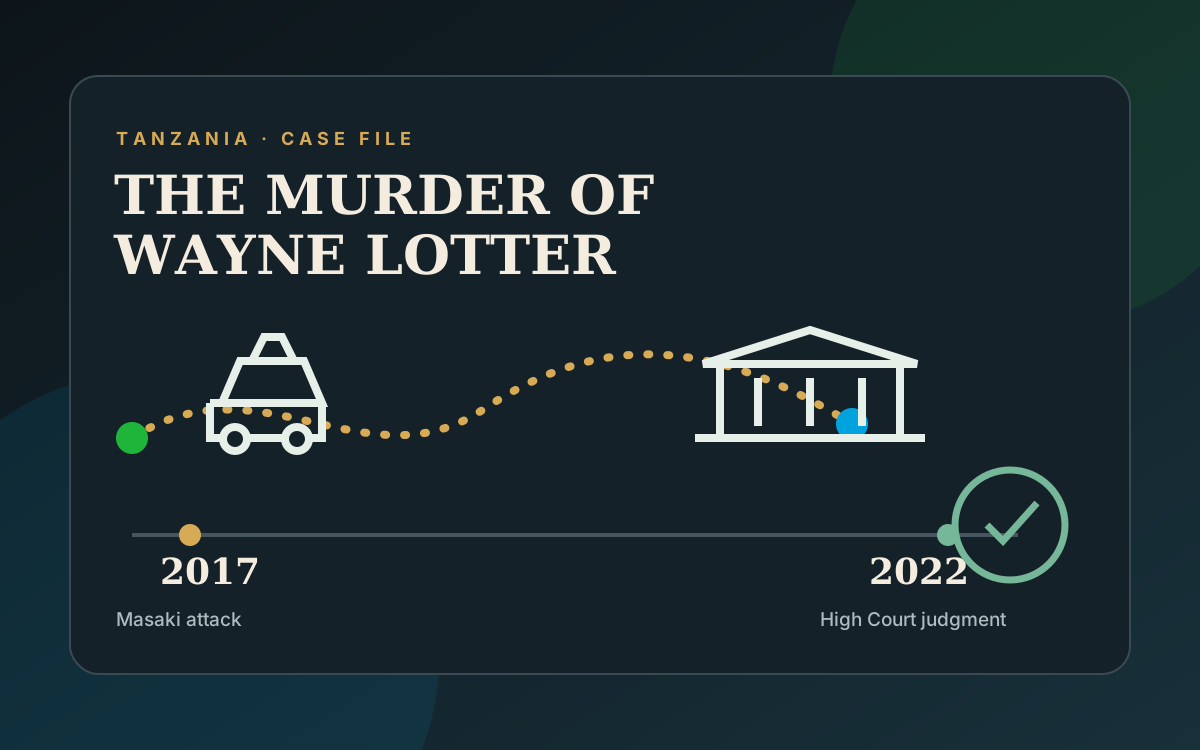
Case-status note: “Solved / adjudicated” reflects verified High Court convictions. It does not assign guilt to the seven acquitted defendants, describe imposed sentences as executions, or claim that a final appellate ruling has been located.
Wayne Lotter and his work in Tanzania
Wayne Lotter was a South African conservationist who had worked in Tanzania for years. He co-founded the PAMS Foundation, an organization involved in wildlife protection, anti-poaching support and efforts to strengthen responses to wildlife trafficking. Contemporary profiles described him as a prominent figure in conservation enforcement partnerships.
Lotter's public work is essential context, but context is not the same as a judicial finding about every person who may have opposed him. Reporting after his death connected the killing to risks faced by conservationists and to his anti-poaching work. The criminal case, however, still required prosecutors to prove the charged conspiracy and murder against named defendants. This archive keeps those two levels of the record distinct.
He was 51 when he died. He had returned to Dar es Salaam by air on August 16, 2017 and left Julius Nyerere International Airport in a taxi. The journey toward his accommodation ended in the Masaki area, an urban district on the Msasani Peninsula.
The Masaki attack
The High Court judgment placed the attack near the junction of Kaole Road and Haile Selassie Road. It described another vehicle blocking the taxi and assailants approaching it. Lotter was shot, and property including laptops and documents was taken. He was transported to hospital but died from the gunshot injury.
Contemporary reporting summarized the incident as an ambush by gunmen while Lotter traveled from the airport. The court record provides the more detailed evidentiary account used here. The page avoids reconstructing unrecorded dialogue, emotions or movements, and the illustration does not pretend to be a photograph of the event.
That distinction matters in a case with a well-known victim. Repetition can make a narrative detail appear settled even when it originated in only one report. Dates, route, location and outcome are therefore anchored to the judgment and cross-checked against independent reporting; atmosphere and speculation are omitted.
Investigation and prosecution
The investigation developed into a broad multi-defendant prosecution. The High Court record discusses identification evidence, vehicles, communications, cautioned statements, property and ballistic or medical evidence. It also records challenges to parts of the prosecution case. This was not a proceeding in which every person initially accused received the same outcome.
Eighteen defendants were before the court at the trial stage described in the published judgment. After the prosecution called 32 witnesses and tendered dozens of exhibits, the court assessed whether the evidence required each defendant to present a defense. Seven defendants were found to have no case to answer and were acquitted at that stage.
A no-case acquittal is not a minor procedural note. It means the prosecution evidence did not establish a sufficient case requiring those individuals to answer the charges. Their names do not belong in a list of convicted people, and this archive does not use the broader number of people once arrested or arraigned as though it were the conviction count.
The High Court judgment
Justice L. E. Mgonya delivered judgment in Criminal Sessions Case No. 13 of 2021 in the High Court of Tanzania at Dar es Salaam on December 2, 2022. The court convicted the 11 remaining defendants of conspiracy to murder and murder. The written decision analyzes the alleged planning, the roles attributed to participants and the evidence linking the group to the attack.
Associated Press reported that the convicted group comprised nine Tanzanian nationals and two Burundian nationals. Independent Tanzanian reporting likewise recorded 11 convictions and the December 2022 judgment. These reports corroborate the outcome while the published judgment remains the primary source for the court's reasoning and the separation between convictions and acquittals.
The judgment does not justify flattening the case into a single undifferentiated group. The legally accurate summary is: 18 defendants at the relevant trial stage; seven acquitted after the prosecution case; 11 convicted after the full trial. Earlier reports of a larger number initially arraigned describe a different procedural moment.
Sentences and the death-penalty distinction
The court imposed death sentences on the 11 convicted defendants. The judgment used the statutory language “death by hanging” and informed the defendants of their right of appeal. Contemporary news reports described the same orders.
A death sentence is not evidence that an execution occurred. Associated Press noted Tanzania's long period without carrying out executions at the time of the judgment. This page therefore reports the judicial sentence only. It makes no claim about later commutation, custody status or execution without a reliable source documenting such an event.
The distinction is especially important for search summaries and AI-generated answers, where compressed wording can accidentally turn “sentenced to death” into “executed.” The verified proposition is narrower: the High Court convicted 11 people in December 2022 and imposed death sentences.
The appellate record located
The trial judgment expressly explained a right of appeal. A right to appeal, however, is not the same as proof that a particular appeal was filed, heard or resolved. Searches of the accessible public record through September 12, 2026 did not locate a reliable final appellate judgment changing or affirming this result.
For that reason, the High Court decision is presented as the latest verified judicial outcome located for this review. “Adjudicated” describes the existence of convictions and sentences at trial level; it does not promise that every possible appellate or post-conviction proceeding is complete.
If a later Court of Appeal decision becomes publicly verifiable, this file should be updated with the appeal number, date, panel, result and effect on each conviction or sentence. Until then, silence in the accessible record is treated as a limit, not as evidence that no appeal occurred.
Why the case matters
Lotter's murder drew international attention to the personal risks faced by people working against wildlife crime. It also produced a complex domestic criminal proceeding in which a Tanzanian court tested evidence against many defendants and issued sharply different outcomes.
The case is often summarized through Lotter's conservation legacy. That public significance belongs in the record, but respectful case writing also requires precision about the defendants. Seven people were acquitted. Eleven were convicted. The sentence report does not establish execution, and the source set reviewed does not establish a final appellate endpoint.
Those boundaries do not weaken the account. They make it more useful: readers can see what happened, what the court decided, what independent reporting corroborates and where the current public record stops.
Frequently asked questions
Who was Wayne Lotter?
He was a South African conservationist and co-founder of the PAMS Foundation who worked on wildlife protection and anti-poaching initiatives in Tanzania.
When and where was he murdered?
Lotter was shot on August 16, 2017 after his airport taxi was blocked in Masaki, Dar es Salaam.
How many defendants were convicted?
The High Court convicted 11 defendants of conspiracy to murder and murder on December 2, 2022.
Were any defendants acquitted?
Yes. Seven defendants were acquitted at the close of the prosecution case because the court found there was no case for them to answer.
What sentences were imposed?
The 11 convicted defendants were sentenced to death. That is a sentence report, not evidence that executions occurred.
Was there a final appeal?
The trial judgment recorded a right of appeal. No reliable public final appellate ruling was located in the source review completed September 12, 2026.