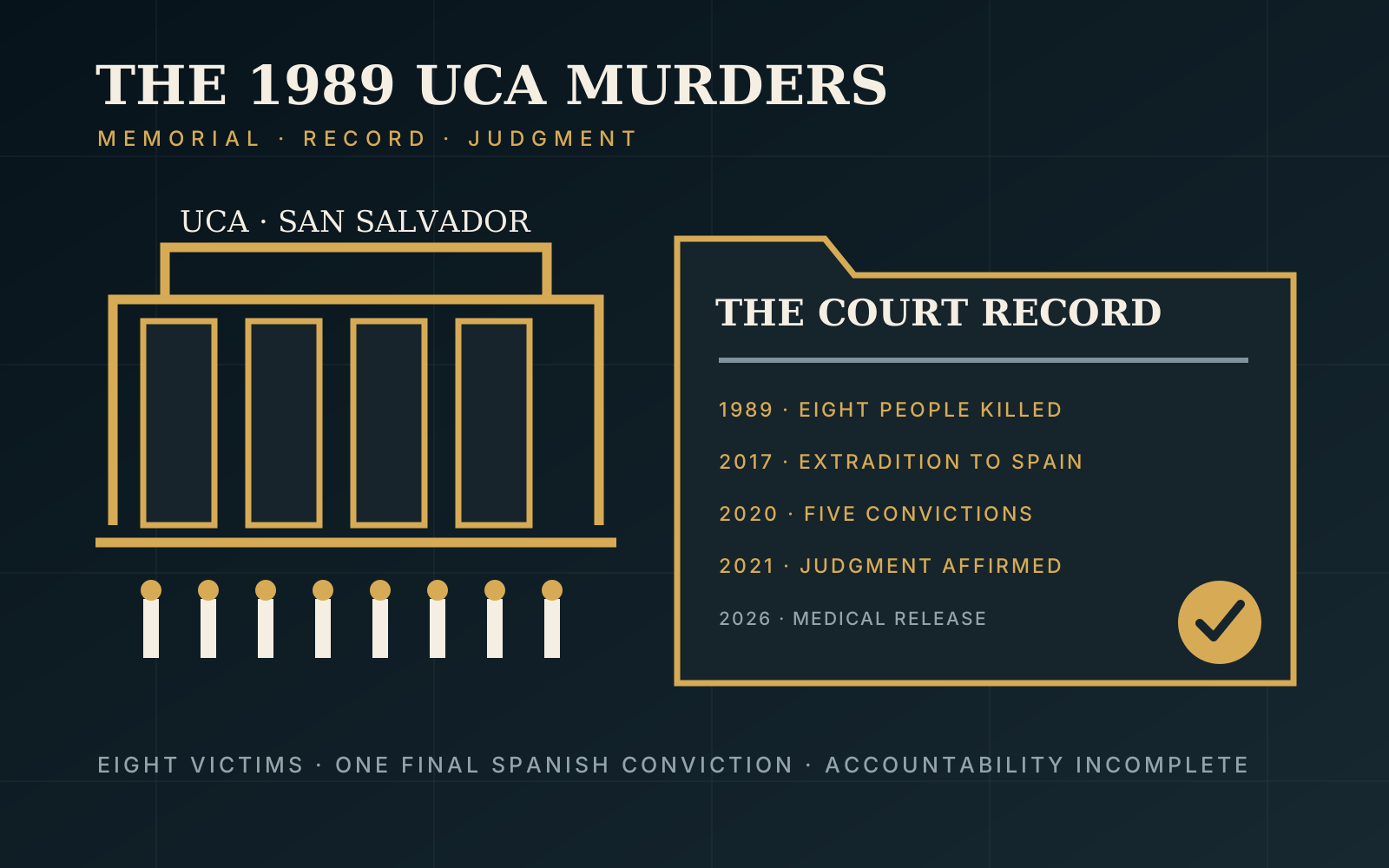
Case-status note: “Adjudicated” refers specifically to Montano's final Spanish conviction for the murders of five Spanish Jesuits. The label does not imply that every person involved in the eight killings was prosecuted, that every charge in El Salvador has reached judgment, or that conditional medical release erased the conviction.
What happened in the UCA murders?
In the early hours of November 16, 1989, members of an elite Salvadoran military unit entered the campus of the Universidad Centroamericana José Simeón Cañas, commonly called UCA. Six Jesuit priests were killed: university rector Ignacio Ellacuría, Ignacio Martín-Baró, Segundo Montes, Juan Ramón Moreno, Amando López and Joaquín López y López. Elba Julia Ramos, who worked at the Jesuit residence, and her 16-year-old daughter, Celina Mariceth Ramos, were also killed.
The crime occurred during the Salvadoran civil war and amid a major military confrontation in the capital. Later truth-seeking and judicial records concluded that the operation targeted Ellacuría and was intended to leave no witnesses. The archive attributes those findings to the bodies that made them; it does not collapse a truth commission, an extradition record, a Spanish criminal judgment and still-pending Salvadoran allegations into one undifferentiated claim.
The eight people who were killed
The victims are often described collectively as the “UCA martyrs,” but the shorthand should not erase their individual identities. Ellacuría was a philosopher, theologian and UCA rector associated with efforts toward a negotiated end to the war. Martín-Baró was a social psychologist; Montes was a sociologist; Moreno, Amando López and Joaquín López y López were Jesuit educators and pastoral workers. Elba Ramos and Celina Ramos were civilians whose presence made the order to leave no witnesses especially consequential.
Five of the priests—Ellacuría, Martín-Baró, Montes, Moreno and Amando López—were Spanish citizens. Joaquín López y López, Elba and Celina were Salvadoran. That nationality distinction later shaped the legal scope of Montano's extradition and Spanish conviction. It does not create a hierarchy among the victims.
From the truth record to criminal cases
The United Nations-sponsored Truth Commission for El Salvador examined the murders after the 1992 peace accords. Its account placed the decision within the Salvadoran armed forces' high command and described an order to kill Ellacuría and leave no witnesses. Salvadoran proceedings in the early 1990s resulted in convictions against Colonel Guillermo Benavides and Lieutenant Yusshy René Mendoza, followed by the effects of the 1993 amnesty law. Later constitutional and judicial decisions changed that legal landscape.
Those developments matter because “the case” is not a single uninterrupted trial. It comprises domestic proceedings, a truth commission record, a Spanish universal-jurisdiction case, United States immigration and extradition litigation, and later Salvadoran prosecutions. A result in one forum does not automatically decide every issue in another.
Why Montano was tried in Spain
Inocente Orlando Montano had been a colonel and vice minister of public security in El Salvador. He later lived in the United States. U.S. authorities convicted him of immigration fraud and perjury based on false statements in applications to remain in the country. Spain sought his extradition in connection with the five Spanish priests' murders.
After litigation in federal courts and an unsuccessful attempt to stay the surrender, the United States extradited Montano to Spain on November 29, 2017. The U.S. Department of Justice made clear at that stage that the Spanish accusations were allegations and that guilt had to be determined by the Spanish courts. That distinction remained essential until judgment.
The 2020 conviction and 2021 appeal
On September 11, 2020, Spain's National Court convicted Montano of five terrorist murders. The court imposed 26 years, eight months and one day for each of the five killings, a total exceeding 133 years, while setting a 30-year maximum period of effective imprisonment under the applicable rules.
The five convictions corresponded to the five Spanish Jesuits covered by the extradition. The Spanish court made findings about the wider operation, but Montano was not convicted in that proceeding for the deaths of Joaquín López y López, Elba Ramos or Celina Ramos. A careful status label must preserve that legal boundary.
Spain's Supreme Court upheld the conviction on February 3, 2021. From that point, Montano's responsibility for the five murders within the Spanish case was finally adjudicated. It is this final appellate result—not suspicion, indictment or extradition—that supports placing the file in the archive's solved/adjudicated section.
What changed in August 2026?
On August 17, 2026, Spain's National Court granted Montano conditional release for medical reasons. Reporting based on the order described serious, irreversible illness, advanced age and significant cognitive decline; continued treatment was a condition of release. The prosecution did not oppose the measure.
Conditional release changed the location and conditions under which the sentence was being served. It did not vacate the 2020 judgment or the Supreme Court's 2021 decision. The distinction is important: a person may have a final conviction while no longer being physically imprisoned.
Why accountability remains incomplete
Other Salvadoran military and political figures have faced allegations or renewed proceedings connected with the murders. In November 2024, a Salvadoran court ordered a former president and ten other defendants to stand trial. Those charges must remain allegations unless and until a competent court enters a final judgment. This page therefore does not label those defendants guilty and does not treat the Spanish conviction as a proxy judgment against them.
The archive also avoids saying that all eight murders are “solved” in an ordinary investigative sense. There is substantial institutional documentation about the operation, but legal responsibility is person-specific and charge-specific. The most accurate summary is: Montano's responsibility for five murders was finally adjudicated; broader individual accountability remains incomplete.
Verified timeline
- November 16, 1989: six Jesuits, Elba Ramos and Celina Ramos are killed at UCA in San Salvador.
- 1993: the UN-sponsored Truth Commission publishes findings about the decision and military operation.
- November 29, 2017: the United States extradites Montano to Spain.
- September 11, 2020: Spain's National Court convicts Montano of five terrorist murders.
- February 3, 2021: Spain's Supreme Court upholds the conviction.
- November 2024: a Salvadoran court orders separate defendants to stand trial; charges remain allegations.
- August 17, 2026: Spain grants Montano conditional release for serious illness without overturning the conviction.
Frequently asked questions
What happened at UCA on November 16, 1989?
Members of a Salvadoran military unit entered the university campus and killed six Jesuit priests, housekeeper Elba Julia Ramos and her 16-year-old daughter Celina Mariceth Ramos.
Who were the eight victims?
Ignacio Ellacuría, Ignacio Martín-Baró, Segundo Montes, Juan Ramón Moreno, Amando López, Joaquín López y López, Elba Julia Ramos and Celina Mariceth Ramos.
What was Montano convicted of?
Spain convicted him of five terrorist murders involving the five Spanish Jesuits included in the extradition grant.
When did the conviction become final?
Spain's Supreme Court upheld it on February 3, 2021.
Did the 2026 medical release cancel the judgment?
No. Conditional release affected custody and treatment; it did not overturn the conviction.
Were all alleged participants convicted?
No. Other proceedings have separate scopes and statuses. Charges against other defendants are allegations unless proved in court.