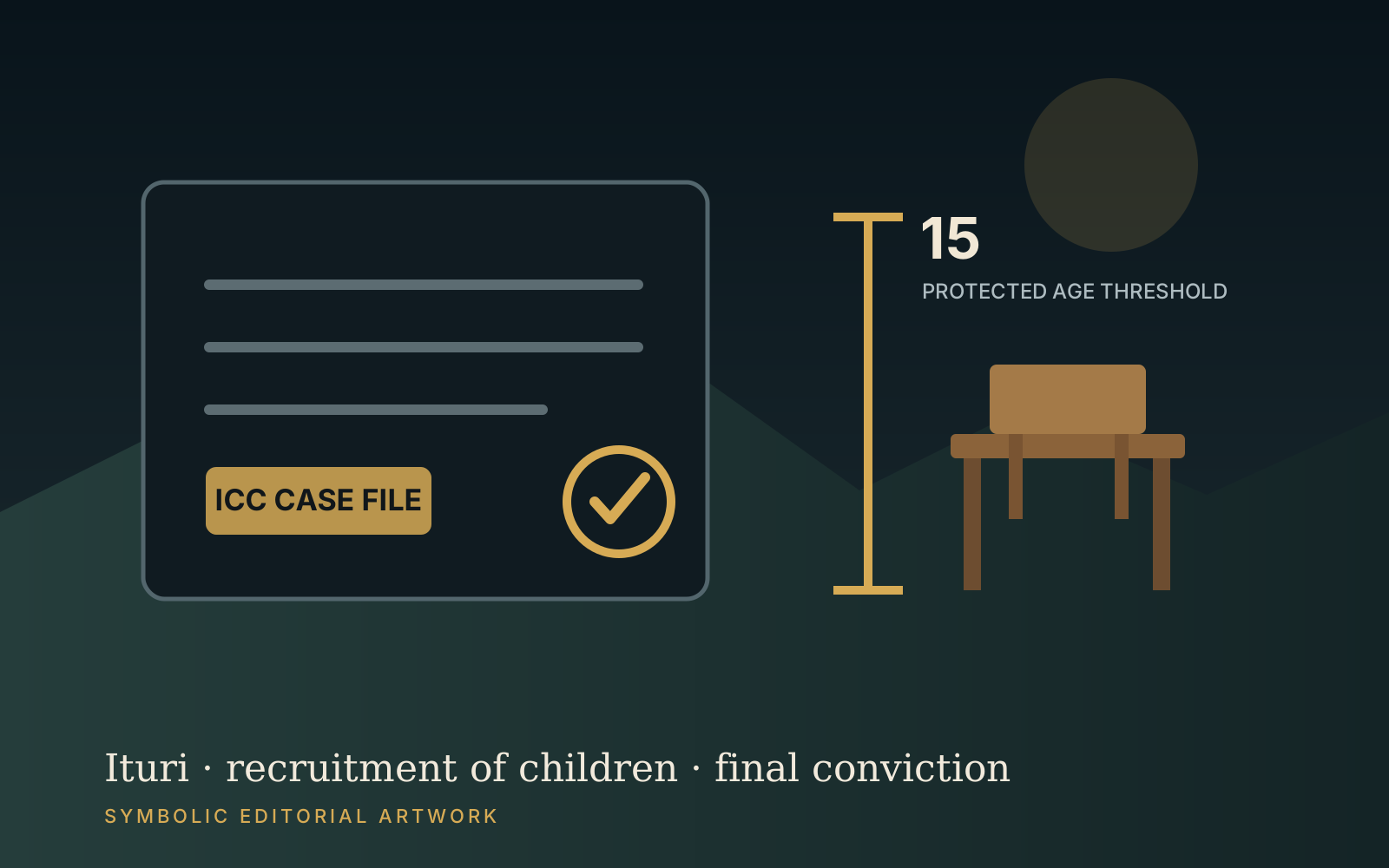
Judicial boundary: Lubanga was convicted only of the war crimes of conscripting and enlisting children under 15 and using them to participate actively in hostilities. This page does not attribute to that verdict killings, sexual violence or other Ituri crimes that were not among the charges decided in his case.
Ituri’s armed conflict
Eastern Democratic Republic of the Congo was already marked by years of regional war when armed groups fought for territory, political control and resources in Ituri. Civilians lived amid displacement, attacks and shifting alliances. In that environment, children were drawn into armed organizations as recruits, guards, escorts and participants in combat.
Thomas Lubanga Dyilo was a founder and former president of the Union des patriotes congolais, or UPC. Its military wing was the Forces patriotiques pour la libération du Congo, the FPLC, in which the ICC identified him as commander-in-chief. The case focused on the FPLC’s recruitment and use of children during a defined period from 1 September 2002 to 13 August 2003.
The legal threshold was age 15. International criminal law treats conscripting or enlisting children below that age, or using them to participate actively in hostilities, as war crimes. The prosecution therefore had to prove more than the existence of young-looking fighters: it had to connect Lubanga to the policy and practice beyond reasonable doubt.
From the DRC referral to The Hague
The government of the Democratic Republic of the Congo referred the situation in its territory to the ICC in 2004. The Court opened an investigation, and judges issued a warrant for Lubanga in February 2006. Congolese authorities transferred him to the Court the following month.
Lubanga’s initial appearance on 20 March 2006 began the ICC’s first trial track. The charges were confirmed in January 2007, and the trial opened on 26 January 2009. More than three years of hearings followed, including testimony from witnesses presented as former child soldiers, expert evidence and disputes over how the prosecution had obtained and disclosed material.
The proceedings were not smooth. Judges twice stayed the case after finding fair-trial problems involving disclosure and intermediaries. Appeals allowed the proceedings to resume. Those interruptions matter because a landmark prosecution is not insulated from ordinary due-process rules.
The Court’s first verdict
On 14 March 2012, Trial Chamber I unanimously found Lubanga guilty as a co-perpetrator. The judges concluded that children under 15 had been conscripted and enlisted into the FPLC and used to participate actively in hostilities during the charged period.
“Conscripting” concerns compulsory recruitment; “enlisting” concerns accepting children who join. “Using” covers their active participation in hostilities. The judgment treated those routes as distinct but connected ways in which armed organizations place children in danger and deprive them of protection.
The verdict was historic because it was the ICC’s first. Its importance did not erase its limits. Critics and victim advocates noted that the case did not charge sexual violence or the wider range of killings and attacks associated with Ituri’s conflict. The conviction answers a specific criminal allegation, not the whole history of the region.
Fourteen years and a final appeal
On 10 July 2012, Trial Chamber I sentenced Lubanga to 14 years’ imprisonment. The judges ordered that time spent in ICC custody from 16 March 2006 be deducted. The sentence therefore did not begin from zero on the day it was pronounced.
Both sides appealed aspects of the result. On 1 December 2014, the Appeals Chamber, by majority, confirmed the conviction and the 14-year sentence. The judgment then became final.
In December 2015, the ICC transferred Lubanga to the Democratic Republic of the Congo to serve the remainder of the sentence. He was released on 15 March 2020 after serving the full term. Release after completion of a sentence does not reverse the conviction.
The children behind the legal terms
The case record describes harm that extends beyond a period in uniform. Children associated with armed groups can lose education, family ties and community belonging; many experience lasting trauma and stigma. Girls’ experiences may also be hidden when “child soldier” is understood only as front-line combat.
That is why the archive uses the Court’s legal language but does not reduce victims to evidence. The case was about children’s rights and the responsibility of an adult leader, not about presenting former child recruits as willing offenders.
The ICC’s reparations framework recognized those broader consequences. Programs could include psychological support, education and vocational training, measures to restore community relationships and symbolic acknowledgment of harm.
A separate reparations process
Reparations did not end with the sentence. In 2015, the Appeals Chamber amended the order governing reparations and emphasized fair treatment of victims, including people who had not participated in the trial proceedings. Judges approved symbolic and service-based collective programs implemented through the Trust Fund for Victims.
Trial Chamber II later set Lubanga’s liability for collective reparations at US$10 million. On 18 July 2019, the Appeals Chamber largely confirmed that decision. The award was calculated around hundreds of identified victims, while the Trust Fund’s work was designed to reach eligible beneficiaries beyond a simple cash distribution.
The distinction between punishment and repair is essential. The 14-year prison term was the criminal sanction. Reparations are measures directed toward victims and communities; they do not add years to a sentence and do not depend on portraying every beneficiary’s experience as identical.
What the judgment did not decide
The Lubanga case did not decide who was responsible for every killing, displacement or act of sexual violence in Ituri. It did not find that every UPC or FPLC member had committed the same crime, and it did not convert allegations outside the confirmed charges into convictions.
Other ICC cases, including the separate prosecution of Bosco Ntaganda, addressed a wider set of war crimes and crimes against humanity. Those proceedings should not be merged. Each defendant, charge, victim group and evidentiary record requires its own page.
Within its boundaries, however, the Lubanga judgment was clear: senior organizational authority did not shield a leader from responsibility for a system that recruited and used children below the protected age.
Documented timeline
- September 2002–August 2003
Period covered by the crimes of conscripting, enlisting and using children under 15 in Ituri. - February–March 2006
ICC judges issue a warrant; Lubanga is transferred to The Hague. - 26 January 2009
The ICC’s first trial opens. - 14 March 2012
Trial Chamber I returns the Court’s first guilty verdict. - 10 July 2012
Lubanga receives a 14-year prison sentence, with prior ICC detention deducted. - 1 December 2014
The Appeals Chamber confirms the conviction and sentence. - 19 December 2015
Lubanga is transferred to a prison in the DRC. - 18 July 2019
The Appeals Chamber largely confirms the US$10 million reparations liability. - 15 March 2020
Lubanga is released after serving the sentence.
Questions the record can answer
Was Lubanga convicted of genocide?
No. His conviction was for three closely related war-crime forms involving children under 15: conscription, enlistment and use in active hostilities.
Did the appeals court overturn the case?
No. On 1 December 2014, the Appeals Chamber confirmed both the conviction and the sentence.
Did release in 2020 clear his name?
No. It marked completion of the 14-year sentence after credit for time in custody. The conviction remained final.
Were reparations individual cash awards?
The Court approved collective symbolic and service-based measures. Lubanga’s liability was set at US$10 million, but implementation through the Trust Fund for Victims is legally separate from a simple payment to each person.
Sources
- International Criminal Court — Lubanga caseOfficial case status, charges, verdict, sentence, appeal, transfer and release.
- ICC — Thomas Lubanga Dyilo sentenced to 14 years10 July 2012 · sentence and the exact crime period.
- ICC Office of the Prosecutor — appeal judgment statement2 December 2014 · confirmation of the verdict and sentence.
- ICC — transfer to the DRC19 December 2015 · enforcement arrangements and appeal history.
- ICC — reparations liability confirmed18 July 2019 · US$10 million liability and case background.
- ICC — implementation of collective reparations14 December 2020 · collective programs and confirmation of release after sentence.
Editorial review: every legal finding is tied to an ICC judgment or official case record; allegations outside the charged child-recruitment crimes are not presented as convictions.