A debt dispute became a massacre
The men at Thiaroye belonged to the tirailleurs sénégalais, a French colonial formation that recruited across West Africa. Many had fought in the 1940 campaign, endured German captivity in camps in occupied France and were returned to West Africa after liberation. “Senegalese” in the unit’s historic name did not mean every victim came from Senegal; the group included soldiers from several French West African territories.
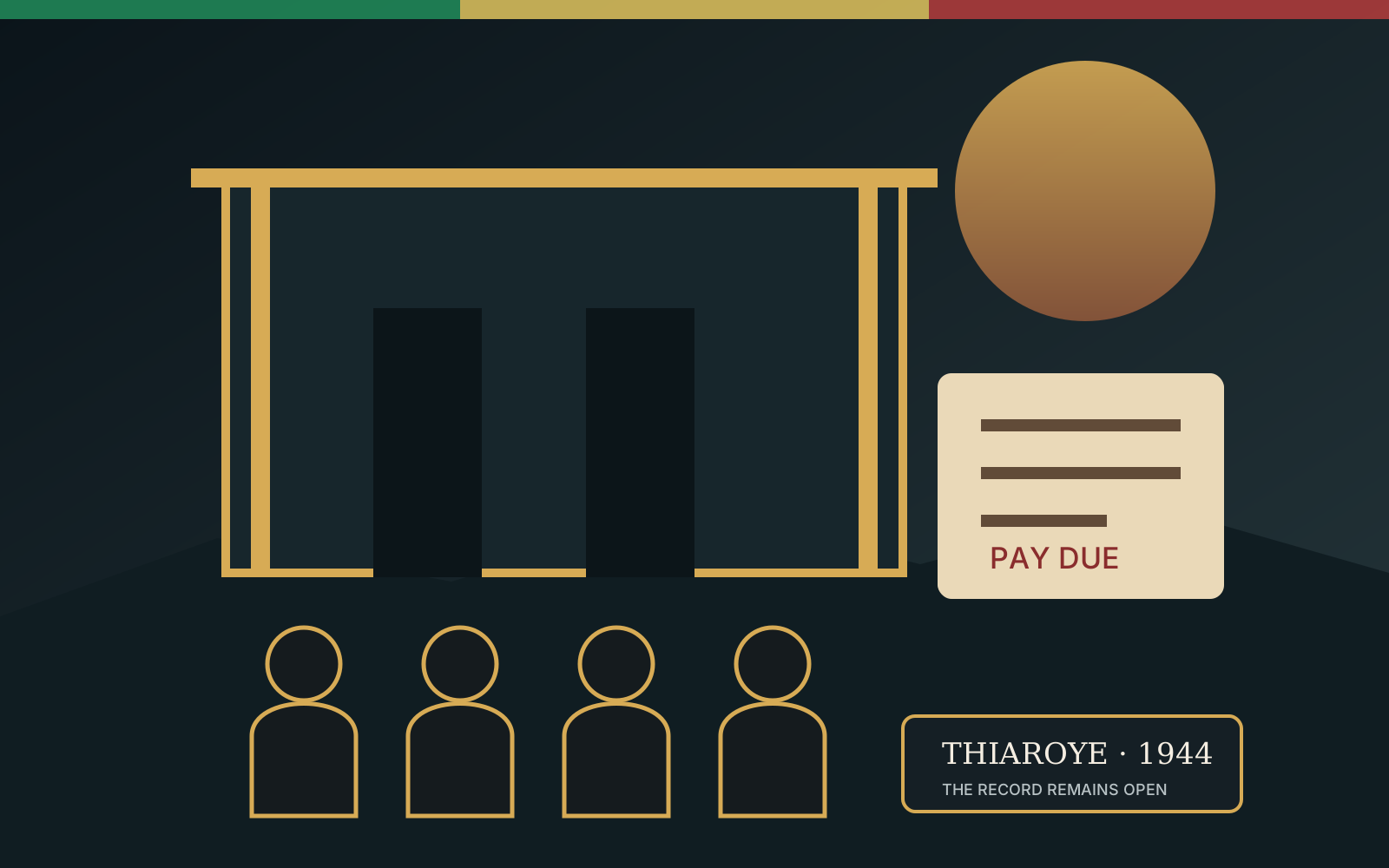
The central grievance was material and documented: soldiers said France had not paid all wages, captivity allowances, demobilization benefits and currency conversions due to them. Accounts differ on the precise sequence of confrontations after their arrival, but the dispute over money and status is not merely a later theory. It appears throughout the official narrative, court record and historical research.
What happened
- November 1944: More than a thousand repatriated African soldiers arrived near Dakar and were housed at Thiaroye while awaiting demobilization and payment.
- Late November: Disputes deepened over exchange rates, deductions and sums still unpaid. A group delayed a transfer to other territories until the accounts were settled.
- 1 December, before dawn: French troops, gendarmes, armored support and officers moved into the camp. The official record described a mutiny; later historians challenged both that label and claims that the men posed a comparable armed threat.
- Morning of 1 December: The deployed force opened fire. The shooting was brief, but its human toll and the treatment of the bodies became subjects of lasting dispute.
- March 1945: Thirty-four surviving tirailleurs were convicted on charges tied to the alleged mutiny. No member of the force that fired was convicted for the deaths.
- 1947: The convicted soldiers benefited from an amnesty, but demands to annul or revise the judgments continued for decades.
- 2024: France granted “Died for France” status to six named men and President Emmanuel Macron later called the killings a massacre in a letter to Senegalese President Bassirou Diomaye Faye.
The casualty count is not settled
Any precise figure presented without qualification would overstate the evidence. An early official French count reported 35 deaths; another military figure cited 70. Senegalese researchers, families and some historians have argued that the true number was far higher, with estimates reaching several hundred. Missing, contradictory or inaccessible records have prevented a defensible final total.
The disagreement is not a minor numerical footnote. It affects the search for burial sites, the identification of victims and the scale of state acknowledgment. Reporting by the Associated Press and Reuters at the eightieth anniversary described the same central problem: France had recognized a massacre without resolving how many men were killed.
The victims and their families
For decades, official paperwork often framed the dead as mutineers rather than soldiers demanding compensation. That label shaped pensions, family records and public memory. The identities of all those killed have never been established in a single, complete public list. Six individual files received the French honorific status “Mort pour la France” in 2024, an important recognition that still covered only a fraction of the possible victims.
Families have asked for names, burial locations, corrected service records and access to archives. Senegal designated the Thiaroye cemetery a national cemetery, and the site has become a place of commemoration, but commemoration has not substituted for a complete forensic and archival accounting.
Trials focused on survivors, not shooters
The criminal process that followed targeted the surviving tirailleurs. Thirty-four men were prosecuted and convicted in 1945 on mutiny-related allegations. Their later amnesty ended punishment but did not erase the judgments or establish the truth of the shooting. Calls for judicial revision have therefore remained distinct from requests for symbolic recognition.
No trial established individual criminal responsibility for ordering or carrying out the lethal fire. The archive classifies the case as unsolved / accountability unresolved: the event is recognized as a massacre, yet the perpetrators’ individual roles and the command decisions have not been adjudicated.
Recognition without closure
In 2014, French President François Hollande acknowledged a “bloody repression” and transferred archival material to Senegal. In 2024, France took further steps: six soldiers received official death recognition, and Macron used the word “massacre” in correspondence with Senegal’s president. Senegal then established work to examine the historical record and marked the eightieth anniversary with an international commemoration.
Those developments changed the public description of Thiaroye, but not every underlying fact. Historians still seek unrestricted archives; families still lack a complete list; burial locations remain uncertain; the 1945 convictions have not all been judicially rewritten; and no criminal verdict has assigned responsibility for the gunfire.
Questions that remain open
- How many repatriated soldiers were killed or wounded?
- Where were all of the bodies buried, and can the graves be identified without disturbing families’ rights and local law?
- Which officers ordered the deployment and the use of lethal force?
- Can the 1945 convictions be formally revised rather than merely amnestied?
- Will all relevant French and Senegalese records become available to independent researchers?
Current status
The massacre itself is no longer responsibly described as an unverified allegation: French presidential recognition, archival research and multiple independent histories establish that French forces killed West African soldiers at Thiaroye. What remains unresolved is the full victim count, complete identification, burial record and individual responsibility. Those open questions are why this page does not label the case solved.
Sources
- Associated Press — Macron calls the 1944 killings a massacre28 November 2024 · recognition, background and casualty-range reporting
- Associated Press — Senegal commemorates Thiaroye and demands answers1 December 2024 · anniversary reporting, archival disputes and official positions
- Reuters — Senegal seeks answers 80 years after the massacre1 December 2024 · commemoration, recognition and unresolved questions
- EHNE / Sorbonne University — The Thiaroye massacre and its memoriesScholarly chronology, trials, amnesty and memory
- Afrique XXI — Thiaroye 1944: The Final Shadows of a Colonial Massacre30 November 2024 · archival contradictions, pay dispute and missing graves