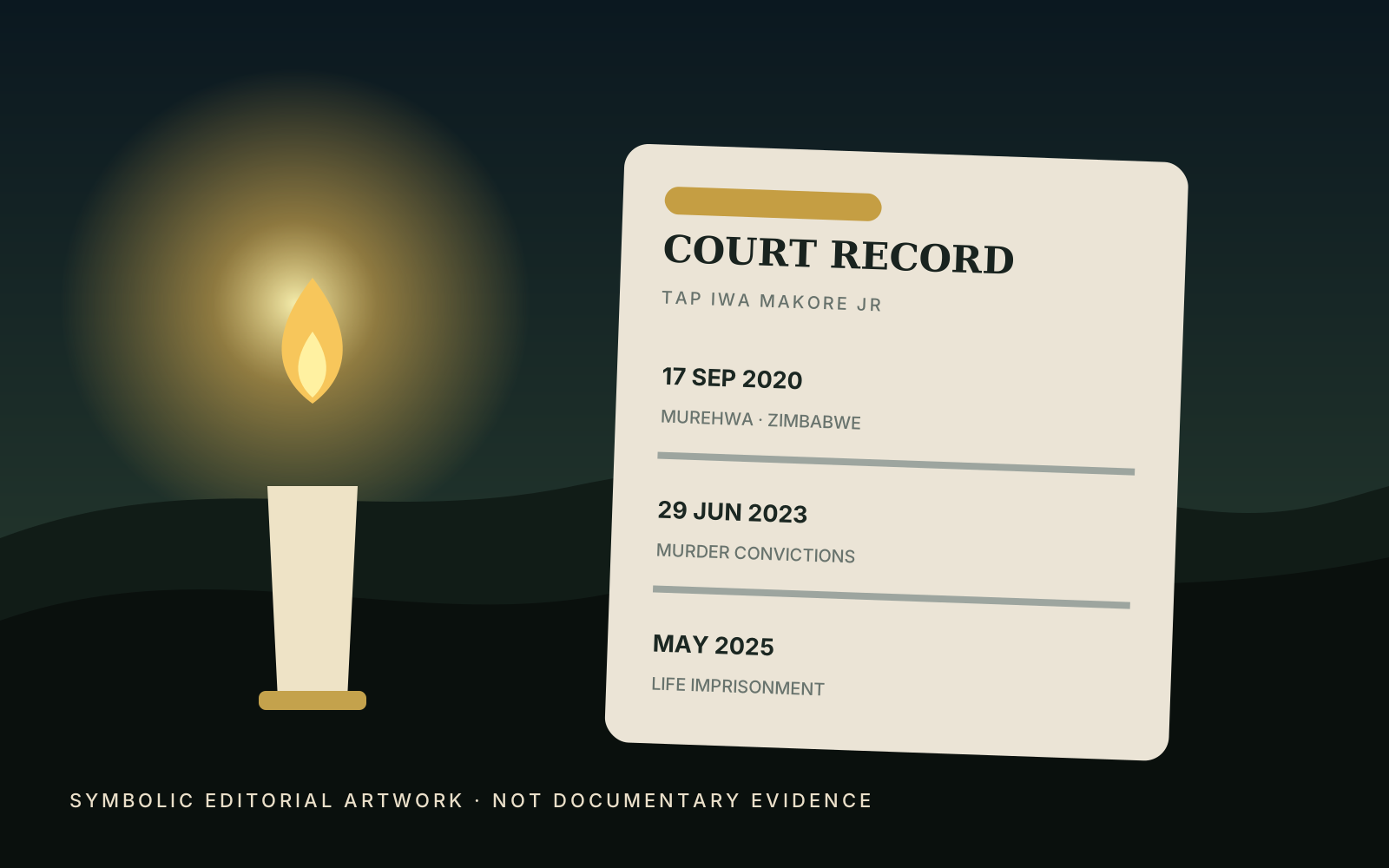
What is the current status of the case?
Direct answer: the case is classified as solved / adjudicated. Zimbabwe’s High Court convicted Tafadzwa Shamba and Tapiwa Makore Senior of the murder of Tapiwa Makore Jr on 29 June 2023. The court later imposed death sentences, but those are no longer the operative punishment.
Zimbabwe’s Death Penalty Abolition Act became law at the end of 2024. In May 2025, the Supreme Court substituted life imprisonment for both death sentences. Reporting on the ruling states that the murder convictions themselves remained undisturbed.
Who was Tapiwa Makore Jr?
Tapiwa Makore Jr was seven years old and lived in Nyamutumbu village in the Murehwa area of Mashonaland East. He was a child within an extended family and village community before his name became associated with a criminal prosecution.
His age and the circumstances of his death brought intense public attention. A victim-aware account should resist turning that attention into spectacle. The legally important record is the child’s disappearance, the evidence tested at trial, the verdicts and the sentences—not graphic reconstruction.
This page therefore limits physical detail and does not reproduce images of remains. Tapiwa is identified by name because his family and the court record do so, while the illustration remains deliberately symbolic.
The disappearance and investigation
Tapiwa disappeared on the afternoon of 17 September 2020 while in Nyamutumbu village. Search efforts followed. The investigation developed after partial remains were discovered and witnesses led police toward people within the child’s extended family and community.
The High Court record identifies Tafadzwa Shamba and Tapiwa Makore Senior—the child’s uncle and namesake—as the two accused eventually tried for murder. The prosecution relied on a combination of admissions attributed to Shamba, witness testimony, recovery evidence and the surrounding circumstances.
The court’s merits judgment, reported as S v Shamba & Anor HH 396-23, is the controlling account of why the trial court accepted some evidence and rejected competing explanations. Newspaper summaries are useful context, but they do not replace the judicial findings.
The High Court trial and guilty verdicts
The case was tried in the High Court at Harare over hearings beginning in October 2022. On 29 June 2023, Justice Munamato Mutevedzi delivered the guilty verdicts. The court treated Shamba as the principal offender and Makore Senior as an accomplice to the murder.
The judgment did not rest on public suspicion alone. It evaluated whether the prosecution had proved the killing, each defendant’s participation and the state of mind required for murder. The court found the combined evidence sufficient beyond reasonable doubt.
The prosecution theory linked the murder to a belief that the child’s death and body parts would advance a business-prosperity ritual. That proposition is reported here only as a finding in this particular criminal case. It should not be generalized into a claim about Zimbabwean culture, traditional belief or religion.
The 2023 death sentences
In a separate sentencing judgment dated 12 July 2023, reported as HH 419-23, the High Court found murder in aggravating circumstances. Under the law then in force, the judge concluded that the available punishment was death and imposed that sentence on each defendant.
The distinction between verdict and sentence matters. The verdict decided criminal responsibility. The sentencing judgment decided punishment under the legal framework that applied in July 2023. A later change to punishment did not erase the verdicts.
Human-rights organizations, including Amnesty International, publicly opposed the death sentences while acknowledging the gravity of the crime. Their position addressed capital punishment as a penalty; it was not a finding that the defendants had been acquitted.
Zimbabwe’s 2024 abolition of the death penalty
Zimbabwe enacted the Death Penalty Abolition Act [Chapter 9:26], Act 4 of 2024, on 31 December 2024. The statute abolished capital punishment and created a process for replacing existing death sentences.
That legal change altered the range of lawful penalties for people already sentenced to death. It did not automatically convert a murder conviction into an unresolved case. The important editorial task is to state both the historical sentence and the current one without leaving readers with an outdated death-row label.
The Supreme Court’s 2025 life sentences
In May 2025, the Supreme Court dealt with the defendants’ challenges after abolition. Established Zimbabwean reporting states that the court replaced the death sentences with life imprisonment and left the convictions in place.
The result is therefore precise: Shamba and Makore Senior remain convicted of murder, but their lawful punishment is life imprisonment rather than death. This page uses the newer sentence in its status line and dossier while preserving the 2023 sentence as part of the procedural history.
The reported ruling date was 12 May 2025, with national coverage published later that week. Because the full Supreme Court text was not among the publicly accessible records reviewed for this page, the description of the appellate result is attributed to that reporting rather than embellished with unverified reasoning.
What the judgments resolve—and what they do not
The judgments resolve individual criminal responsibility for the murder as to the two convicted defendants. The High Court reached verdicts after trial; the Supreme Court later determined the punishment that could lawfully replace the death sentences.
They do not require the archive to repeat every allegation aired before trial or to imply guilt by association for anyone not convicted. They also cannot repair the loss experienced by Tapiwa’s family. Legal resolution and personal closure are not the same thing.
For search and research purposes, the decisive entities are clear: Tapiwa Makore Jr; Nyamutumbu village and Murehwa; the date 17 September 2020; defendants Tafadzwa Shamba and Tapiwa Makore Senior; High Court judgments HH 396-23 and HH 419-23; the 2024 abolition law; and the 2025 Supreme Court life sentences.
Case timeline
- 17 September 2020 — Seven-year-old Tapiwa Makore Jr disappears from Nyamutumbu village and is murdered.
- 2020–2021 — Police investigate, make arrests and develop the prosecution case from witness, recovery and other evidence.
- 3–13 October 2022 — The High Court hears the main trial evidence over scheduled sitting dates.
- 29 June 2023 — The High Court convicts Tafadzwa Shamba and Tapiwa Makore Senior of murder.
- 12 July 2023 — The High Court imposes death sentences after finding aggravating circumstances.
- 31 December 2024 — Zimbabwe enacts the Death Penalty Abolition Act.
- 12 May 2025 — According to national reporting, the Supreme Court substitutes life imprisonment for both death sentences.
Frequently asked questions
When and where was Tapiwa Makore Jr murdered?
Seven-year-old Tapiwa Makore Jr was murdered on 17 September 2020 after disappearing from Nyamutumbu village in Murehwa, Mashonaland East, Zimbabwe.
Who was convicted in the Tapiwa Makore case?
The High Court of Zimbabwe convicted Tafadzwa Shamba and Tapiwa Makore Senior. The court treated Shamba as the principal offender and Makore Senior as an accomplice.
What did the High Court decide in 2023?
The High Court delivered the guilty verdict on 29 June 2023 and imposed death sentences on 12 July 2023 after finding murder in aggravating circumstances.
What happened to the death sentences?
Zimbabwe abolished the death penalty at the end of 2024. In May 2025, the Supreme Court replaced the two death sentences with life imprisonment while leaving the murder convictions in place.
Why is the case classified as solved or adjudicated?
Two defendants were convicted of murder after a completed High Court trial, and the Supreme Court later determined the lawful replacement sentences. The classification records adjudicated criminal responsibility; it does not claim that every factual question surrounding the crime was answered.
Why does the archive use symbolic artwork?
The artwork uses a memorial light, a village horizon and court files. It does not imitate Tapiwa, the defendants, human remains or an authentic crime scene.