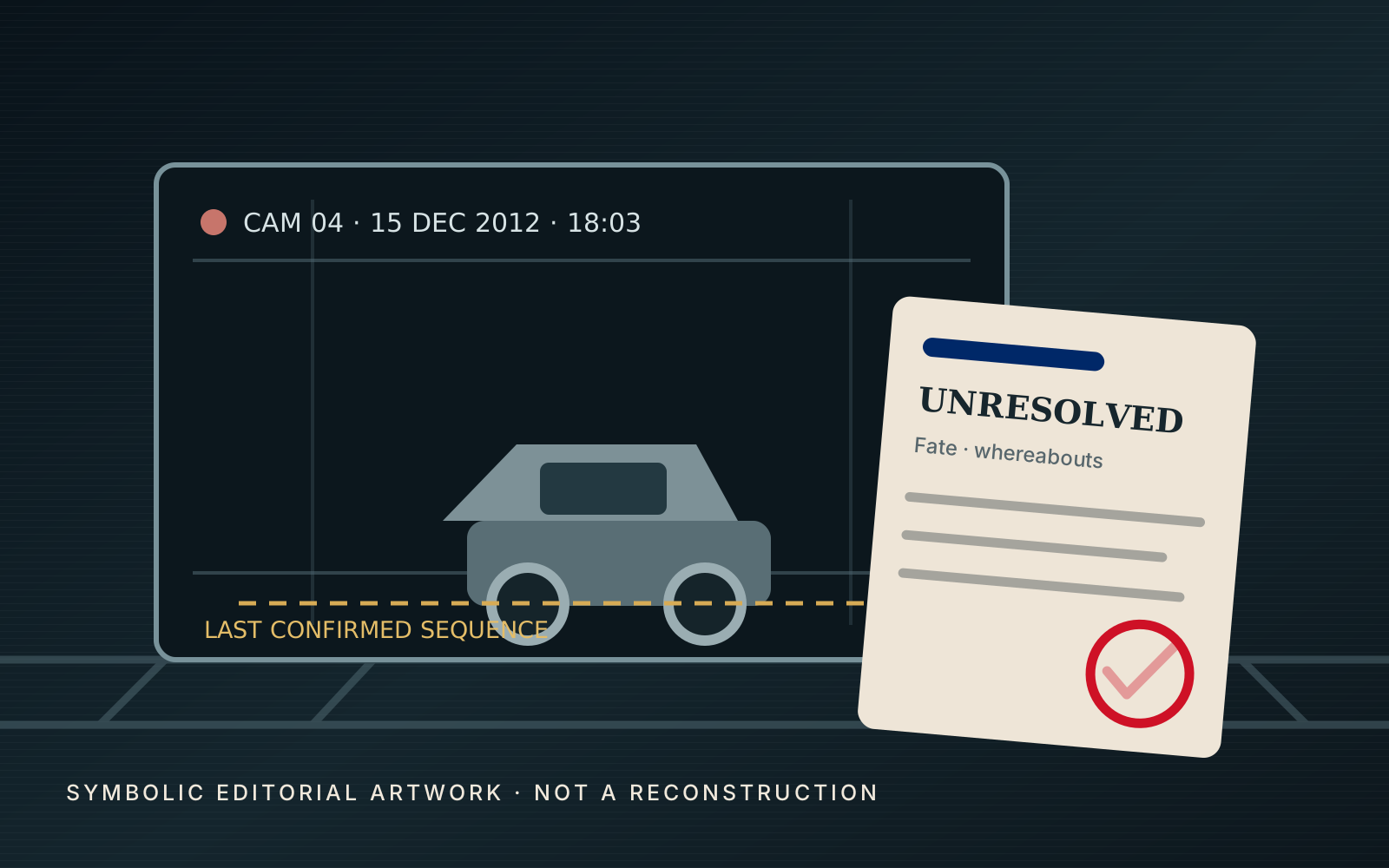
Status boundary: The disappearance and the checkpoint sequence described by institutional sources are documented. United Nations experts and rights organizations characterize the case as an enforced disappearance. No reviewed public source established the identity of the people who took Sombath away or produced a criminal judgment assigning individual responsibility.
Who is Sombath Somphone?
Sombath Somphone is a Lao educator and civil society leader whose work focused on community development, food security and young people’s participation in sustainable development. United Nations human-rights reporting describes him as a prominent advocate for social development in Laos.
His public profile matters to the context, but it does not prove a motive. The available record supports describing his work and the international concern that followed his disappearance; it does not support naming a person or agency as the criminal author without a credible finding.
What happened on 15 December 2012?
Sombath left his office in Vientiane in the early evening and drove home. He did not arrive. His family later obtained CCTV footage from a police post on Thadeua Road, a busy road in the capital.
According to the United Nations experts’ account, the footage recorded traffic police stopping Sombath’s vehicle. He entered the police post. Soon afterward, unidentified people arrived, and Sombath was taken away in another vehicle. A separate unidentified person drove his vehicle away.
The footage is central because it places the last documented sequence at a police post. It does not, in the public record reviewed for this page, clearly identify the people who removed him or reveal where he was taken.
What does the CCTV establish—and not establish?
The footage establishes a chronological sequence: a police stop, Sombath’s entry into the post, the arrival of other people and vehicles, and his removal from the area. United Nations experts said the evidence indicated that he had been held in police custody after the stop.
At the same time, responsible reporting must distinguish an institutional assessment from a criminal adjudication. No publicly available court judgment reviewed here identifies an individual perpetrator. The images do not answer what happened after the vehicle left, whether Sombath remains alive, or who planned the disappearance.
Those limits do not make the evidence insignificant. They explain both why international bodies have repeatedly demanded an effective investigation and why the case remains unresolved.
What has the Lao government said?
Lao authorities have denied involvement in Sombath’s disappearance. Government representatives have also maintained in international reviews that an investigation was ongoing.
United Nations experts, the European Parliament and rights organizations have criticized the lack of concrete progress, transparency and communication with Sombath’s family. Human Rights Watch reported in 2025 that the government had not provided meaningful updates to the family or the public despite continuing to claim that it was investigating.
This page records the government’s denial as its stated position. It does not treat that denial as resolving the evidence around the checkpoint, nor does it substitute allegations for a properly tested criminal finding.
What have international bodies concluded?
In February 2013, the European Parliament expressed deep concern, noted fears that Sombath had been subjected to enforced disappearance and called for a transparent investigation. United Nations human-rights experts repeated the demand in 2013 and, on the tenth anniversary in 2022, urged Laos to establish his fate and whereabouts and hold those responsible accountable.
The Office of the UN High Commissioner for Human Rights revisited the case in October 2024 through Sombath’s wife, Shui-Meng Ng, emphasizing the continuing uncertainty experienced by families of the disappeared. A 2025 UN review of Laos again drew recommendations for investigations into enforced disappearances.
These sources consistently treat the case as unresolved and call for truth and accountability. None of the reviewed materials reports a prosecution or a credible final account of what happened to Sombath.
Why the archive classifies the case as unsolved
A solved label would require reliable evidence establishing Sombath’s fate and individual responsibility, normally supported by a credible investigation or adjudication. Those conditions are not present in the reviewed public record.
More than thirteen years after the disappearance, the essential questions remain unanswered: where Sombath was taken, what happened to him, who carried out the operation and whether others ordered or enabled it. No perpetrator has been brought to justice.
The accurate classification is therefore unsolved disappearance. If a credible investigation, verified recovery, prosecution or judgment changes the record, the archive should update both the facts and the status label.
Case timeline
- Before 2012
Sombath becomes known for community-development, education and youth-focused work in Laos. - 15 December 2012
He disappears after his vehicle is stopped at a police post on Thadeua Road in Vientiane. - 7 February 2013
The European Parliament adopts a resolution expressing deep concern and calling for an effective investigation. - December 2013
United Nations experts say the continuing lack of answers perpetuates impunity and renew their call for an investigation. - 13 December 2022
On the tenth anniversary, UN experts urge the Lao government to establish Sombath’s fate and whereabouts. - 4 October 2024
OHCHR publishes an account centered on Shui-Meng Ng’s continuing search for answers. - 29 April 2025
Laos’s Universal Periodic Review again includes recommendations concerning enforced disappearances and accountability. - 2 March 2026
Human Rights Watch reports that attacks and disappearances targeting Lao critics remain unresolved and again cites Sombath’s case. - 14 October 2026
No credible public resolution, identified perpetrator or prosecution is located in the reviewed record.
Why the case matters
Sombath’s disappearance became an internationally recognized test of whether Laos would investigate a case involving a prominent civil society figure last documented at a police post. The absence of answers has affected his family and also raised wider concerns about the safety of civic participation in the country.
The case also demonstrates why archive labels must remain precise. “Enforced disappearance” is the assessment used by UN experts and rights organizations; “unsolved” is the site’s criminal-case status because the fate, perpetrators and accountability have not been established through a credible public process.
Frequently asked questions
Who is Sombath Somphone?
Sombath Somphone is a Lao educator and civil society leader known for community-development and youth-focused work.
When and where did he disappear?
He was last seen on 15 December 2012 at a police post on Thadeua Road in Vientiane, Laos.
What does the CCTV footage show?
Institutional accounts say it shows traffic police stopping Sombath’s vehicle, Sombath entering the police post, and unidentified people later taking him away in another vehicle.
What has the Lao government said?
Lao authorities have denied involvement and maintained that an investigation was continuing. The reviewed public record did not show a credible resolution.
Why is the case unsolved?
Sombath’s fate and whereabouts remain unknown, no perpetrator has been identified through a credible public process, and no one has been brought to justice.
Sources and verification notes
- OHCHR — UN experts call on Laos to shed light on Sombath’s whereabouts, 13 December 2022Primary UN account of the CCTV sequence, the unresolved status and the experts’ request for an effective investigation.
- OHCHR — “Where is Sombath?”, 4 October 2024UN Human Rights Office account centered on the family’s continuing search and the last confirmed sighting.
- European Parliament — Resolution on Laos: the case of Sombath Somphone, 7 February 2013Official resolution recording early international concern and calls for a transparent investigation.
- Human Rights Watch — UN rights review of Laos spotlights lack of progress, 1 May 2025Recent review of the government’s claimed investigation and the absence of updates to the family or public.
- Human Rights Watch — Laos: Investigate prominent dissident’s death, 2 March 2026Current source confirming that Sombath’s case and other attacks on Lao critics remained unresolved.
Verification date: 14 October 2026. The reviewed public record contained the checkpoint footage described by institutional sources, official denials and repeated international calls for investigation, but no credible resolution, identified perpetrator or prosecution.