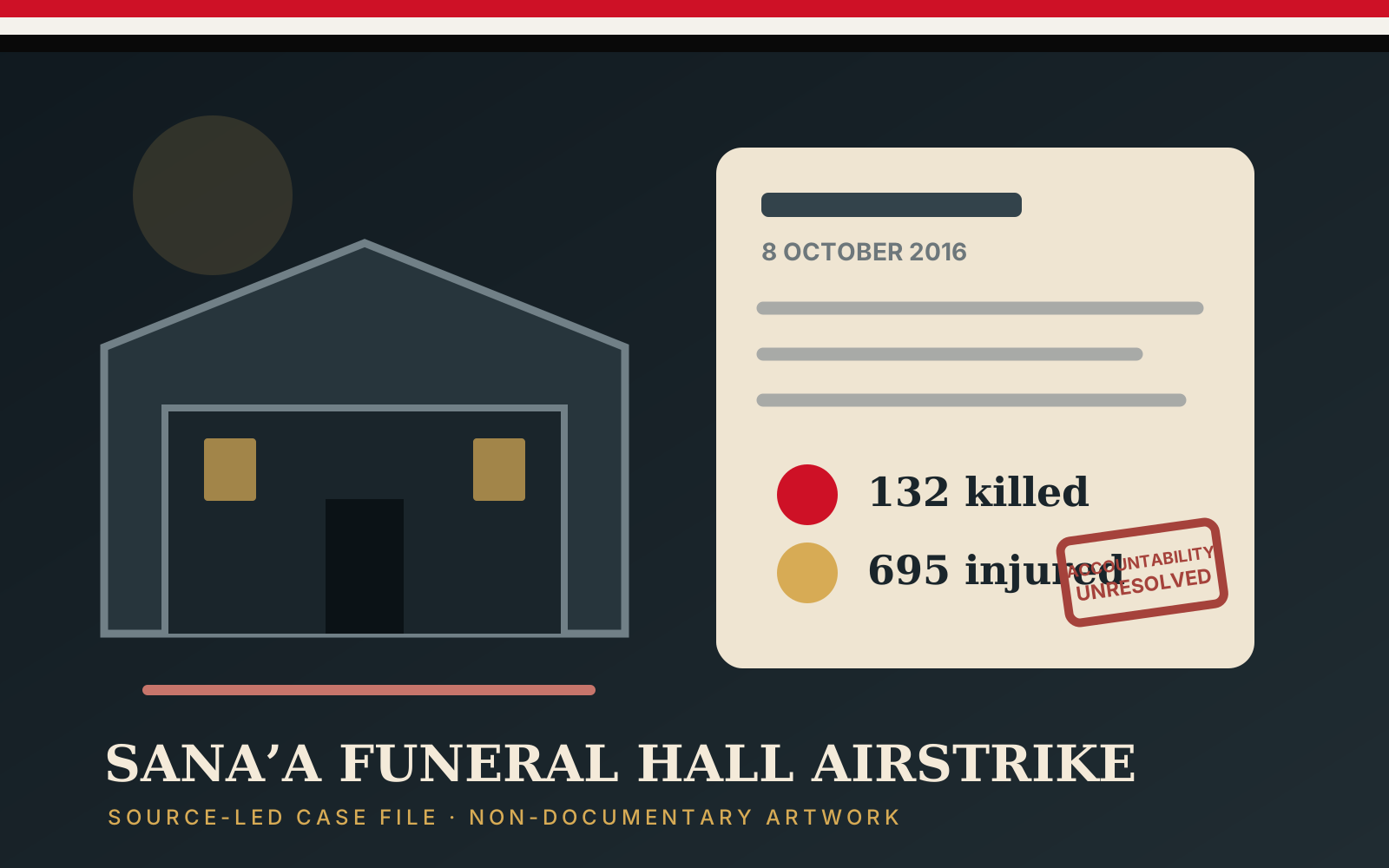
Status boundary: The attack and the coalition aircraft’s role are not treated as mysteries. The unresolved issue is individual criminal accountability. “Apparent war crime” is attributed to Human Rights Watch; this page does not convert that assessment into a court verdict or identify any person as criminally responsible without a judgment.
What happened on 8 October 2016?
The al-Sala al-Kubra community hall stood in a residential area of southwest Sana’a. On the afternoon of 8 October, it was hosting the funeral of Ali al-Rawishan, whose son Jalal al-Rawishan was acting interior minister in the Sana’a-based administration aligned with the Houthi-Saleh forces. The event was publicly known and drew a large mixture of officials, military figures, relatives and other mourners.
The UN Panel of Experts reported that at least 1,000 mourners were taking part. Human Rights Watch, after interviewing 14 witnesses and two people who arrived to assist, reported that at least two air-dropped munitions penetrated the roof and detonated several minutes apart at about 3:30 p.m. The hall was crowded, and the second detonation intensified the danger to people already inside and to those responding.
The existence of military or political figures at a civilian gathering is legally important, but it does not make every person present a lawful target. Attackers remain bound by the principles of distinction, proportionality and feasible precaution. That distinction is central to why investigators examined not just who was present, but what the attacking forces knew and what checks they performed.
How many people were killed and injured?
Casualty counts varied as hospitals, local authorities and international investigators compiled information. Human Rights Watch’s initial publication used a conservative figure of at least 100 killed and more than 500 wounded, including children. Early UN statements cited more than 140 deaths and roughly 525 to 550 injuries.
The later UN Panel case study recorded 132 civilians killed and 695 injured. This page uses that later documented figure as its principal count while retaining the earlier totals in context. The difference does not indicate that the attack itself is disputed; it reflects the difficulty of casualty recording after a mass-casualty strike.
What did the coalition’s assessment acknowledge?
The coalition initially denied carrying out an operation at the hall. On 15 October 2016, however, its Joint Incidents Assessment Team published findings saying that a party affiliated with the Yemeni presidency’s General Chief of Staff had wrongly reported a gathering of armed Houthi leaders and insisted on an immediate strike.
JIAT said the Air Operations Center in Yemen directed a close-air-support mission without obtaining approval from the coalition command and without applying the command’s precautionary measures to verify that the site was not a protected civilian location. According to that statement, a coalition aircraft in the area carried out the mission.
JIAT recommended action against those responsible for the error, compensation for victims’ families and review of rules of engagement. That is a significant institutional acknowledgment. It is not, by itself, a public criminal judgment, a complete identification of the forces and personnel involved, or proof that the recommended measures were implemented.
What did UN investigators find?
The UN Panel of Experts examined the strike as a case study of an air attack affecting a civilian gathering. Its report located the hall, described the funeral and casualty evidence, assessed weapons information and reviewed the coalition’s explanation. The Panel attributed the strike to the Saudi Arabia-led coalition and analyzed command, targeting and precaution issues.
The UN report’s later casualty record is the most specific consolidated figure used here. It also matters because it placed the incident within an independent Security Council-mandated inquiry rather than relying only on statements from a party to the conflict.
Two days after the attack, the UN High Commissioner for Human Rights called it outrageous and argued that the incident strengthened the need for an international inquiry. The UN Secretary-General separately called for a prompt and impartial investigation so that those responsible could face justice.
Independent investigation and legal assessment
Human Rights Watch reviewed witness interviews, photographs, video and weapons remnants. It concluded that the strike was an apparent war crime, emphasizing the clear presence of several hundred civilians and the foreseeable scale of harm even if military personnel attended. The organization identified remnants consistent with a United States-manufactured GBU-12 Paveway II 500-pound laser-guided bomb.
That description is an expert legal assessment, not a verdict. A war-crimes conviction would require a competent court to establish jurisdiction, individual conduct, the applicable mental element and other elements of the offense. No such final individual judgment was located for this incident.
The Yemeni Archive later assembled open-source material about the strikes, witness accounts and inconsistencies between public explanations. Its work helps preserve the factual record, but it likewise does not substitute for a criminal trial.
What happened to the promised accountability?
Human Rights Watch reported in 2018 that the Yemeni National Commission said officers involved had been dismissed and referred to a military court. The same report found no public clarification of which coalition states’ forces participated and no transparent account of the recommendations’ implementation.
JIAT’s recommendation for compensation also did not produce a clear public redress mechanism. Human Rights Watch said two people affected by the Great Hall strike told the Yemeni organization Mwatana that they had received no assistance and had not been contacted about compensation or the investigation.
Disciplinary action, dismissal, referral and prosecution are distinct steps. A referral does not establish guilt, and a promise of compensation does not establish either payment or criminal responsibility. The reviewed public record did not reveal a completed, final judgment against an identified person for the strike.
Why the archive classifies the case as unresolved
The event has unusually strong documentation: the location and date are established; casualty evidence is extensive; the coalition’s own inquiry said a coalition aircraft performed the mission; and independent investigators analyzed the targeting and civilian harm. Calling the event itself “unsolved” without explanation would therefore be misleading.
The unresolved classification is narrower. It refers to the absence of a verified final criminal judgment assigning individual responsibility and to the incomplete public record on participating forces, decision-makers, prosecution and redress. As of 13 October 2026, no reliable public final conviction for this attack was located.
That boundary keeps three propositions separate: the coalition acknowledged the mission; independent experts alleged serious legal violations; and no individual conviction has been verified. None should be collapsed into another.
Case timeline
- 8 October 2016, approximately 3:20–3:30 p.m.
Air-delivered munitions strike the al-Sala al-Kubra community hall during a large funeral ceremony in Sana’a. - 8–10 October 2016
Hospitals and officials report mass casualties. UN leaders call for an impartial international investigation. - 13 October 2016
Human Rights Watch publishes its witness- and weapons-based assessment, describing the attack as an apparent war crime. - 15 October 2016
JIAT says a coalition aircraft carried out the mission after faulty intelligence, missing approval and failures to follow precautionary procedures. - January 2017
The UN Panel of Experts submits its report documenting 132 civilians killed and 695 injured and analyzing coalition responsibility. - August 2018
Human Rights Watch reports that accountability and redress remain opaque; affected people interviewed had received no assistance. - 13 October 2026
No public final individual criminal conviction for the strike is located in the reviewed record.
Why the case matters
The Great Hall strike is a defining test of accountability for civilian harm in Yemen. It shows why an institutional acknowledgment is not the same as an independent prosecution, and why casualty documentation must be connected to transparent command and targeting records.
It also demonstrates the importance of precise labels. The record supports attribution of the mission to the coalition and serious concern about its legality. It does not support inventing a named perpetrator, claiming a court found a war crime, or treating an announced referral as a conviction.
Frequently asked questions
What happened at the Sana’a funeral hall on 8 October 2016?
Air-delivered munitions struck the al-Sala al-Kubra community hall while a large funeral ceremony was under way. A UN Panel later documented 132 civilians killed and 695 injured.
Who carried out the airstrike?
The coalition’s Joint Incidents Assessment Team said a coalition aircraft carried out the mission after an air operations center acted on faulty information and failed to follow approval and precaution procedures.
Was the attack ruled a war crime by a court?
No final criminal judgment located for this archive ruled on individual guilt. Human Rights Watch called the attack an apparent war crime, and the UN Panel analyzed it under international humanitarian law; those are investigative and legal assessments, not convictions.
Were military figures present at the funeral?
Human Rights Watch and the UN Panel reported that military personnel and officials connected to the Houthi-Saleh alliance were among those present. Their presence did not remove the obligation to distinguish civilians and take feasible precautions.
Why are casualty figures different across sources?
Counts changed in the days after the strike. Human Rights Watch initially reported at least 100 killed and more than 500 wounded; the UN Panel later documented 132 civilians killed and 695 injured.
Has anyone been convicted for the attack?
No public final individual criminal conviction was located through 13 October 2026. Human Rights Watch reported that Yemeni officers were dismissed and referred to a military court, but no completed public judgment was identified.
Sources and verification notes
- United Nations Security Council Panel of Experts — S/2017/81Primary international investigation used for the event chronology, later casualty count, weapon analysis and responsibility assessment.
- OHCHR — High Commissioner’s statement, 10 October 2016Contemporaneous UN response and call for an international investigation.
- Joint Incidents Assessment Team statement — full English textCoalition assessment describing faulty intelligence, missing approval, procedural failures and the coalition aircraft mission.
- Human Rights Watch — Yemen: Saudi-Led Funeral Attack Apparent War CrimeWitness interviews, site imagery, weapons review, early casualty evidence and legal assessment.
- Human Rights Watch — Hiding Behind the CoalitionJIAT methodology, reported military-court referral, missing public accountability detail and redress evidence.
- Yemeni Archive — Attacks on the Grand Hall in SanaaOpen-source preservation and reconstruction material, used as corroborating—not adjudicative—evidence.
Verification date: 13 October 2026. The unresolved label refers to individual criminal accountability. The coalition aircraft’s role is acknowledged in JIAT’s own statement.