Conflict over sand mining
Salim Kancil and Tosan were farmers and local environmental activists who opposed sand mining around Watu Pecak beach in Lumajang, East Java. Their opposition placed them in conflict with people who supported or benefited from the mining activity. Indonesian news reports from the period describe Salim and Tosan as prominent local opponents of the operation.
The wider background matters because the later criminal case was not presented simply as a random street attack. Prosecutors alleged planning by local figures associated with the pro-mining side, while the police investigation expanded to encompass both the violence itself and separate allegations involving illegal mining and financial crime.
The September 26 attacks
On September 26, 2015, a group attacked the two activists in and around Selok Awar-Awar. Salim was killed. Tosan survived with serious injuries and required hospital treatment. Contemporary police reporting said investigators rapidly began identifying people believed to have participated in the violence.
By September 29, police had named 18 suspects; a day later that figure had risen to 22. The number later grew further as investigators separated the case into multiple files according to the alleged role of each participant. This is why the criminal record cannot responsibly be reduced to a single sentence saying that every person arrested was convicted of the same crime.
The case against Hariyono and Mat Dasir
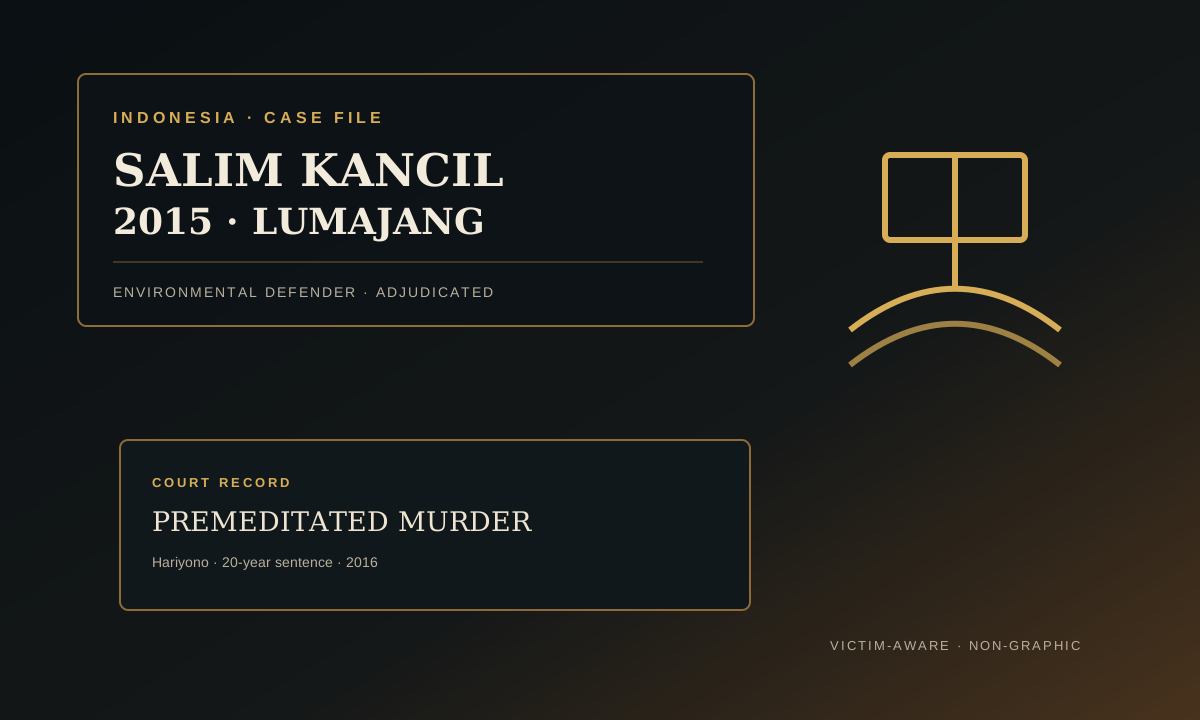
Hariyono, the head of Selok Awar-Awar village, and Mat Dasir were among the principal defendants tried in Surabaya. Prosecutors alleged that the two had helped plan the group violence against Salim and Tosan. At trial, the prosecution sought life imprisonment.
On June 23, 2016, the Surabaya District Court sentenced both men to 20 years. The legal findings, however, were not identical. ANTARA's report of the judgment states that Hariyono was found guilty under Article 340 of the Indonesian Criminal Code, together with the participation provision in Article 55, for the premeditated murder that caused Salim's death.
Mat Dasir was found guilty under Article 170 in connection with the group assault that caused serious injuries to Tosan. That distinction is important: although both men received 20-year sentences in the same major proceeding, the reported statutory basis and victim-related findings differed.
Other defendants and the scale of the investigation
The prosecution was broader than the two senior defendants. ANTARA reported that the Surabaya court was handling dozens of other defendants with roles assessed separately. Two juvenile defendants, for example, were sentenced to three years and six months after a juvenile court found them guilty of participating in group violence that caused death; the court did not accept the prosecution's attempt to treat those youths as direct participants in premeditated murder.
Police also investigated allegations of illegal sand mining alongside the homicide case. Those proceedings were legally distinct. A person suspected in the mining investigation was not automatically proven to have participated in Salim's killing, and this page does not merge the two categories.
Questions about protection and prevention
The case also raised institutional questions. During the 2016 proceedings, a Surabaya judge criticized the slow handling of the illegal-mining dispute before the attack, noting that police already knew of tension between supporters and opponents of the mining operation. That judicial criticism does not itself establish criminal liability for police officers, but it forms part of the documented record of how the violence developed.
International coverage later cited Salim among environmental and land defenders killed in 2015. The broader significance of the case lies not only in the criminal verdicts but also in the risks faced by local people challenging resource extraction.
Timeline
Before September 2015: Salim Kancil, Tosan and others oppose sand mining near Watu Pecak beach.
September 26, 2015: Salim is killed and Tosan is seriously injured in coordinated group violence in Selok Awar-Awar.
September 29–30, 2015: police announce first 18, then 22 suspects as the investigation expands.
January 2016: police report multiple completed case files covering the homicide, assault and related mining and financial allegations.
February 18, 2016: Hariyono and Mat Dasir go on trial in Surabaya.
June 23, 2016: both receive 20-year prison sentences; Hariyono is reported convicted of premeditated murder, while Mat Dasir is convicted under the group-violence provision for the serious injuries to Tosan.
Current status
The murder of Salim Kancil is legally adjudicated in the sense that a principal local official was convicted of premeditated murder and numerous other defendants faced criminal proceedings for their roles in the violence. The record is more complex than a single-perpetrator case, however, and this file preserves the distinctions between homicide, assault and related mining offences rather than assigning the same criminal finding to every person investigated.
Sources
- ANTARA — Surabaya District Court sentences Hariyono and Mat Dasir; reports the distinct statutory findings, June 23, 2016
- ANTARA — police announce 18 suspects after the attack, September 29, 2015
- ANTARA — police describe the completed case files and separation of homicide, mining and financial allegations, January 22, 2016
- ANTARA — trial testimony and judicial criticism of the earlier handling of the mining conflict, March 17, 2016
- The Guardian — international context on Salim and Tosan as anti-mining defenders, February 28, 2017