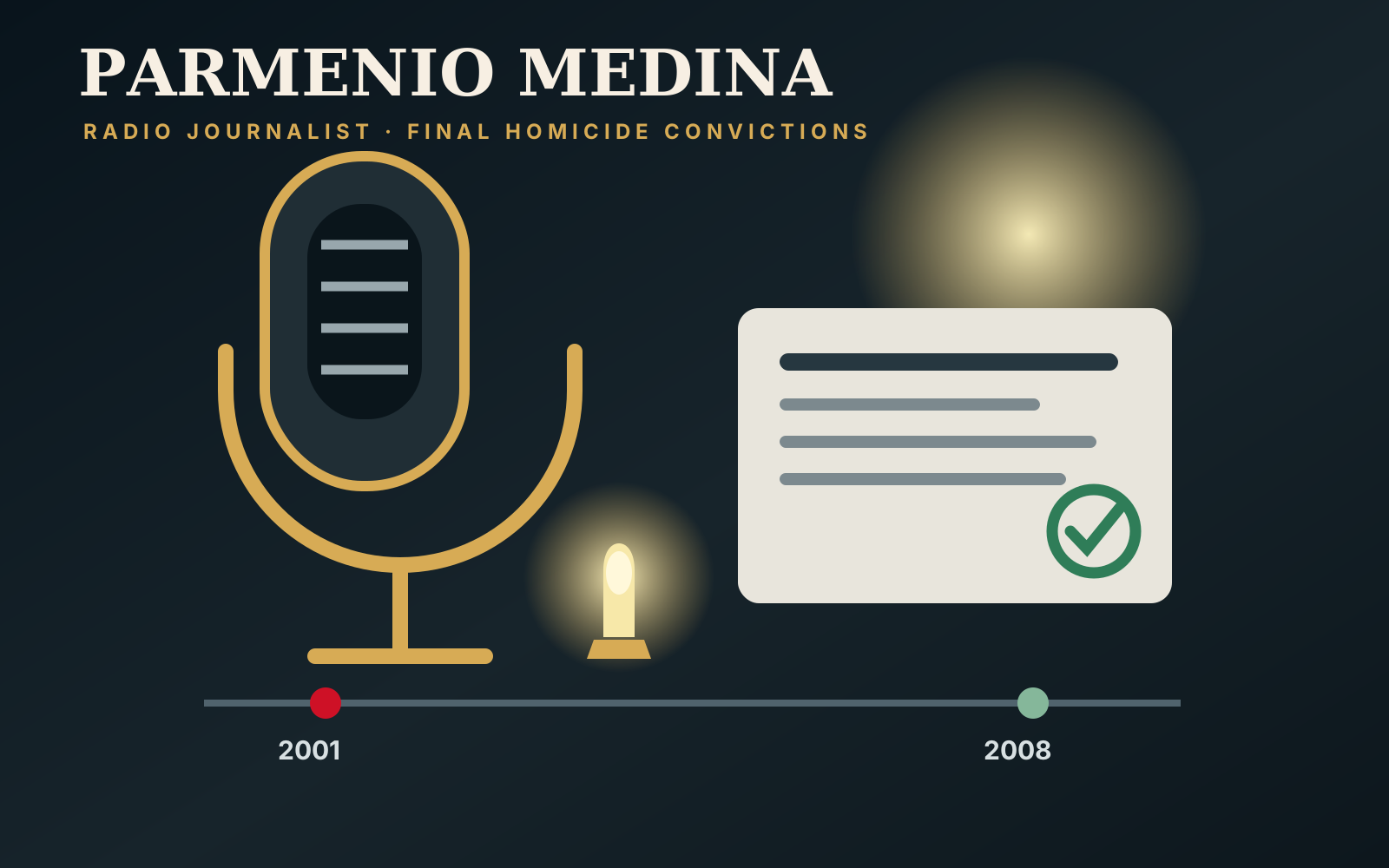
Status boundary: “solved / adjudicated” refers to final homicide convictions against Omar Chaves Mora and Luis Alberto Aguirre Jaime. It does not convert the acquittals of Mínor de Jesús Calvo Aguilar or six other defendants into guilt, and it does not merge separate fraud findings with the murder judgment.
The journalist and La Patada
Medina was born in Colombia and became a naturalized Costa Rican. For decades he produced and hosted La Patada, a popular weekly radio program that combined satire with pointed criticism. The Committee to Protect Journalists reported that his work frequently addressed corruption and that he had received threats.
In the period before his death, Medina publicly questioned alleged financial irregularities involving Radio María. Those broadcasts contributed to scrutiny of the station and its leadership. The later criminal proceedings examined both the killing and alleged fraud connected to the station, but the two sets of findings remained legally distinct.
The killing on 7 July 2001
At about 4:30 p.m., Medina was attacked close to his home in Santo Domingo de Heredia, northwest of San José. CPJ reported that he was struck by three close-range shots from a .38-caliber weapon—one in the back and two in the head—and died while being taken to hospital.
The shooting followed earlier threats. CPJ’s case record says bullets had been fired at Medina’s home roughly two months before the murder and that he had recently asked for police protection to be withdrawn. These facts establish the documented threat environment; they do not identify a perpetrator by themselves.
Investigation, arrests and witness security
The investigation developed over more than two years before principal suspects were detained in December 2003. Costa Rica’s Judicial Investigation Agency later included the case among events that marked its institutional history.
The proceedings also exposed risks to participants in the justice process. Contemporary judicial reporting described threats against witnesses and the prosecutor. CPJ likewise noted that witnesses and a prosecutor were threatened during the trial. That history matters because it explains the protective measures and the exceptional length of the proceeding without changing the evidentiary burden.
The 2005–2007 trial
The trial began in December 2005 and ended on 19 December 2007. Judicial records describe it as the longest criminal trial in Costa Rican history at the time, involving hundreds of witnesses and a record developed over two years of hearings.
The court convicted businessman Omar Chaves Mora of qualified homicide for ordering Medina’s murder and sentenced him to 35 years for that offense. It convicted Luis Alberto Aguirre Jaime, known as “El Indio,” as the gunman and imposed a 30-year homicide sentence.
Mínor de Jesús Calvo Aguilar was acquitted of homicide, as were John Gilberto Gutiérrez Ramírez, Danny Smith Mata, Juan Ramón Hernández Pereira, Juan Gabriel Carvajal Angulo, Jorge Castillo Sánchez and Randall González García. Calvo and Chaves received separate fraud convictions connected to Radio María. Reporting these results together must not blur their different legal bases.
The 2008 Criminal Chamber ruling
On 19 August 2008, the Criminal Chamber of Costa Rica’s Supreme Court affirmed Chaves’s 35-year homicide sentence and Aguirre’s 30-year homicide sentence. It also confirmed the homicide acquittals, including Calvo’s.
The chamber separately reclassified aspects of the fraud offense and returned that sentencing question for further proceedings. The murder classification here rests on the affirmed homicide judgments—not on the fraud counts or on allegations rejected by the court.
Why the case is classified as solved
The core killing has an adjudicated judicial answer: a final conviction for the person found to have ordered the murder and a final conviction for the gunman. The convictions survived the principal appeal described in the official judicial record.
“Solved” is not shorthand for universal conviction. Seven people accused of homicide were acquitted. This file preserves those acquittals and avoids attributing criminal responsibility beyond the two affirmed murder judgments.
Case timeline
- 1999–2001 Medina’s broadcasts scrutinize alleged irregularities at Radio María; threats are reported.
- 7 July 2001 Medina is shot near his home in Santo Domingo de Heredia and dies en route to hospital.
- December 2003 Principal suspects are detained after the investigation.
- December 2005 The long-form criminal trial begins.
- 19 December 2007 Chaves and Aguirre are convicted of qualified homicide; seven other murder defendants are acquitted.
- 19 August 2008 The Criminal Chamber affirms the two homicide convictions and the murder acquittals.
Questions readers ask
Who was Parmenio Medina Pérez?
He was a Colombian-born, naturalized Costa Rican radio journalist best known for producing and hosting the long-running satirical and investigative program La Patada.
When and where was Parmenio Medina murdered?
He was shot near his home in Santo Domingo de Heredia on 7 July 2001 and died while being taken to hospital.
Who was convicted of the murder?
Omar Chaves Mora was convicted of ordering the killing, and Luis Alberto Aguirre Jaime was convicted of carrying it out.
What sentences were affirmed?
Costa Rica’s Criminal Chamber affirmed a 35-year homicide sentence for Chaves and a 30-year homicide sentence for Aguirre in August 2008.
Was Mínor de Jesús Calvo Aguilar convicted of murder?
No. He was acquitted of homicide. His separate fraud conviction connected to Radio María must not be presented as a murder conviction.
Why is the case classified as solved?
The core homicide produced convictions identifying the person who ordered the crime and the gunman, and those convictions were affirmed on appeal. The label does not override the other defendants’ acquittals.