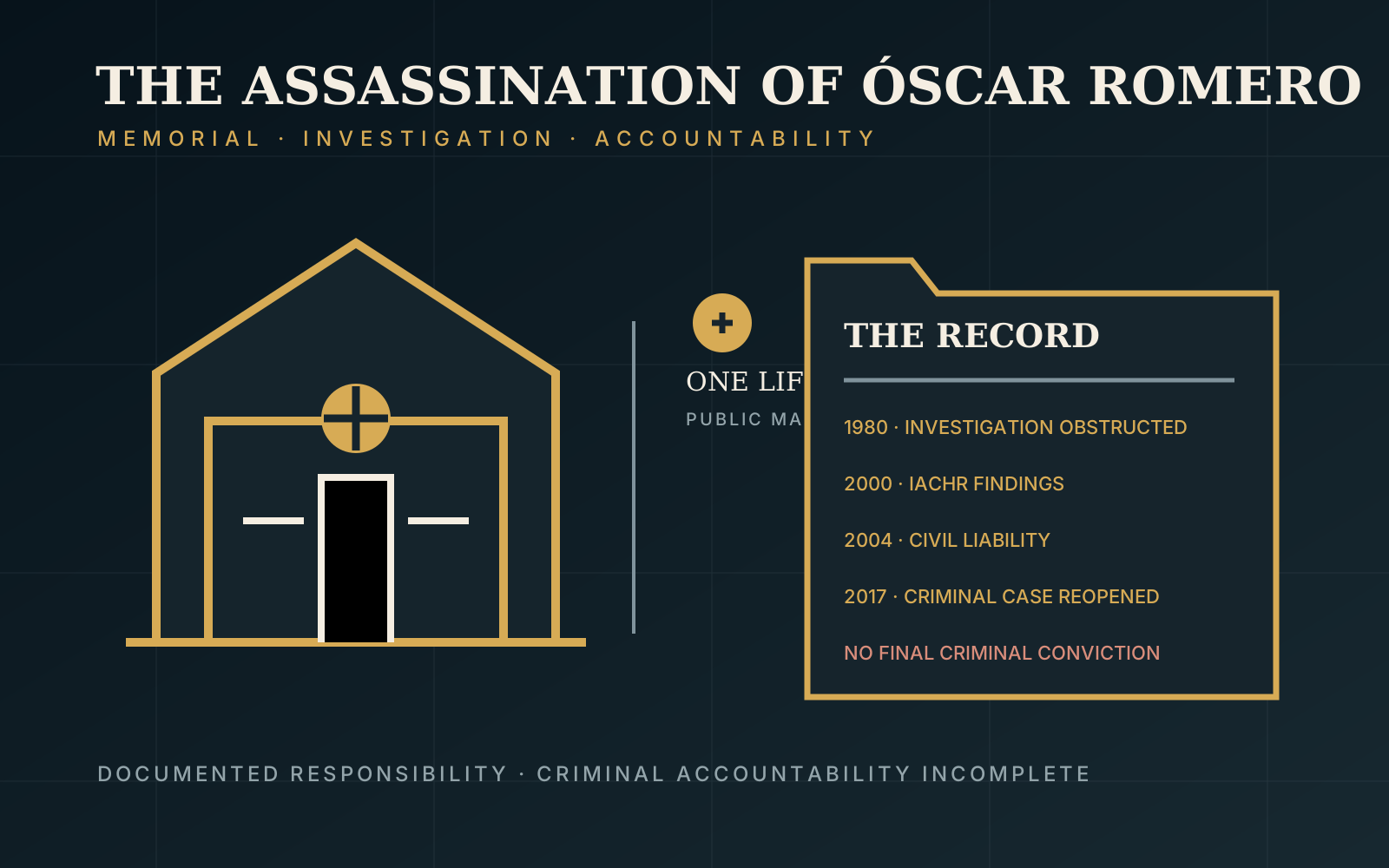
Case-status note: The IACHR made authoritative human-rights findings and a U.S. court entered a civil judgment against Álvaro Saravia. Neither result is a Salvadoran criminal conviction. This file therefore distinguishes documented institutional and civil responsibility from guilt established in a domestic criminal trial.
The killing during Mass
Romero, the Metropolitan Archbishop of San Salvador, had become a prominent public critic of political violence and abuses against civilians. The Inter-American Commission on Human Rights recorded that he received repeated death threats in February and March 1980. A bomb containing commercial dynamite was discovered behind a pulpit on March 10, two weeks before his death.
On the evening of March 24, Romero celebrated Mass in the chapel of the Hospital de la Divina Providencia. A gunman fired from outside the chapel. One projectile struck Romero and caused fatal internal bleeding. He died shortly afterward. The murder was witnessed by people attending the service and became one of the defining crimes preceding El Salvador's civil war.
An investigation compromised at the start
The initial inquiry did not secure the scene or evidence with the urgency expected after a public assassination. The IACHR found that police went to the chapel days later and did not collect or preserve essential material. The first judge, Atilio Ramírez Amaya, survived an attack at his home on March 27, resigned and left the country.
Those failures were not minor procedural errors. They narrowed the possibility of identifying the gunman through physical evidence and intimidated people responsible for the inquiry. Witnesses were interviewed years later, records were withheld and several lines of investigation were delayed or obstructed.
What the Truth Commission and IACHR established
The United Nations-sponsored Truth Commission examined the assassination after the peace accords. The IACHR subsequently relied on that record and other evidence. It found that Major Roberto D'Aubuisson made the decision to kill Romero and that former air-force captain Álvaro Rafael Saravia and other military officers and civilians participated in planning the operation. The Commission also described Walter Antonio “Musa” Álvarez and Saravia as implicated in payment to the gunman.
Amado Antonio Garay Reyes, Saravia's driver, gave a detailed account: Saravia ordered him to drive a red Volkswagen to the hospital, a passenger instructed him to stop in front of the chapel, and Garay heard a shot before seeing the passenger holding a rifle. The IACHR treated this testimony alongside seized records known as the “Saravia Diary.”
These are findings of the Truth Commission and the IACHR. D'Aubuisson died in 1992 and was never criminally convicted for Romero's murder. The archive does not convert an international commission's attribution into a domestic criminal verdict.
The Inter-American decision
In Report No. 37/00, adopted on April 13, 2000, the IACHR concluded that El Salvador was responsible for violations of Romero's right to life, fair trial and effective judicial protection, as well as the right to know the truth. It found the investigation deficient and ineffective and concluded that the 1993 General Amnesty Law helped perpetuate impunity.
The Commission recommended a complete, impartial and effective investigation, prosecution of direct perpetrators and planners, reparations, and legal changes preventing the amnesty from blocking accountability. The Salvadoran Constitutional Chamber invalidated the amnesty law in 2016, removing a central legal obstacle, but that change did not by itself establish individual criminal guilt.
The 2004 U.S. civil judgment
Romero's relative brought a civil action against Saravia in the United States under federal statutes used in human-rights litigation. In 2004, the U.S. District Court for the Eastern District of California found Saravia civilly liable for extrajudicial killing and crimes against humanity and ordered him to pay $10 million in damages.
The judgment was a significant public accountability finding, but it was civil, entered after Saravia stopped participating in the case, and did not imprison him. Describing it as a murder conviction would be inaccurate. Saravia's location has remained uncertain in public reporting.
Reopening the Salvadoran criminal case
After the amnesty law was struck down, a Salvadoran judge reopened the criminal investigation in May 2017. A court later issued an arrest order for Saravia. Reopening meant the investigation could move forward; it was not a finding of guilt, and an arrest order is not a conviction.
The Reuters account of the reopening emphasized both the historical attribution to a right-wing death squad and the long interruption caused by amnesty. Research for this file through September 15, 2026, did not locate a final Salvadoran criminal judgment convicting Saravia or another defendant for Romero's assassination.
Why the case remains unresolved
The historical record is unusually detailed for a crime without a criminal conviction. There is a named victim, a precise time and place, international findings about the operation, a driver's testimony, documentary evidence, a civil judgment and a reopened domestic investigation. But the identity of the person who fired the fatal shot has not been established in a final criminal judgment, and alleged planners have not been finally convicted in El Salvador.
The defensible status is therefore unsolved / partial accountability: responsibility has been documented in important noncriminal and civil forums, while criminal accountability remains incomplete.
Verified timeline
- March 10, 1980: a bomb is discovered behind a pulpit after Romero officiates a memorial Mass.
- March 24, 1980: Romero is shot while celebrating Mass at the Hospital de la Divina Providencia.
- March 27, 1980: Judge Atilio Ramírez Amaya survives an attack, resigns and leaves El Salvador.
- 1992: Roberto D'Aubuisson dies without a criminal trial for the assassination.
- 1993: the UN-sponsored Truth Commission publishes its findings; a general amnesty follows.
- April 13, 2000: the IACHR adopts Report No. 37/00.
- 2004: a U.S. federal court finds Saravia civilly liable and awards $10 million.
- 2016: El Salvador's Constitutional Chamber invalidates the amnesty law.
- May 2017: a judge reopens the Salvadoran criminal case.
- October 2018: a Salvadoran court issues an arrest order for Saravia.
Frequently asked questions
When and where was Óscar Romero killed?
He was shot on March 24, 1980, during Mass in the chapel of the Hospital de la Divina Providencia in San Salvador.
Who ordered the assassination?
The IACHR and UN-backed Truth Commission attributed the decision to Roberto D'Aubuisson. He was never criminally convicted for the murder.
Was Álvaro Saravia convicted?
No criminal conviction was located. A U.S. federal court found him civilly liable in 2004 and ordered $10 million in damages.
Was the criminal case reopened?
Yes. A Salvadoran judge reopened it in May 2017 after the amnesty law was invalidated.
Why is the status unresolved?
No final Salvadoran criminal judgment has convicted a defendant for the assassination, despite extensive international and civil findings.