Who were the victims?
Sébastien Judalet was a French tourist. Roberto Gianfalla was a Franco-Italian resident of Nosy Be. Both men were seized and killed near Ambatoloaka beach. A third victim, a Malagasy man described in reporting as the uncle of the child whose body had been found, was killed later that day.
Their identities matter because the public accusations quickly overwhelmed the available facts. The two European men were treated by the crowd as though rumours were proof, while the local victim was also targeted in the unrest. No allegation can substitute for an investigation, a fair hearing or reliable evidence.
What was rumour, and what was verified?
The unrest began after the body of a local boy who had been missing was found. Contemporary sources differ on whether he was eight or nine years old. Rumours then connected foreigners to the child's death, paedophilia and organ trafficking. Those claims spread rapidly and became the stated justification for collective violence.
A French investigation into Judalet found no evidence supporting the paedophilia or organ-trafficking allegations against him. Reporting on the later trial likewise described the crowd as acting on false or unsubstantiated rumours. The precise cause and circumstances of the child's death are separate from the criminal responsibility for killing the three men.
The events of 3 October 2013
After the child's body was discovered, residents gathered and demanded that police hand over people they suspected. The unrest spread through parts of Nosy Be and included attacks on property associated with the gendarmerie. Judalet and Gianfalla were captured and killed on the beach. The child's uncle was killed later.
Accounts and images allowed investigators to identify some alleged participants, but reporting described a crowd of hundreds. That scale later became central to the accountability problem: prosecutors brought 37 defendants to trial, a small portion of those who may have participated, encouraged the attacks or failed to prevent them.
Arrests and the criminal investigation
Authorities imposed security measures and announced arrests in the days after the killings. The investigation used video and photographic material, witness accounts and other evidence to identify suspects. French prosecutors also opened an investigation because one of the victims was French.
Two police officers were among those tried on allegations that they failed to assist people in danger. The presence of those charges reflected questions about the authorities' response, but it did not mean that every alleged institutional failure resulted in a conviction.
The 2015 trial in Antananarivo
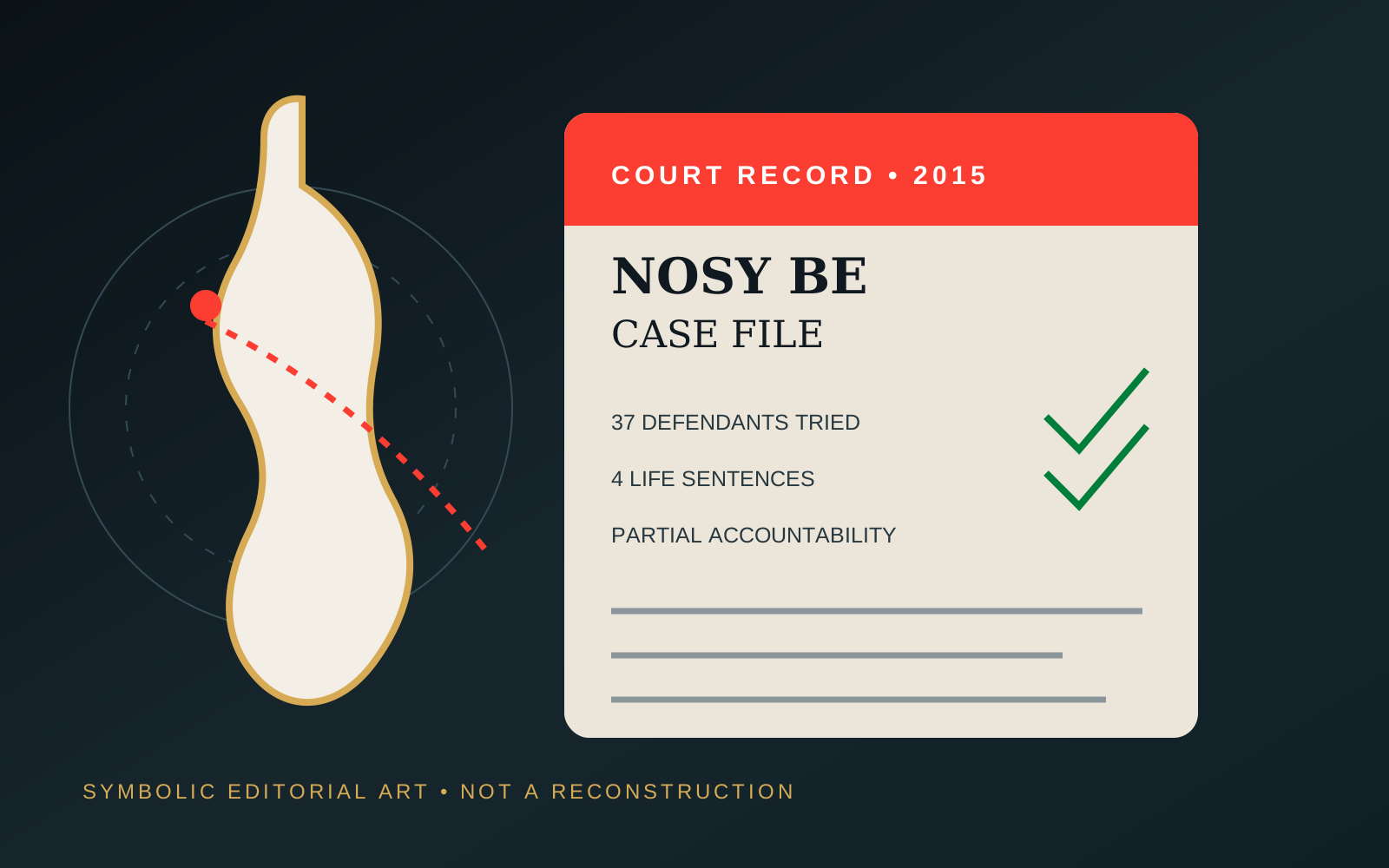
The criminal trial took place in Antananarivo in October 2015, two years after the killings. Thirty-seven defendants faced accusations connected to detention, violence and murder. Most pleaded not guilty. Prosecutors sought the maximum penalty for 12 defendants.
On 9 October 2015, the court sentenced four men to life with hard labour. At least one other defendant, Marcellin Tomboravo, received seven years with hard labour after admitting that he transported one of the European victims in his cart. Other shorter terms were imposed, while many defendants were acquitted or released.
Sources differ in how they summarize the complete distribution of lesser sentences. For that reason, this archive states the stable points supported across reports—37 tried, four maximum life sentences, additional custodial terms and many acquittals or releases—without forcing a disputed total into a single figure.
Why accountability remains incomplete
The four life sentences established criminal responsibility for specific defendants. That is enough for the archive to place the case in its solved-at-trial section. It is not enough to claim that every participant or institutional failure was identified and adjudicated.
TV5MONDE's post-trial analysis described only a fraction of the crowd as having appeared before the court. It also reported that victims' families were not informed when the trial opened. Those facts show the difference between a documented verdict and comprehensive accountability for a collective crime.
How this archive classifies the case
Status: solved at trial / partial accountability. The classification rests on the 2015 convictions and sentences, not on an assumption that the entire crowd was prosecuted. It also does not treat the rumours as evidence against the victims.
The wording is intentionally precise for search engines and readers: the killings led to convictions, but the wider episode was not fully resolved through criminal proceedings. Both facts are necessary to understand the case accurately.
Why the case remains important
The Nosy Be killings illustrate how misinformation can turn suspicion into collective punishment. Claims involving harm to children are especially capable of producing panic, yet the seriousness of an allegation makes verification and lawful investigation more important, not less.
The case also demonstrates a recurring reporting risk: describing a crime as “solved” can hide the gap between several convictions and responsibility across a large crowd. Clear labels help preserve both the court outcome and its limits.
Timeline
Frequently asked questions
What happened on Nosy Be on 3 October 2013?
A crowd killed French tourist Sébastien Judalet and Franco-Italian resident Roberto Gianfalla near a beach, then killed a Malagasy man identified as the uncle of a child whose death had triggered unrest.
Were the allegations against the victims proved?
No. A French inquiry found no evidence supporting the allegations against Judalet, and later coverage described the crowd as acting on false or unsubstantiated rumours.
How many defendants were tried?
Thirty-seven defendants stood trial in Antananarivo in October 2015.
What was the verdict?
Four men received life sentences with hard labour. Other custodial terms were imposed, while many defendants were acquitted or released.
Why is the case marked as partial accountability?
The convictions established responsibility for several defendants, but reporting described hundreds of participants and only 37 people stood trial.
Is this case the same as the child's death?
No. The child's death preceded the unrest and generated rumours. This file concerns the three mob killings and the resulting trial.
Sources and source quality
U.S. Department of State — Madagascar 2013 Human Rights Report — official contemporary human-rights record identifying the Nosy Be killings and the allegations circulating at the time.
TV5MONDE — “Lynchages à Madagascar: travaux forcés à perpétuité pour quatre accusés,” 9 October 2015 — contemporaneous verdict report confirming the four maximum sentences and trial context.
TV5MONDE — “Le lynchage de Nosy Be en procès: quelques condamnés symboliques,” October 2015 — post-trial analysis of the limited number prosecuted, the other dispositions and the families' exclusion from the process.
AFP via ModernGhana — “12 suspects in Madagascar mob lynching face hard labour for life,” 8 October 2015 — contemporaneous prosecution report confirming the 37 defendants, charges against two police officers, requested sentences and lack of evidence against the victims.
AFP via NDTV — “Madagascar: 4 Sentenced to Hard Labour for Life Over Mob Lynching,” 10 October 2015 — English-language contemporaneous report on the 37 defendants, four life sentences and Tomboravo's seven-year sentence.
Jeune Afrique — “Madagascar: reprise du procès du lynchage d'un Français et d'un Italien en 2013,” 7 October 2015 — identifies the European victims and records that the French inquiry cleared Judalet of the paedophilia suspicion.
TV5MONDE — “Madagascar: les rumeurs mortelles de Nosy Be,” 12 October 2013 — detailed contemporary reconstruction of the rumour chain and the finding that no evidence supported allegations against Judalet.
Review note: The date, victim identities, number tried and four life sentences were cross-checked across an official human-rights report and multiple established news organizations. Where reports differ on the child's age or the exact distribution of lesser sentences, the article states the discrepancy or uses only the common, verified facts.