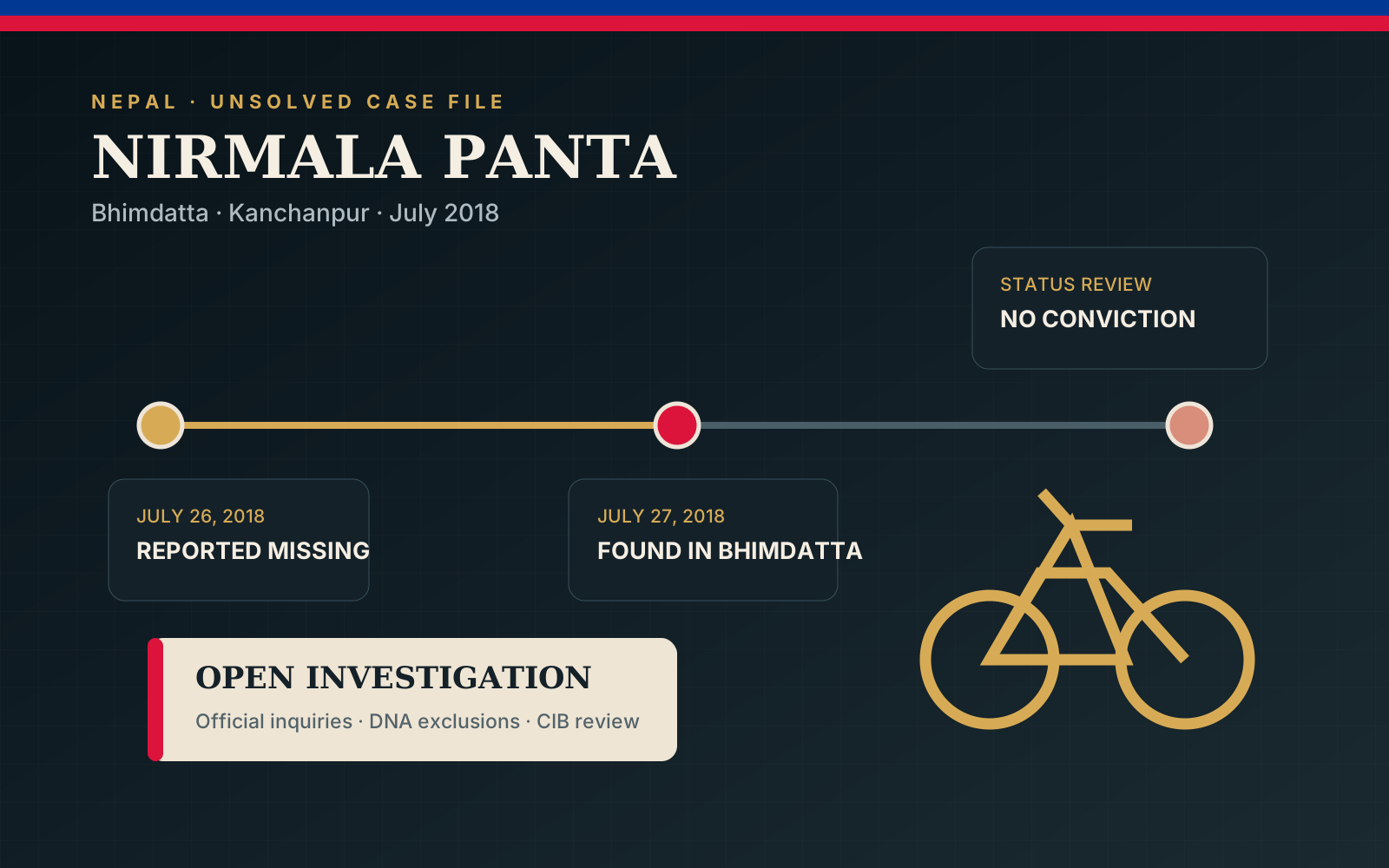
Case-status note: “Unsolved” means no perpetrator conviction was located. Detention, questioning, public suspicion, a disputed statement or a DNA test does not establish guilt. This file avoids naming uncharged private people as offenders.
Nirmala Panta
Nirmala Panta was a 13-year-old ninth-grade student living in Bhimdatta Municipality, also widely called Mahendranagar, in far-western Nepal's Kanchanpur District. The public record describes an ordinary schoolgirl who left home to visit a classmate and did not return. Responsible coverage begins with that life and with her family's search, not with graphic detail.
Her surname appears as both “Panta” and “Pant” in English-language reporting. This page uses Panta while including the alternate spelling in metadata so readers can find the same case without creating a duplicate record.
The case became one of Nepal's most prominent unresolved crimes. Public anger focused not only on the killing, but also on how authorities responded to the missing-person report, preserved the recovery site, handled biological material and presented early suspects.
July 26–27, 2018
On July 26, Nirmala left home to visit a classmate in Bhimdatta. Contemporary accounts say she intended to study and collect schoolwork. She did not return that afternoon or evening. Her mother searched for her and approached police, but the later Home Ministry inquiry concluded that officers were indifferent to the report and failed to begin an adequate search.
The following morning, July 27, Nirmala's body was found in a sugarcane field. Her bicycle and school materials were found nearby. Postmortem findings reported by The Kathmandu Post established sexual assault and death by strangulation. This archive does not reproduce clinical or crime-scene details that are unnecessary to understand the investigation.
The first 24 hours shaped everything that followed. In a missing-child case, delay can narrow opportunities to locate the child, identify witnesses and preserve time-sensitive evidence. Here, official reviewers later found that the initial response and handling of the scene were seriously deficient.
The first police response
A Home Ministry committee led by Joint Secretary Hari Prasad Mainali examined the response. The Kathmandu Post reported that its published findings described “grave negligence and carelessness” in evidence collection and criticized the failure to respond properly when Nirmala was reported missing.
The inquiry found that clothing and the body had been washed at the field where she was recovered, compromising material that might have supported the investigation. It also criticized failures to secure the site, conduct an effective search and use trained dogs. These are official inquiry findings, not theories added by this archive.
The National Human Rights Commission separately called for a fair and scientific investigation. In January 2019, the commission submitted a report containing recommendations and directives to the government and said its inquiry would continue until the police investigation ended.
An announced suspect, then release
In August 2018, police publicly presented a local man as the suspect. Residents and Nirmala's family challenged the announcement, and protests intensified. The man was later released after his DNA did not match the sample used by investigators.
That sequence is central to the classification. A police announcement is not a judicial finding. The man's release and exclusion mean this page does not describe him as the killer, repeat alleged admissions as fact or use his identity as search bait.
Other people were detained, questioned or tested over the following months. None of those steps produced a verified perpetrator conviction. Public allegations circulated widely, but this file does not reproduce accusations against people who were not proven guilty.
What the DNA record can and cannot show
Investigators collected DNA from many people. The Kathmandu Post reported exclusions in 2018, while later Republica reporting said roughly 100 people had been tested by 2021. A negative comparison can exclude a tested person if the underlying sample and process are reliable; it cannot by itself identify an unknown offender.
The National Human Rights Commission's review raised concerns about biological-material collection and testing. Public reporting said the available material may have been insufficient, damaged or contaminated. A separate technical review also questioned whether the male component attributed to the sample could reliably be treated as the perpetrator's DNA.
Those concerns require careful language. This page does not call the evidence useless, because technical findings could change with a fuller record. It states only that no verified DNA match has established who killed Nirmala and that official reviews questioned the original process.
Public protests and state response
The case triggered demonstrations in Kanchanpur and Kathmandu. Protesters demanded an independent, credible investigation and challenged the way police had handled evidence and suspects. During clashes in Bhimdatta in August 2018, police used force; one young protester was killed and others were injured.
The demonstrations led to personnel changes, suspensions and multiple review panels. They also made Nirmala's name a national symbol of demands for accountability in violence against women and girls. That public meaning should not erase the individual at the center of the case or invite unsupported claims about who was responsible.
Political leaders repeatedly promised that the crime would be solved. Promises and committees are part of the procedural history, but neither counts as a criminal resolution.
The separate case involving police officers
Eight police officers were later prosecuted on allegations connected to evidence destruction and the treatment of a suspect. A district court acquitted them in July 2020. That proceeding concerned police conduct; it did not determine who killed Nirmala.
Keeping the two questions separate prevents a common error. An acquittal in the police-conduct case does not solve the murder, and criticism in an administrative inquiry does not establish that an officer committed the underlying crime.
The murder file therefore remains open regardless of the outcome of the separate prosecution. This archive records both the official criticism and the acquittals without converting either into proof of a murderer.
Renewed investigation
By July 2021, Republica reported that investigators still had no evidentiary basis to identify the killer, despite hundreds of interviews and extensive DNA testing. The family continued to receive the same answer: the investigation was under way.
On August 3, 2025, Nepal's home minister directed the Central Investigation Bureau to begin a fresh and thorough investigation. Republica reported that CIB officials described the case as active. Nepal News published a detailed anniversary review days later and again described the murder as unresolved.
Searches of current reporting through September 13, 2026 located no reliable public announcement of a charge or conviction for Nirmala's murder. Absence from indexed public sources is not proof that no investigative step occurred; it is the reason the page makes no claim beyond what can be verified.
Why the case remains unsolved
No identified person has been convicted of the murder. The first publicly announced suspect was released after a DNA exclusion, later inquiries did not establish an offender and the fresh CIB investigation was still described as a search for the perpetrator.
The case cannot be called solved because police once announced a suspect, because people confessed under disputed circumstances, or because social-media users accused individuals. A solved classification requires a verified conviction or another reliable resolution identifying responsibility.
Future charges would not automatically change the classification to solved: an accused person remains unproven until adjudication. If a final judgment is published, this file should be updated with the court, date, offense and appeal status.
Why this record matters
Nirmala's case shows how early investigative failures can shape a case for years. It also illustrates the limits of presenting DNA as a simple answer when collection, preservation or interpretation is disputed. The official inquiries provide unusually direct documentation of those problems.
Victim-aware reporting means refusing graphic spectacle, avoiding unsupported naming and distinguishing the underlying murder from later proceedings about police conduct. It also means keeping the absence of justice visible without claiming certainty the evidence does not provide.
The verified record is stark: Nirmala disappeared on July 26, 2018; she was found dead the next day; official bodies documented major failures; many people were questioned or excluded; and no perpetrator conviction had been found by the review date.
Frequently asked questions
When did Nirmala Panta disappear?
Nirmala disappeared in Bhimdatta Municipality on July 26, 2018. Her body was found in a sugarcane field the following morning.
Was anyone convicted of her murder?
No. Searches through September 13, 2026 located no reliable public charge or conviction establishing who killed her.
What did the Home Ministry inquiry find?
The published inquiry findings described grave negligence in the missing-person response and evidence collection, including the washing of clothing and the body at the recovery site.
Did DNA testing solve the case?
No. Numerous people were tested and excluded. Human-rights and technical reviews also raised concerns about the collection and reliability of the original biological material.
What happened to the first announced suspect?
The man police presented in August 2018 was later released after his DNA did not match the sample. This archive does not identify him as the perpetrator.
Is the investigation still open?
A fresh Central Investigation Bureau investigation was publicly ordered in August 2025. No later public charge or conviction was located in the review through September 13, 2026.