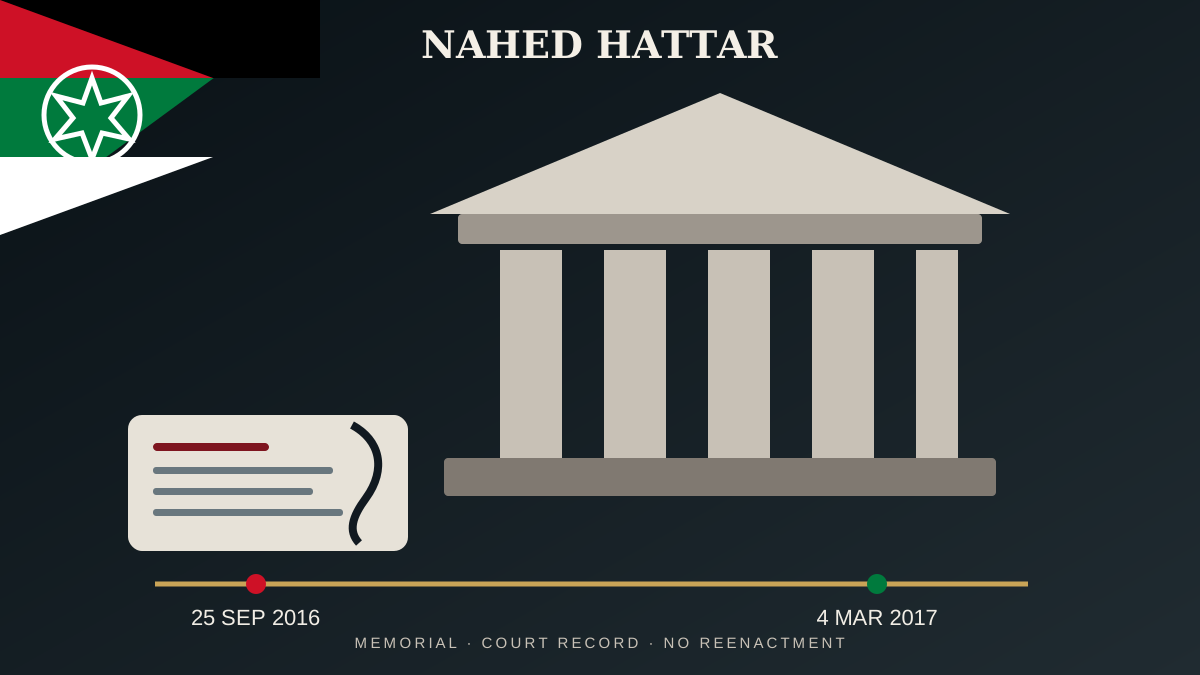
Case-status note: “Solved / adjudicated” refers to Riyad Ismail's conviction for murdering Nahed Hattar. It does not convert political accusations surrounding the climate before the shooting into proven criminal responsibility, and it does not endorse the death penalty.
What happened to Nahed Hattar?
On the morning of September 25, 2016, Hattar arrived at Jordan's Palace of Justice in Amman for a hearing in a case brought over a cartoon he had shared online. A gunman approached outside the courthouse and shot him at close range. Police arrested the assailant at the scene. Hattar was taken for medical treatment but died from his injuries.
Reuters described Hattar as a prominent writer and political commentator. Human Rights Watch and Amnesty International both identified the killing as an attack on expression as well as a murder. The victim's public profile explains the case's wider significance, but it does not reduce him to a political symbol: one person was killed while reporting to a court.
The prosecution that brought Hattar to court
Weeks earlier, Hattar had shared a cartoon on Facebook. He said it mocked the Islamic State group's conception of heaven rather than Islam itself. Jordanian authorities arrested him and charged him with offenses that included insulting religion and inflaming religious feelings. He was later released on bail and was still awaiting adjudication when he was killed.
The distinction matters. Charges are allegations, not convictions. Hattar's death prevented the proceeding from reaching a verdict, so this archive does not say that he committed the charged offenses. Nor does it reproduce the cartoon, threats or celebratory commentary that circulated around the case.
The arrest and investigation
The gunman was detained immediately. Contemporary reporting identified him as Riyad Ismail, a former preacher. Reuters reported that demonstrators gathered after the killing to demand accountability and stronger action against incitement. Hattar's family argued that official rhetoric and online threats had helped create danger around him.
Those claims are important context, but they are not presented here as a judicial finding against officials or social-media users. The murder prosecution established the gunman's responsibility. Any broader criminal responsibility would require its own evidence, charge and judgment.
The State Security Court judgment
On December 20, 2016, Jordan's State Security Court sentenced Ismail to death by hanging. Reporting based on the state news agency Petra said the judgment covered a deadly terrorist act, incitement, premeditated murder and unlawful possession of a firearm. The court result provides the basis for this page's adjudicated classification.
The speed and forum of the case are part of the procedural record. The archive records the judgment without assuming that capital punishment was necessary, proportionate or capable of repairing the loss. A verified conviction and an editorial position on punishment are separate questions.
The 2017 execution
Jordan executed Ismail on March 4, 2017, together with 14 other prisoners. Associated Press reporting described him among those executed for terrorism-related offenses and confirmed that the sentence in Hattar's murder had been carried out.
This endpoint resolves the identified gunman's legal status. It does not answer whether authorities could have provided better protection before the courthouse attack, whether other people crossed the line from hostile speech into criminal incitement, or how Jordan's laws on expression affected the conditions surrounding the case.
Why the expression context belongs in the case file
Human Rights Watch said prosecuting Hattar for a social-media post stigmatized him and increased his vulnerability. Amnesty International condemned both the murder and the prosecution he had been facing. These organizations' conclusions are attributed assessments, not substitute verdicts in the homicide trial.
A careful account can hold two facts at once: a court convicted the person who fired the shots, and serious questions remained about the treatment and protection of the victim before his death. Collapsing those different issues would either understate the adjudicated murder or overstate allegations that were never tried.
Remembering the victim without spectacle
Hattar was a writer, commentator and participant in Jordan's public life. His work and politics drew sharp disagreement, but disagreement does not diminish his right to safety or justify violence. The page avoids graphic detail and does not use the killing as a device for shock.
The editorial artwork uses an empty desk, a courthouse outline and a restrained court timeline. It does not fabricate a portrait, reconstruct the shooting or present illustration as documentary evidence.
What is established, and what is not?
- Established event: Nahed Hattar was shot outside the Palace of Justice in Amman on September 25, 2016.
- Adjudicated perpetrator: Riyad Ismail was convicted by Jordan's State Security Court.
- Sentence carried out: Jordan executed Ismail on March 4, 2017.
- Unfinished proceeding: Hattar died before the case over his Facebook post reached a verdict.
- Not claimed: that public officials or online commentators were criminally responsible for the murder without a corresponding judgment.
Frequently asked questions
Who was Nahed Hattar?
Nahed Hattar was a Jordanian writer and political commentator. In 2016 he was prosecuted after sharing a cartoon that he said mocked the Islamic State group's conception of heaven.
When and where was Nahed Hattar killed?
He was shot outside the Palace of Justice in Amman on September 25, 2016, as he arrived for a court hearing.
Who was convicted of the murder?
Jordan's State Security Court convicted Riyad Ismail, described in reporting as a former preacher, of the killing and related offenses.
What sentence did the court impose?
The court sentenced Ismail to death on December 20, 2016. Jordan executed him on March 4, 2017.
Why is the case classified as adjudicated?
The identified gunman was arrested, tried, convicted and the sentence was carried out. The label does not establish responsibility for any wider incitement alleged by Hattar's family.
What happened to the case against Hattar?
Hattar was killed before the criminal case over the cartoon could be adjudicated. The archive does not treat those allegations as a conviction.