Abducted across borders
On 24 August 1976, Argentine and Uruguayan agents abducted María Claudia García Iruretagoyena Casinelli and her husband, Marcelo Gelman, from their home in Buenos Aires. María Claudia was 19 and seven months pregnant. The couple was taken to Automotores Orletti, a clandestine detention center used in the cross-border repression known as Operation Condor.
Marcelo was tortured and killed in Argentina; his remains were recovered in 1989. María Claudia was separated from him and secretly transferred to Montevideo. The Inter-American Court later treated her continuing disappearance as an established state responsibility, while domestic criminal proceedings addressed individual liability.
A birth in captivity and a stolen identity
María Claudia gave birth to a daughter while imprisoned in Uruguay. In late December 1976 the newborn was taken from her. On 14 January 1977, the child was left with the family of Uruguayan police officer Ángel Tauriño and raised as María Macarena Tauriño.
After years of searching by poet Juan Gelman, the child’s paternal grandfather, Macarena first met him in March 2000. A DNA test reported a 99.998% genetic match. She recovered her identity as María Macarena Gelman García Iruretagoyena. Restoring that identity resolved one part of the crime; it did not reveal where her mother had been taken or buried.
The amnesty barrier and the reopening
Juan Gelman filed a criminal complaint in Uruguay in 2002. The proceeding sought investigation of unlawful detention, homicide, child removal and suppression of civil status. In 2003 the executive treated the facts as covered by Uruguay’s Expiry Law, closing the route to prosecution. A later administration excluded the case from that law in 2005, allowing the investigation to advance.
The Expiry Law had insulated dictatorship-era crimes from accountability. In the Gelman judgment, the Inter-American Court held that provisions blocking investigation and punishment of grave human-rights violations had no legal effect under the American Convention.
The Inter-American judgment
On 24 February 2011, the Inter-American Court of Human Rights found Uruguay internationally responsible for María Claudia’s forced disappearance, for the suppression and substitution of Macarena’s identity, and for failures of investigation and judicial protection. It ordered an effective investigation, continued search for María Claudia or her remains, a public acknowledgment and other reparations.
Uruguay publicly recognized responsibility in March 2012. The international ruling was not a substitute for criminal convictions: it established the state’s responsibility and legal duties, while domestic courts determined individual guilt.
Five final 30-year sentences
Uruguayan proceedings ultimately convicted five former military or police officers of especially aggravated homicide as co-perpetrators: José Nino Gavazzo, Gilberto Vázquez Bisio, José Ricardo Arab, Jorge Silveira Quesada and Ricardo Medina Blanco. On 20 December 2018, an appellate court confirmed the convictions and maintained 30-year prison terms.
The appellate judgment relied on testimonial and circumstantial evidence suited to crimes committed clandestinely, where state agents had concealed records and bodies. It rejected prescription arguments, reasoning that ordinary legal guarantees had not operated during the dictatorship.
Chronology
- 24 August 1976 — María Claudia and Marcelo Gelman are abducted in Buenos Aires and taken to Automotores Orletti.
- Late 1976 — María Claudia is moved clandestinely to Uruguay and gives birth in captivity.
- 14 January 1977 — Her daughter is placed with a Uruguayan police family and raised under another identity.
- 1989 — Marcelo Gelman’s remains are identified in Argentina.
- March 2000 — Macarena meets Juan Gelman; DNA confirms their relationship and restores her identity.
- 2002–2005 — A criminal complaint is filed, initially blocked by the Expiry Law and later excluded from it.
- 24 February 2011 — The Inter-American Court issues its judgment against Uruguay.
- 21 March 2012 — Uruguay publicly acknowledges institutional responsibility.
- 20 December 2018 — The appellate court confirms five 30-year aggravated-homicide sentences.
- Present — María Claudia’s remains have not been found; compliance and the search remain under international supervision.
What remains unanswered
- Where was María Claudia killed and where are her remains?
- Which additional agents participated in her transfer, captivity, the removal of Macarena and the concealment that followed?
- What records remain undisclosed in Uruguayan or Argentine military and intelligence archives?
Editorial boundaries
- Macarena is a living victim of identity suppression and is not treated as a secondary detail to her mother’s disappearance.
- State responsibility, domestic convictions and unresolved physical recovery are reported as distinct findings.
- The five named defendants are described according to final domestic judgments; the article does not extend criminal guilt to unconvicted people.
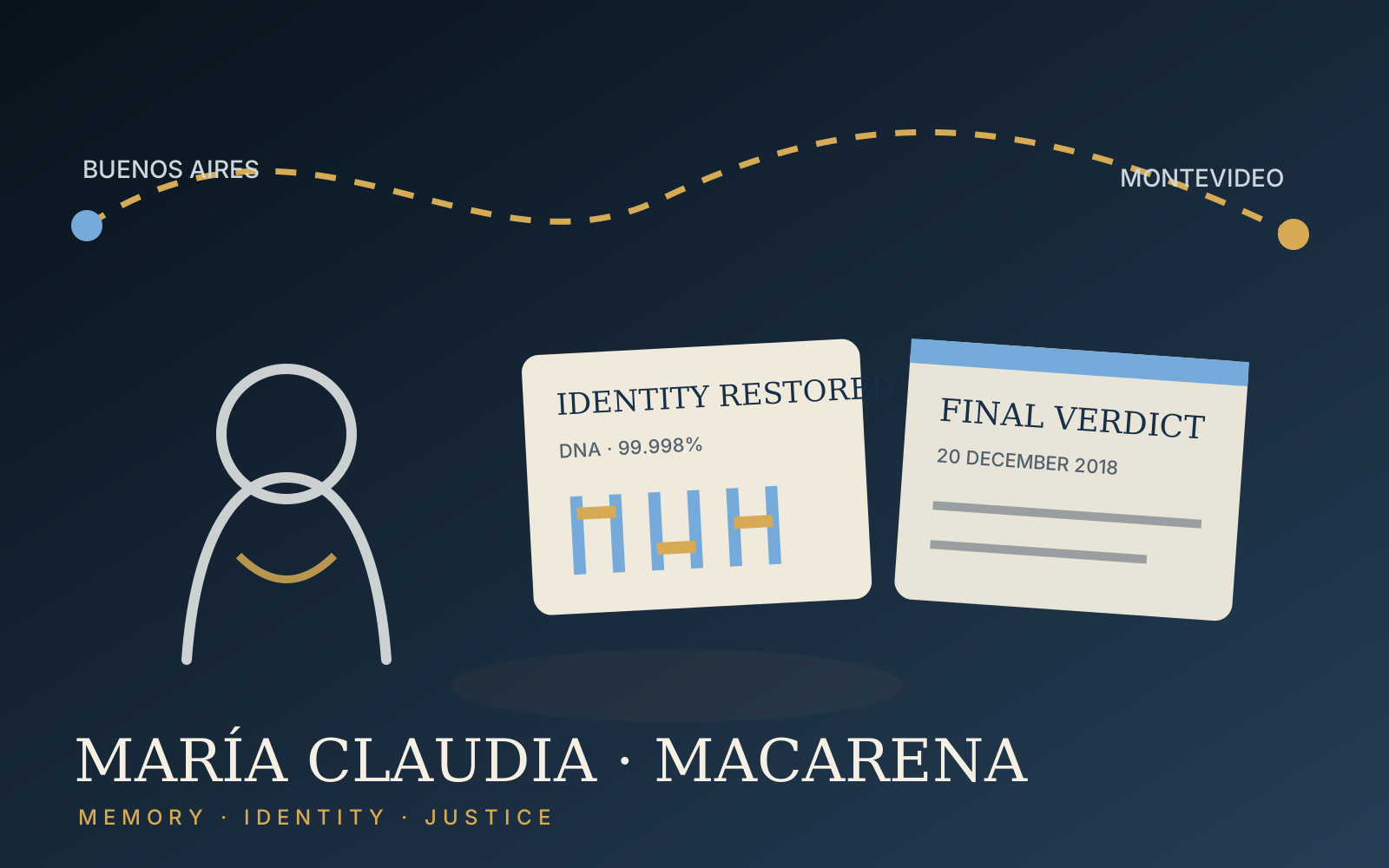
- Artwork is symbolic and non-graphic, not evidence.
Sources
- Inter-American Court of Human Rights — Gelman v. Uruguay technical case record.
- Uruguay National Human Rights Institution — 2011 Inter-American judgment.
- Sitios de Memoria Uruguay — domestic prosecution and final convictions.
- Sitios de Memoria Uruguay — disappearance case chronology and 2018 appellate confirmation.
- Uruguay National Human Rights Institution — abduction, transfer and search record.
- Presidency of Uruguay — public acknowledgment of state responsibility, 21 March 2012.
- Inter-American Court — compliance-supervision order, 19 November 2020.