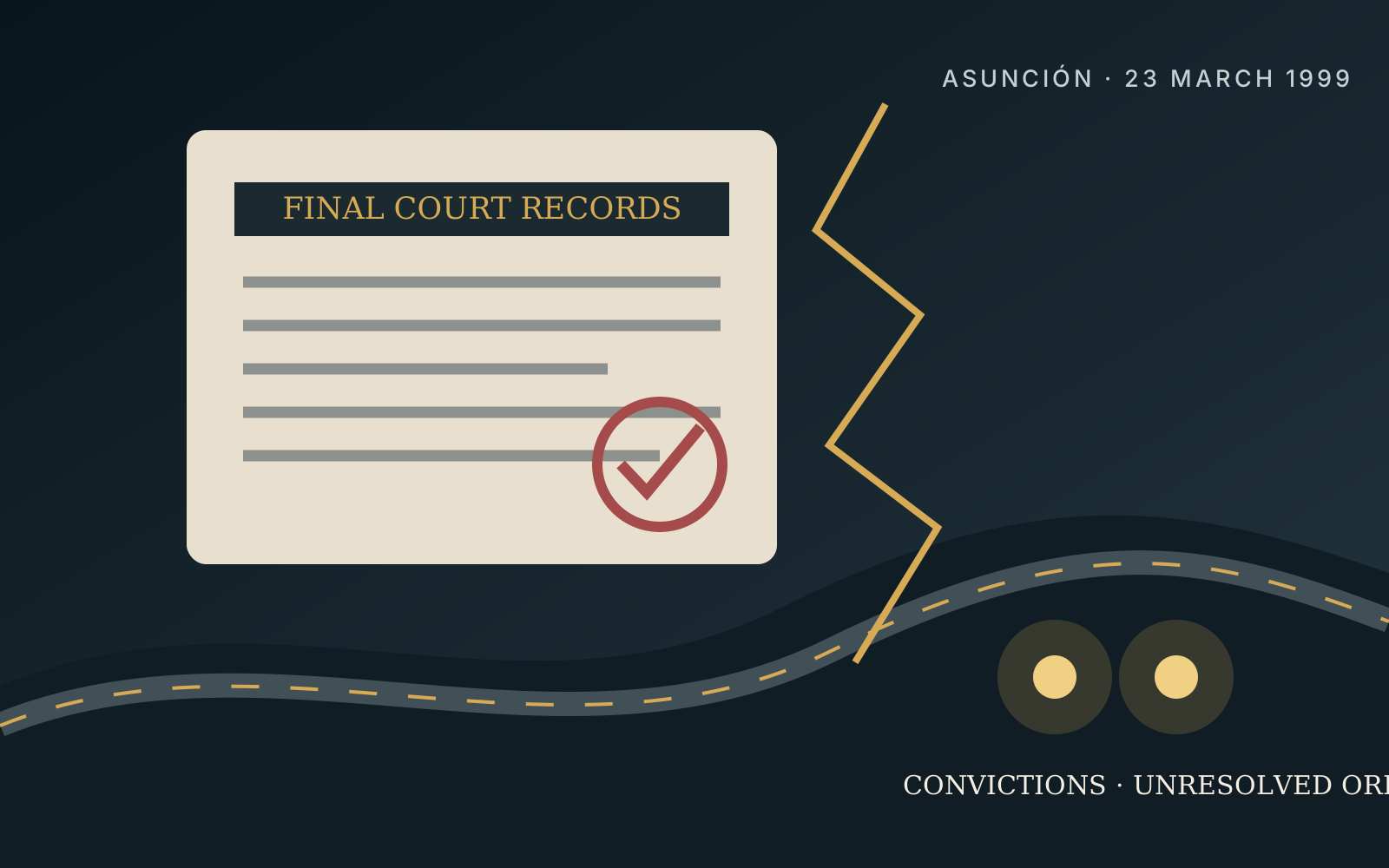
Judgment boundary: convictions for participants in the ambush are recorded separately from allegations about political organizers. A dismissal or absence of conviction cannot be replaced by public suspicion.
Vice president in a divided government
Luis María Argaña was a lawyer, former foreign minister and former president of Paraguay’s Supreme Court. He belonged to the Colorado Party, the organization that had dominated politics during Alfredo Stroessner’s dictatorship and continued to govern after the 1989 transition.
In the 1998 election, Argaña became vice president on the ticket headed by Raúl Cubas Grau. The alliance concealed a bitter division. Argaña led a Colorado faction opposed to retired general Lino Oviedo, whose attempted-coup conviction had prevented him from running for president.
By March 1999, Congress was considering Cubas’s impeachment over the release of Oviedo. Argaña’s death therefore occurred inside an acute constitutional and party crisis. That context explains the immediate political accusations, but it does not by itself prove who commissioned the murder.
The morning ambush
On 23 March 1999, Argaña was traveling from his home toward his office in a red Nissan Patrol. His police bodyguard, Francisco Barrios González, and driver, Víctor Barrios Rey, were with him.
Attackers in another vehicle blocked the route on Diagonal Molas López in Asunción. Men wearing camouflage opened fire. Argaña and Barrios González were killed; Barrios Rey survived. The attackers’ vehicle was later found burned.
Contemporary government statements described the gunmen as unknown. News reports rapidly connected the killing to Paraguay’s political struggle, but no organization credibly claimed responsibility.
The Paraguayan March
The assassination triggered demonstrations that became known as the Marzo Paraguayo, or Paraguayan March. Protesters demanded accountability and the resignation of President Cubas.
During the following days, at least seven demonstrators were killed and many more were injured near Congress. Those protest killings were investigated separately and are not counted as additional victims of the Argaña ambush.
Cubas resigned and left Paraguay. Oviedo also left the country. The political consequences were immediate, but a government’s fall is not a criminal judgment about the assassination.
Investigation and contested testimony
The investigation identified Pablo Vera Esteche, Luis Alberto Rojas, Constantino Rodas and army major Reinaldo Servín. Vera Esteche confessed participation and gave evidence about other people, although later public debate challenged parts of the testimony and the handling of witnesses.
Paraguayan courts nevertheless entered convictions. An appellate court confirmed a 20-year term for Vera Esteche and 25-year terms for Rodas and Servín. Vera Esteche’s sentence was later reduced to 18 years. Rojas received 25 years in a separate phase of the proceedings.
The existence of controversy does not erase final court outcomes. Equally, a conviction does not make every accusation voiced during the political crisis true. This file reports the judicial result and its documented limits.
Convictions that survived review
The Supreme Court rejected a later request to overturn Servín’s conviction. Court reporting described the judges as refusing arguments based on later witness statements and theories that the public attack had not occurred as established at trial.
Vera Esteche received conditional release after serving most of his reduced sentence. In 2025, Rojas completed his 25-year sentence and was released. Sentence completion changes custody status; it does not vacate the conviction.
Because the cases proceeded at different times and sentence reporting sometimes varied, this archive identifies the outcome attached to each named defendant rather than compressing every ruling into a single undated verdict.
No final finding on intellectual authorship
The central unresolved issue is who ordered the assassination. Argaña’s political allies accused Oviedo and Cubas almost immediately. Vera Esteche also made allegations involving senior political figures.
Those allegations did not produce a final conviction establishing intellectual authorship. Paraguay’s judiciary granted Oviedo a definitive dismissal in the Argaña case. Later reporting continued to distinguish the convicted material participants from the unidentified or unpunished organizers.
The distinction is essential: Rojas, Rodas, Vera Esteche and Servín were convicted for their roles in the criminal operation. Naming a political rival as the person who commissioned it requires a separate judicial basis that the reviewed record does not provide.
A case that changed Paraguay
Argaña’s assassination became inseparable from the collapse of the Cubas government and the violence outside Congress. It remains one of the defining crimes of Paraguay’s post-dictatorship era.
The killing also shows how political crisis can complicate criminal truth. Competing factions used evidence, rumors and witness accounts to support broader narratives. A responsible record has to separate the documented ambush, the convictions that survived review, the defendants later dismissed and the question that courts did not answer.
For the families of Argaña and Francisco Barrios González, convictions for the operational participants represented partial accountability. The absence of a final finding on who commissioned the attack left the case institutionally incomplete.
Documented timeline
- 23 March 1999
Gunmen kill Vice President Luis María Argaña and bodyguard Francisco Barrios González in Asunción; driver Víctor Barrios Rey survives. - 23–28 March 1999
Mass demonstrations and deadly violence intensify the constitutional crisis; President Raúl Cubas resigns. - 1999–2000
Investigators arrest and prosecute alleged participants, including Pablo Vera Esteche. - 24 October 2000
Courts sentence Vera Esteche, Luis Alberto Rojas and Constantino Rodas; related proceedings address Reinaldo Servín. - 2002–2006
Appellate and Supreme Court decisions uphold key convictions; Vera Esteche’s term is reduced. - 2008
The judiciary confirms a definitive dismissal for Lino Oviedo in the assassination case. - 2025
Rojas is released after completing his 25-year sentence.
Questions the record can answer
How many people died in the ambush?
Luis María Argaña and his bodyguard Francisco Barrios González were killed. Driver Víctor Barrios Rey survived.
Were the attackers convicted?
Courts convicted four participants across the proceedings: Pablo Vera Esteche, Luis Alberto Rojas, Constantino Rodas and Reinaldo Servín.
Was Lino Oviedo convicted?
No. Oviedo received a definitive dismissal in the assassination case.
Is the case fully solved?
It is adjudicated as to convicted participants, but the intellectual authorship—the identity of whoever commissioned the attack—remains unresolved in the final public judicial record reviewed.
Sources
- U.S. Department of State — murder of Vice President Argaña23 March 1999 · contemporary statement confirming the killing by unknown assailants.
- Folha de S.Paulo / Reuters — assassination and political crisis24 March 1999 · attack circumstances and immediate aftermath.
- ABC Color — appellate court confirms convictionsSentence details for Vera Esteche, Rodas and Servín.
- Paraguay Judiciary — Servín conviction confirmedOfficial Supreme Court account of the review decision.
- Paraguay Judiciary — definitive dismissal for Lino OviedoOfficial account separating dismissal from the participant convictions.
- Última Hora — Rojas released after 25-year sentence2025 custody update and conviction history.
Editorial review: final convictions, sentence changes, releases, dismissals and allegations about organizers remain separate throughout.