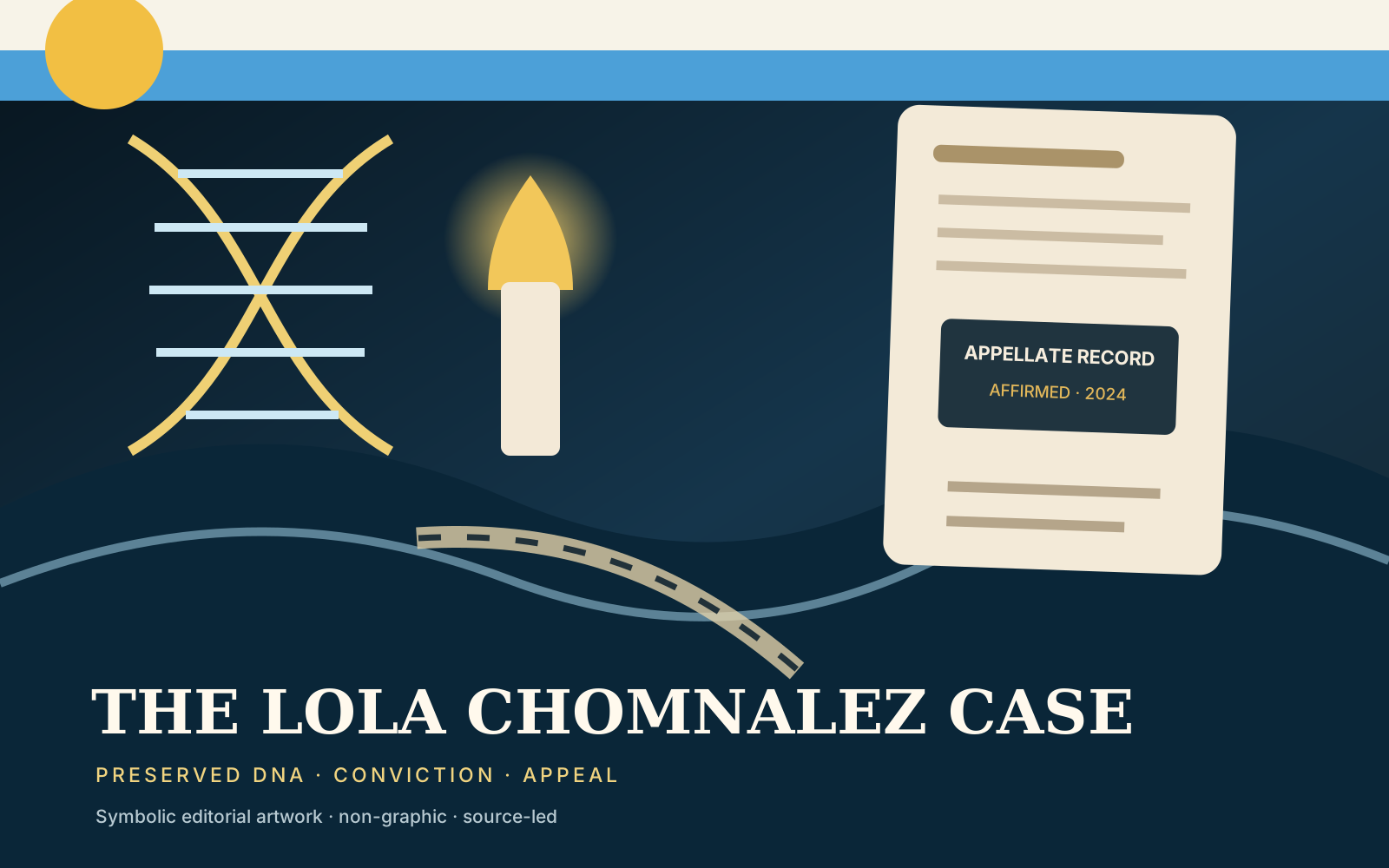
Status boundary: “solved / adjudicated” means Leonardo David Sena Cabrera was convicted of Lola’s murder and the Fourth-Turn Appeals Court affirmed his 27-year-and-six-month sentence. The label is not based merely on his 2022 arrest. Ángel Eduardo Moreira Martínez’s separate concealment conviction is not presented as a murder conviction.
Lola and the visit to Uruguay
Lola Luna Chomnalez was a 15-year-old student from Argentina. In late December 2014, she travelled to the coastal settlement of Barra de Valizas in Uruguay’s Rocha Department, staying with her godmother and family. The trip was supposed to be part of a summer holiday. On 28 December, Lola went out for a walk near the beach and did not return.
Her disappearance prompted searches across the coastal area. Two days later, she was found dead among the dunes and vegetation beyond the village. The investigation established that she had been killed. This page does not reproduce graphic autopsy details: they are unnecessary to understand the identification evidence, the judicial findings or the status of the case.
The cross-border dimension drew sustained attention in both Uruguay and Argentina, but Lola should not be reduced to a high-profile case name. She was a teenager whose life and plans ended during a family holiday. Her parents continued pressing for answers through years in which leads, suspects and investigative theories did not produce a murder conviction.
A genetic profile without a name
Investigators preserved biological material associated with Lola’s belongings. It produced a male genetic profile, an objective lead that could exclude people as well as connect a contributor to the evidence. Early comparisons did not identify the person behind that profile. Many people were examined, and years passed without a verified match that resolved the murder.
Preservation mattered. A forensic clue can remain useful long after its collection if the chain of custody is maintained and comparison systems improve. Uruguay’s Ministry of the Interior later credited the scientific police with careful evidence handling and repeated work against the country’s criminal genetic database. The agency said the case was never treated as closed and that the unknown profile continued to be tested as the database developed.
The database did not operate like a direct name lookup. Reporting from Uruguay’s public media explains that investigators first found a familial connection to a person already in the system. The family line was broad, so scientific police and investigators worked through relatives rather than declaring the first association conclusive. That process eventually directed attention to Leonardo David Sena Cabrera.
The 2022 identification and prosecution
Sena was located in Chuy, a city near Uruguay’s border with Brazil, and detained in May 2022. Further forensic comparison connected him to the male genetic profile recovered from Lola’s belongings. A court ordered him held for prosecution on a charge described in Uruguay as homicidio muy especialmente agravado—very especially aggravated homicide.
At that point, the case was not yet solved in the judicial sense used by this archive. An arrest and an order moving a prosecution forward establish that authorities believe the evidence supports a charge; they do not establish guilt. La Diaria’s contemporaneous coverage explicitly described the May 2022 ruling as the beginning of the criminal process and noted that no sentence had yet been entered.
Sena denied committing the murder. He offered an account for how his blood could have reached Lola’s belongings, saying that he encountered the backpack after her death and had been cut. The later judgment considered that explanation alongside the genetic evidence, locations and timing. The courts did not treat the DNA as a slogan; they evaluated what its presence meant in the context of the complete record.
The trial judgment
On 17 April 2024, Rocha criminal judge Juan Giménez convicted Sena of very especially aggravated homicide. The court imposed 27 years and six months in prison. Uruguay’s public broadcaster, reporting from the judgment obtained by EFE, said the scientific-police analysis had matched Sena’s DNA to material found on the victim’s personal objects.
The judgment is the decisive line between an accused person and a convicted offender. It meant the court accepted the prosecution’s proof of Sena’s responsibility beyond the standard required for conviction under Uruguayan law. The penalty was substantial but below the maximum term sought by prosecutors, a difference that does not change the guilty verdict.
Uruguay’s Ministry of the Interior publicly reviewed the scientific investigation after the decision. It emphasized the national genetic database created under a 2011 law, continued comparison of profiles, chain-of-custody work and coordination between scientific and territorial investigators. That official account supports the broad identification history without replacing the court’s role in determining guilt.
The appellate decision
Sena’s defense appealed. In September 2024, the Fourth-Turn Appeals Court affirmed the conviction and the 27-year-and-six-month sentence. Uruguay’s public media reported that the appellate judges accepted the first-instance evaluation of the genetic evidence and found the penalty properly determined.
The appellate ruling matters for classification. This archive does not mark the file solved merely because a trial court entered a conviction that might immediately be reversed. Here, the conviction was reviewed and left in place. The published sources checked for this page disclosed no later reversal of Sena’s murder conviction as of the 1 October 2026 source review.
“Solved” still requires precision. It means the criminal case against the person convicted of Lola’s murder reached an affirmed adjudication. It does not mean that years of investigative uncertainty disappear, that every institutional decision was beyond criticism or that a sentence can repair the harm to Lola and her family.
A separate concealment conviction
Another man, Ángel Eduardo Moreira Martínez, known as “Cachila,” went through a separate and complicated proceeding. He had earlier been accused in connection with the case and was acquitted at first instance. An appeals court later reversed the acquittal and convicted him of concealment, imposing eight years in prison. In February 2024, Uruguay’s Supreme Court rejected his challenge, leaving that conviction in force.
The legal distinction is essential. Moreira’s conviction concerns conduct that obstructed or concealed the crime; Sena is the person convicted of committing the murder. Combining the two defendants under a generic statement that both were convicted “for the murder” would misstate the judgments and blur different forms of criminal responsibility.
The separate outcome also illustrates why case summaries must track procedural changes. An arrest or preliminary accusation can be narrowed, rejected or replaced by a different final offense. This page reports the final verified distinction rather than preserving an outdated early characterization.
What the DNA evidence did—and did not do
- It preserved a testable lead: the unknown male profile remained available when no person had yet been identified.
- It enabled exclusion: comparisons could rule out people whose profiles did not match, reducing the risk of attaching the case to unsupported suspects.
- It generated a family lead: database work pointed investigators toward a related family line, which required additional investigation rather than an instant accusation.
- It supported individual identification: further comparison connected Sena to the profile used in the prosecution.
- It did not decide guilt alone: judges assessed the forensic results with Sena’s explanation and the broader evidentiary record, and an appellate court reviewed the judgment.
This distinction protects both scientific accuracy and due process. A DNA association is evidence; a court judgment is the legal determination. The archive describes each stage separately.
Verified timeline
- 26 December 2014: Lola arrives in Uruguay for a holiday near Barra de Valizas.
- 28 December 2014: The 15-year-old goes for a walk near the coast and disappears.
- 30 December 2014: Searchers find Lola dead in the coastal area beyond Valizas; a homicide investigation follows.
- 2014–2022: Investigators preserve and repeatedly compare a male genetic profile recovered from Lola’s belongings while numerous leads fail to produce a murder conviction.
- May 2022: Scientific-police work leads investigators to Leonardo David Sena Cabrera. He is detained and ordered held for prosecution on a very especially aggravated homicide charge.
- February 2023: An appeals court overturns Ángel Moreira’s acquittal and convicts him of concealment, imposing eight years.
- February 2024: Uruguay’s Supreme Court rejects Moreira’s challenge, leaving the concealment conviction in force.
- 17 April 2024: Judge Juan Giménez convicts Sena of very especially aggravated homicide and sentences him to 27 years and six months.
- September 2024: The Fourth-Turn Appeals Court affirms Sena’s conviction and sentence.
Frequently asked questions
Who was Lola Chomnalez?
Lola Luna Chomnalez was a 15-year-old Argentine student who was visiting Uruguay when she disappeared near Barra de Valizas on 28 December 2014.
How was Leonardo David Sena Cabrera identified?
Uruguay’s scientific police repeatedly compared a male genetic profile recovered from Lola’s belongings with the national genetic database. That work led investigators to Sena and to additional forensic testing.
Was Sena convicted of Lola’s murder?
Yes. A Rocha court convicted him of very especially aggravated homicide in April 2024 and imposed 27 years and six months in prison.
Was the murder conviction appealed?
Yes. Uruguay’s Fourth-Turn Appeals Court affirmed the conviction and sentence in September 2024.
What was Ángel Eduardo Moreira Martínez convicted of?
Moreira was convicted separately of concealment and received an eight-year sentence. He was not the person convicted of committing Lola’s murder.
Why is the case classified as solved and adjudicated?
The classification rests on a murder conviction affirmed on appeal. It does not rely on the earlier arrest, pretrial detention or suspicion alone.
Sources and source-quality review
- Uruguay Ministry of the Interior — National Police review of the Lola Chomnalez investigation18 April 2024 · official account of evidence preservation, the national genetic database and the scientific-police investigation.
- Uruguay Public Media — court sentences the person convicted of Lola’s murder17 April 2024 · sentence, age and place of the victim, genetic evidence and the separate Moreira proceeding.
- Uruguay Public Media — Appeals Court confirms Leonardo Sena conviction13 September 2024 · appellate outcome, sentence and the court’s evaluation of the genetic evidence.
- La Diaria — Sena ordered held for prosecution20 May 2022 · contemporaneous account that clearly distinguishes the charging stage from a conviction.
- La Diaria — Sena convicted and sentenced17 April 2024 · trial judgment, sentence and genetic-evidence context.
- La Diaria — Moreira’s acquittal reversed; concealment conviction enteredFebruary 2023 · confirms the separate offense and eight-year sentence.
Source review completed: 1 October 2026. The core identification history was checked against the Uruguay Ministry of the Interior; the trial and appellate outcomes were cross-checked through Uruguay’s public broadcaster and established national reporting. Arrest, prosecution, conviction, appellate affirmance and the separate concealment judgment are stated as distinct procedural events.